

Audio By Carbonatix
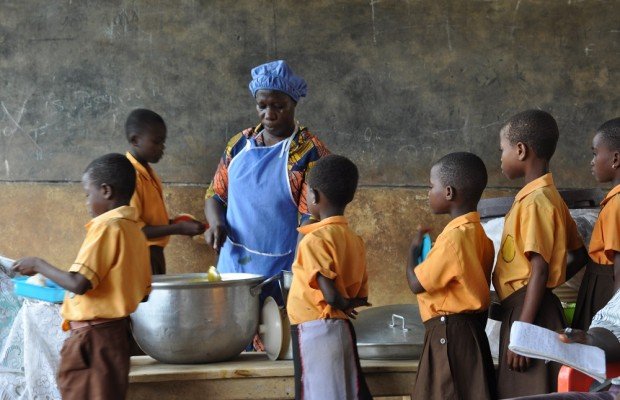
The National Coordinator of Ghana School Feeding Programme, Madam Gertrude Quashigah says her Secretariat will soon train caterers to spend less on cooking nutritional foods for school children.
She said the training would help them to rake in profits by cutting down on costs and food wastage in their pantries.
Madam Quashigah who was addressing a day's workshop on the 'Dissemination of Landscape Analysis Report on Rice Fortification,' stressed that this would help them to put to good and sufficient use the GHS1.00 per child they receive.
This workshop shared findings of a comprehensive report on rice fortification and discussed strategies to enhance the nutritional value of school meals through rice fortification.
The dissemination workshop is the commencement of a two-and-a-half-year project by the World Food Programme, with funding support from the Rockefeller Foundation and Royal DSM, to improve the nutritional needs of school children through the Ghana School Feeding Programme.
The project seeks to improve the nutritional value of rice for the school children to meet their nutritional needs since rice was a staple.
Madam Quashigah said, though the amount they received needed to be increased, they could still cook nutritious foods for the school children with it.
She said they had recently agreed on a proposed increment from GH₵1.00 they received per child head to GH₵1.20 pesewas, saying they were still engaging the Finance Ministry on further increment.
She added that such training would be certificated through which they would be able to sort and assess their work.
Madam Patience Asiedu, Head of Nutrition, World Food Programme (WFP) Accra, said the project supported the Government’s efforts to boost local production of rice.
The capacity of 5,000 smallholder farmers and 10 rice millers will be enhanced to support local rice production for the School Feeding Programme, she said.
She said under the project, caterers and cooks would be trained to cook nutritional foods for the school children.
The Ghana School Feeding Programme as an intervention by the Government of Ghana, started in 2005 to provide food to children in public basic schools from kindergarten to primary six.
The Programme aims to increase school enrolment, attendance and retention, reduce short-term hunger and malnutrition and boost domestic food production.
The Programme has 3,801,491 beneficiary pupils, 34,350 cooks and caterers and covers 10,832 public basic schools nationwide.
Latest Stories
-
Gov’t sets 12%–12.5% guidance for 7-year bond as market re-entry gains momentum
12 minutes -
New political party to challenge dominance of two major parties
19 minutes -
Stroke survivors demand inclusive healthcare, urgent policy interventions nationwide
23 minutes -
China reaffirms unwavering ties with Ghana as Ambassador presents credentials
30 minutes -
Wrongful teacher postings undermine early childhood education in Upper East
35 minutes -
Five new envoys present Letters of Credence to Mahama
40 minutes -
BoG Governor says building buffers and lowering credit costs go together
46 minutes -
Fuel shock looms as petrol nears GH¢15.19, diesel GH¢17.85 from April 1
53 minutes -
From May to December, nothing works – Tomato traders reveal harsh reality for farmers
1 hour -
Ghanaian farmer can’t grow tomatoes because of lack of irrigation – Tomato Importers Association president
1 hour -
Social media firms must better enforce Australia under-16 ban, watchdog says
2 hours -
King Charles should meet Epstein victims, US lawmaker says
2 hours -
Belgian ex-diplomat appeals order to stand trial in Congo’s Lumumba murder
2 hours -
Cholera aid for African countries stalled by Iran conflict
2 hours -
The Oscars are leaving Hollywood
2 hours