

Audio By Carbonatix
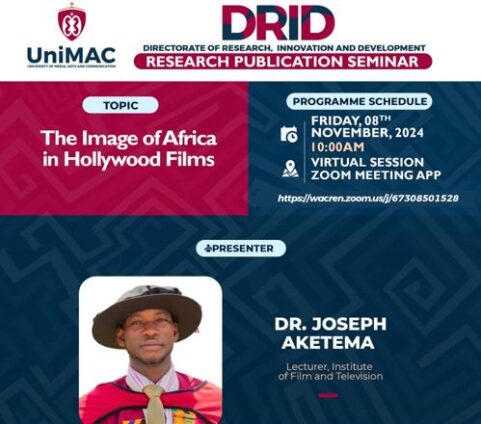
The University of Media, Arts, and Communication (UniMAC) held an online seminar on November 7, 2024, organised by its Directorate of Research, Innovation, and Development (DRID).
Titled “The Image of Africa in Hollywood Films,” the session was led by Dr Joseph Aketema, a lecturer at UniMAC-IFT.
Dr Aketema’s presentation attracted an array of guests including including the Pro Vice-Chancellor of UniMAC, Prof Winston Kwame Abroampa and Nana Adwoa Awindor, a celebrated television host, African cultural ambassador and the Development Queenmother of Afigya-Kwabre district in the Ashanti Region.
In his opening remarks, Dr Aketema set the stage by discussing the powerful, often politicised and stereotypical role that media plays in shaping public perception, noting, “When the cine-camera was made in 1895, as early as 1896, Americans were using the media to capture some of the happenings in the Spanish-American world.”
He explained how Hollywood, as a political and ideological institution throughout history, portrayed Africa through its distorted lens that frequently reinforces negative stereotypes. According to Dr Aketema, such portrayals stem from early Euro-American cinema’s tendency to depict Africa as exotic, uncivilised, and thus, a burden to the Whiteman.
The seminar delved into the legacy of pioneering African filmmakers who have challenged such stereotypes, “So we talk about Paulin Soumanou Vieyra, Safi Faye, Ousmane Sembène, Fanta Régina Nacro, Idrissa Ouedraogo, Souleymane Cissé, I'll come to Ghana and talk about Kwaw Ansah, King Ampaw, and the rest, these are colonial and post-colonial African filmmakers who are not just producing films for us, but striving to represent Africa’s social reality, and as it were, give an authentic image of Africa” he said.
He highlighted the influence of Afrocentric Theory, urging African filmmakers to create pedagogical content rooted in African-centered worldviews rather than those imposed by Euro-American, and colonial legacies.
The seminar also covered pivotal historical examples, such as Zulu Heart (1908), Birth of a Nation (1915) and Walter Futter’s Africa Speaks (1929), which Dr. Aketema cited as evidence of early 20th-century media's racially biased portrayals of Africans and people of African descent. Additionally, he touched on the more recent film Hotel Rwanda (2004), critiquing how its portrayal of protagonist Paul Rusesabagina significantly diverged from witness accounts and historical records, casting doubt on the accuracy of Hollywood's rendition of African stories.
A dynamic Q&A session followed the lecture, where participants discussed issues such as African films having traditional settings and Africans building their own distribution platforms such as Netflix.
The Pro Vice-Chancellor of UniMAC, Prof. Winston Kwame Abroampa commended Dr Aketema’s presentation and shared the insight he picked from the presentation “Something I picked from the presenters' submission, is having to do with the fact that we always get people presenting African stories in their own way, telling the African story, or looking at African realities with Eurocentric lenses, or telling our stories from their own perspectives and so on. And it's high time we begin to tell our stories ourselves” he said. “So, I think it's a good thing, and I will have an opportunity to be part of more of these presentations so that together we can contribute to academia, and also to the development of Africa as a whole” he added expressing his delight in the seminar.
Dr Aketema concluded by encouraging African filmmakers to, "examine communication products from an African and anti-imperial point of view," he suggested that African cinemas should endeavour to adopt methodologies that authentically portray African experiences and counteract the misrepresentations frequently seen in international media.
Latest Stories
-
Ghana to begin camping with 12 athletes after Accra Open Championships – Bawa Fuseni
20 minutes -
Anthony Joshua declines showdown with Tyson Fury but admits they ‘probably’ clash next
33 minutes -
Tyson Fury dominates Makhmudov, calls out Joshua next
52 minutes -
I have supported highway authority financially to fix roads in my constituency – A Plus
2 hours -
US, Iran fail to reach peace agreement after marathon talks in Pakistan
2 hours -
ECG kicks off Phase Two of transformer upgrades at Lashibi; brief outages expected
3 hours -
Port crises loom as 11,000 drivers threaten four-day strike
4 hours -
A source of excellence across generations – Vice President Opoku-Agyemang lauds Mfantsipim
5 hours -
(Photos) Mfantsipim School launches historic 150th anniversary
5 hours -
Knights and Ladies of Marshall group backs Catholic Bishops’ stance on anti-LGBTQ+
6 hours -
Bright Simons writes: All the Filla in the Ibrahim Mahama/E&P – Gold Fields Saga
6 hours -
Monetise Idiocy In Ghana
6 hours -
The Ghanaian prophet and the mysterious death of his scottish wife Charmain Speirs
7 hours -
Nearly 400 sentenced in Nigeria for links to militant Islamists
8 hours -
Ghana’s recovery supported by gold strength despite global oil price pressures – Standard Bank Research
8 hours