

Audio By Carbonatix
Standard Chartered has pledged its commitment to serve as a key player in driving private sector engagement with the African Continental Free Trade Area (AfCFTA), leveraging its extensive history and network.
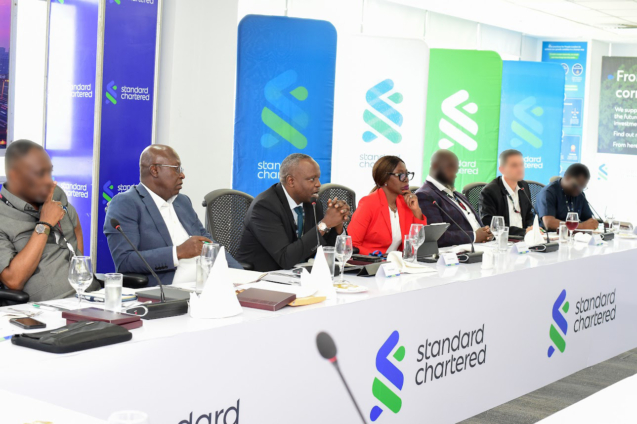
At a recent Business Roundtable in Ghana, Kariuki Ngari, Chief Executive for Standard Chartered - Africa, emphasised the bank's commitment to the initiative.
"AfCFTA represents a pivotal moment in Africa's economic journey. As a bank deeply rooted in the continent's history, we see it as our responsibility to be at the forefront of this transformation. Our continued investment in trade facilitation is proof of our belief in Africa's potential,” he said.
“We are not just financing trade; we are helping reshape the fabric of intra-African commerce. This is about creating a more integrated, and prosperous Africa, and Standard Chartered is committed to playing a central role in that vision,” Mr. Ngari added.
This comes as globalisation continues to power cross-border trade exports from Africa, currently worth US$645.3 billion, which are set to reach US$952 billion by 2035.

Moreover, the bank's focus on sustainability aligns with the broader goals of AfCFTA. "Creating a sustainable basis for our future growth is a critical issue for our continent. We believe that no company can thrive with economic or systemic inequalities. This is why sustainability is a strategic priority for our Group,” the Africa CEO emphasised, indicating the bank's commitment to balanced economic development.
The AfCFTA, which aims to create a single market for goods and services across 54 African countries, has been hailed as a game-changer for the continent's economic development. However, its success hinges on robust private-sector participation.
Mohamed Ali, Director of Trade in Goods and Competition at the AfCFTA Secretariat, corroborated this view, stressing the need for more private sector involvement in AfCFTA.
Mr. Ali added, "The private sector is the engine of growth, and their full engagement is crucial for the success of this continental initiative."
Standard Chartered, one of the world's top three trade banks, sees itself as uniquely positioned to bridge this gap.
CEO of Standard Chartered Ghana, Mansa Nettey, noted, "We are well positioned as a connector bank because of our network and footprint. Our presence in 15 African markets gives us unparalleled insights into the continent's trade dynamics."
The bank's long-standing presence in Africa - over 150 years - gives it a distinct advantage in understanding the continent's complex business landscape.
"Standard Chartered has been an active participant in Africa's growth and development for more than 150 years, proudly contributing to the continent's financial infrastructure and economic development," Mrs. Nettey further stated.
Mrs. Nettey said Standard Chartered is taking innovative steps to enhance its adoption of the Pan African Payment and Settlement System (PAPSS) across the continent, starting with the West African corridor.
PAPSS, developed by the African Export-Import Bank (Afreximbank), aims to facilitate intra-African trade by enabling cross-border payments in local currencies. This system is expected to save the continent more than US$5 billion annually in payment transaction costs.
She explained that the bank is implementing a phased rollout of PAPSS integration, beginning with our operations in Ghana and Nigeria. This will allow it to facilitate seamless cross-border transactions for its clients, reducing costs and time associated with traditional payment methods.
The bank is also investing heavily in digital infrastructure to support PAPSS implementation “to upgrade our systems and train our staff to effectively utilize PAPSS.”
Industry experts believe this move could significantly boost intra-African trade. According to a recent report by the African Development Bank, intra-African exports are projected to increase by 81 percent by 2035 if AfCFTA is fully implemented, with PAPSS playing a crucial role in this growth.
Despite the optimism, challenges remain. David Ofosu-Dorte, founder of pan-African law firm AB & David Africa and AfCFTA proponent stated while AfCFTA presents immense opportunities, there is a need to address issues such as non-tariff barriers and infrastructure gaps to fully realize its benefits.
He pointed out that specific sectors retain very high potential to be explored, including pharmaceuticals and value addition to minerals.
Latest Stories
-
Act swiftly on climate and conflict risks – Local Government Minister to West African leaders
2 minutes -
Big Push exposé only the beginning — Sulemana Braimah
3 minutes -
Mining will continue but the risk of galamsey must be stopped—NAIMOS
6 minutes -
Ghana Month: Losing our dishes means losing our identity — Expert warns
13 minutes -
Illegal mining requires coordinated national response, KAIPTC Deputy Commandant urges
13 minutes -
Big Push: 81 of 107 contracts sole-sourced raises serious concerns – Sulemana Braimah
17 minutes -
Assemblies of God rallies behind Mahama after LGBTQ-linked degree withdrawal
20 minutes -
GES shoots down claims of new graduate teacher recruitment
22 minutes -
GEXIM@10: Experts explore policies to boost Ghana’s trade competitiveness
23 minutes -
Endangered Ghanaian dishes need better presentation to survive — UCC Lecturer
25 minutes -
NDPC deepens stakeholder engagement on national development plan in Bono East
28 minutes -
Suspect arrested over killing of elderly woman in Kadjebi
34 minutes -
Ghana Month: Ghana at risk of losing its heritage when it comes to food – Academic warns
39 minutes -
GEXIM@10: CEO seeks to shape next chapter of Ghana’s trade and industrial growth
40 minutes -
Mula Gad to release ‘Globetrotter EP’ and global tour to bridge cultures through music
44 minutes