

Audio By Carbonatix
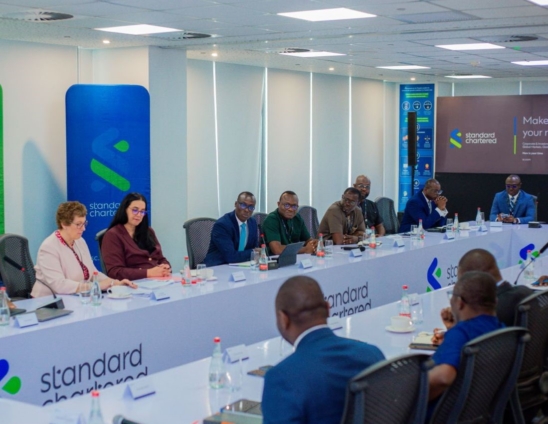
Standard Chartered Bank Ghana Plc hosted a Business roundtable in Accra to examine the evolution of Ghana’s capital markets, with discussions focusing on how digital assets are transitioning from retail-driven activity toward structured, bank-led infrastructure.
The meeting brought together regulators, infrastructure providers, pension fund trustees, real estate investment trusts managers and asset managers to assess how policy direction can translate into credible market development.
The session was also attended by Standard Chartered executives including Global Head of Financing and Securities Services, Margaret Harwood-Jones and the Africa Head of Financing and Securities Services Michelle Swanepoel. At the center of the discussion moderated by Jojo Bannerman, Head of Markets, Standard Chartered Bank Ghana PLC, was the view that digital assets are gradually moving into mainstream financial systems rather than operating on the margins.
Across Africa, digital asset growth has largely been fuelled by retail participation, particularly in markets such as Ghana, Kenya and Nigeria. Institutional adoption remains limited, but participants acknowledged that the next stage of market development will depend on regulated products, institutional-grade custody arrangements and integration with traditional banking structures.
Standard Chartered executives indicated that custody, the safekeeping and servicing of digital assets, is emerging as the critical foundation for institutional participation. Because digital assets represent investor funds in a different form, they require clear legal ownership frameworks, robust governance standards and secure infrastructure.
Allowing digital assets to evolve outside established financial systems was viewed as unsustainable, with integration seen as essential for long-term stability.
The bank outlined its own experience in the sector, noting that it began developing digital asset capabilities nearly eight years ago. Through dedicated ventures focused on custody, trading and tokenisation infrastructure, it built technological and operational frameworks before embedding them into its broader corporate and investment banking operations.
Initial launches were undertaken in jurisdictions with clear regulatory direction, including the United Arab Emirates, followed by tokenisation initiatives in Hong Kong involving money market fund structures.
Early engagement with regulators has shaped that approach. The bank positioned digital asset services within existing risk management and custody standards, emphasising regulatory alignment from the outset rather than pursuing isolated pilot projects.
Financial sector regulators at the meeting signalled that safeguards are being strengthened as the country’s virtual asset framework advances. The Securities and Exchange Commission (SEC), working in collaboration with the Cyber Security Authority, is developing guidelines that will introduce strict cybersecurity requirements as part of the licensing regime.
Operators will be required to meet defined security standards before approval and will be subject to ongoing monitoring and system testing to reduce vulnerabilities.
Authorities also addressed concerns about regulatory arbitrage. A coordinating committee comprising the SEC, the Bank of Ghana, the Financial Intelligence Centre and the Ministry of Finance has been established to align oversight across agencies.
The framework is structured around activity-based licensing with clear supervisory boundaries, while jointly regulated activities will be governed by coordinated guidelines to prevent gaps or overlaps.
The Ghana Stock Exchange underscored the importance of deeper institutional participation in building market depth. Structured engagement between regulators, exchanges and financial institutions was seen as necessary to convert policy frameworks into executable products that can attract long-term capital.
Industry participants noted that adoption challenges extend beyond regulation and infrastructure. Behavioural factors, including investor confidence and risk perception, were identified as key determinants of uptake. Market education and ecosystem-wide engagement were viewed as critical to broadening participation.
The discussions reflected a broader shift in tone within Ghana’s financial sector, with banks increasingly engaging in digital asset conversations. While the regulatory architecture continues to evolve, participants broadly aligned on the view that digital assets are likely to become a structural component of future banking and capital market activity.
In Ghana, the immediate task is to translate dialogue into operational systems that balance innovation with investor protection. The roundtable signalled that coordinated action among regulators, banks and market operators will determine how quickly digital assets move from retail experimentation to institutional integration.
Latest Stories
-
World Cup visa scandal: Sports Ministry not shielding anyone – Sports Minister’s special aide
15 minutes -
World Cup visa scandal: Over 30 people misrepresented as GTA board members to US Embassy – Vincent Assafuah alleges
16 minutes -
Fire destroys wooden structure near Yesu Mo Villa at Bush Road
18 minutes -
NDC threatens sanctions over oversized campaign posters, gives aspirants 5 days to comply
1 hour -
Star Oil paid GH¢2.7bn in taxes, levies in nine months of 2026
1 hour -
Samson’s Take: The rule of law is cheaper before the bulldozer
1 hour -
GRA blames system failure for delay in issuing receipt over passenger’s customs duty
2 hours -
Livestream: Newsfile discusses World Cup visa scandal, beach demolitions, education strikes, BRICS bid
2 hours -
NC-PTAs welcomes end of teachers’ strike, urges parents to prepare children for Monday
2 hours -
Government procures over 2,000 transformers as Ghana’s electricity access hits 89.13% – Energy Minister
2 hours -
UTAG-UG threatens strike on October 19 over unpaid allowance
3 hours -
Let The Constitution direct Chieftaincy to deliver “All Development Is Local”
4 hours -
John Jinapor outlines renewable energy, nuclear power priorities for 2027
4 hours -
Ghana explores centre of excellence for hearing, communication and cochlear implant care
5 hours -
Schizophrenia-related disorders lead mental health cases recorded in Ghana
6 hours