

Audio By Carbonatix
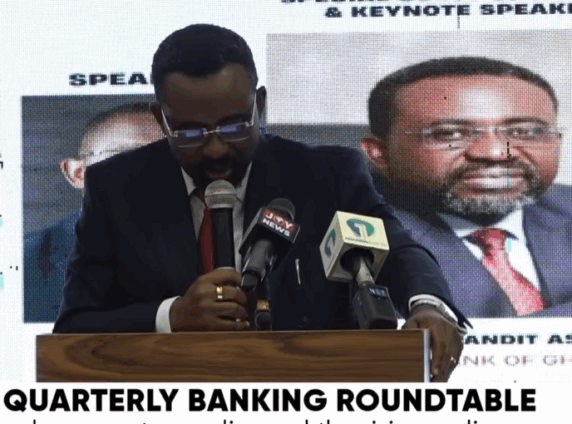
The Governor of the Bank of Ghana (BoG) Dr. Johnson Asiama has categorically stated that the dollar is not a legal tender in Ghana that can be used to pay for goods and services.
He pointed out that businesses and individuals can reject the dollar when used as a medium of payment in the country.
“Let me say that the dollar is not legal tender. It cannot go everywhere the cedi goes. The dollar is not a legal tender in Ghana. What it means is if you pay me in dollars for service or something I sell to you, I have every the right to say no, I will not accept it,” he said at the ABSA-UPSA Quarterly Banking Roundtable.
Appealing to the public to support the central bank in its efforts to stabilize the cedi for the long term, Dr. Asiama urged businesses to reject dollars and rather demand the cedi for payment of goods and services.
He added that accepting the cedi as the only currency for payment is not only legal, but a civil responsibility that will grow the economy to stimulate growth and development.
“Consciously, we must be able to protect the cedi. We must be able to ensure that it's the only form for transacting in this country. Legal tender in its simplest form refers to money that must be accepted if offered in payment of a debt”, he said.
He cautioned that even though a few speculators may desire to pursue selfish interest, expecting volatilities, the overall riding theme must be focused on collective gain of the economy.
“Any attempt to displace the cedi in ordinary commercial transactions whether through mandatory dollar invoicing, preferential pricing in foreign currency, or informal currency substitution, is not only economically distorting, but also legally impermissible”, he warned.
Dr. Asiama stressed the need for Ghanaians to see the cedi as national asset which must be protected used in the rightful money for its intended purpose.
This, he said underscores the pride and integrity in the currency.
It challenges the very fabric of monetary sovereignty. So the legal tender status of the cedi is therefore not a ceremony, but a ceremonial provision. It is the cornerstone of macroeconomic governance. It ensures monetary policy decisions, interest rates, and liquidity management”.
Latest Stories
-
A source of excellence across generations – Vice President Opoku-Agyemang lauds Mfantsipim
1 hour -
(Photos) Mfantsipim School launches historic 150th anniversary
2 hours -
Knights and Ladies of Marshall group backs Catholic Bishops’ stance on anti-LGBTQ+
3 hours -
Bright Simons writes: All the Filla in the Ibrahim Mahama/E&P – Gold Fields Saga
3 hours -
Monetise Idiocy In Ghana
3 hours -
ECG kicks off Phase Two of transformer upgrades at Lashibi; brief outages expected
4 hours -
The Ghanaian prophet and the mysterious death of his scottish wife Charmain Speirs
4 hours -
Nearly 400 sentenced in Nigeria for links to militant Islamists
4 hours -
Ghana’s recovery supported by gold strength despite global oil price pressures – Standard Bank Research
4 hours -
Methodist Church hails Mfantsipim@150; calls for “fresh consecration” to excellence
5 hours -
‘Excellence is our inheritance’ – Nana Sam Brew-Butler hails Mfantsipim’s 150-year reign in leadership
5 hours -
Kwaku Azar writes: A-G vs OSP
5 hours -
Mfantsipim–Adisadel rivalry built excellence, not division – Sam Jonah
5 hours -
Vice President launches Mfantsipim’s 150 years of shaping Ghana’s greatest mind
6 hours -
I assure Otumfuo, Mahama will join him to commission KNUST Teaching Hospital by end of this year – Haruna Iddrisu
6 hours