

Audio By Carbonatix
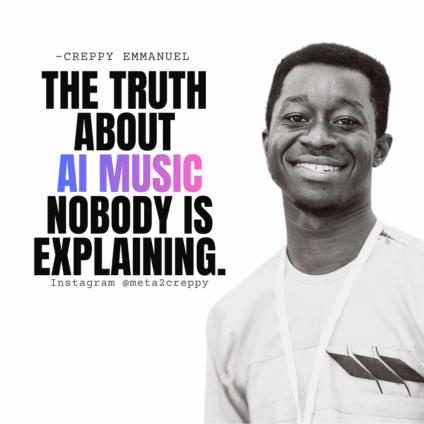
The conversation around AI and music often sounds like a courtroom drama: artists on one side, technologists on the other, with producers caught somewhere in the middle. But that framing misses the bigger picture. AI is not here to kill creativity. It’s here to redistribute leverage—who has it, who earns from it, who learns faster, and who adapts smarter.
At its core, music has always been about tools. From drum skins to DAWs, from tape machines to streaming platforms, AI is simply the next tool—but one that touches songwriting, production, promotion, distribution economics, and identity all at once. That’s why the tension feels heavier.
Let’s look at all sides—clearly, fairly, and without panic.
Songwriters: Ideas to Records
For songwriters, AI quietly unlocks something powerful: independence. Traditionally, many songwriters depended on artists or labels to hear their ideas. Today, AI allows a songwriter to generate high-quality demo tracks, experiment with arrangement, tempo, genre, and even vocal direction—enough to pitch convincingly or release independently. This doesn’t replace musical skill; it compresses the distance between idea and execution.
A songwriter who understands AI can now present a near-finished track for pitching, learn basic production literacy, and build a catalog without studio dependency. But here’s the new responsibility that comes with this freedom: understanding money flow. Who owns the publishing? How are splits defined when AI assists? Who controls metadata, performance rights, and licensing revenue? Without this literacy, autonomy can quietly turn into value leakage.
In Africa especially—where access to studios, producers, and funding is uneven—this is a quiet revolution. It doesn’t eliminate collaboration; it makes collaboration optional, not compulsory. But without strong publishing education and rights enforcement, the same old extraction risks can simply wear new AI clothing.
Artists: The Real Asset Was Never the Studio
Artists often fear AI will flood the internet with “fake music.” That fear is understandable—but misplaced. Here’s the truth: music has never been the artist’s biggest asset. Connection is.
An artist who understands songwriting—or collaborates deeply with songwriters—becomes more consistent, less stressed, and far more strategic. Production becomes cheaper, creative blocks become manageable, and output becomes regular. If an artist already built a fan base before the AI wave, that fan base is now priceless.
Why? Because AI can generate sound—but it cannot replace live performance energy, emotional memory, shared cultural moments, and human presence. People don’t attend concerts because the song is perfect. They come because the artist feels real. And live performance remains the most expensive and wealth-generating capital in music—far beyond streams.
What AI changes for artists is not relevance, but trust. Audiences are becoming more emotionally intelligent. If fans sense dishonesty, over-automation, or hidden shortcuts, brand trust erodes. But when artists are transparent and intentional with AI, audiences often lean in—not away. AI doesn’t weaken artists; it exposes who never invested in connection.
Producers: From Beat Makers to Sonic Architects
Producers are not being erased—they are being elevated. The producer of the future is not competing with AI. They are directing it, working at higher dimensions of frequency intelligence, sample fusion, cultural sound design, and emotional texture. AI handles repetition; producers handle taste.
Globally, top producers are already using AI to speed up workflows while focusing on what humans do best: decision-making and emotional judgment. The producer becomes less of a laborer and more of a sonic architect. Yet there is a quiet tension emerging: credit erosion and pricing pressure. As AI reduces technical barriers, producers must increasingly defend their value through identity, authorship clarity, and creative leadership. Those who don’t reposition risk doing more work—for less recognition.
The Middle Ground: AI as Force Multiplier, Not Author
The healthiest future isn’t “AI vs humans.” It’s AI as amplification. Songwriters gain autonomy, artists gain consistency and leverage, and producers gain scale and precision. Across Africa, Europe, and the U.S., independent artists are already increasing output, lowering costs, and reaching global audiences faster—without major labels. But this shift is not about technology alone. It’s about who understands platforms, algorithms, ownership structures, and audience psychology. AI rewards those who combine cultural intelligence with systems thinking.
Africa’s Advantage — and Its Risk
Africa sits at a critical edge. AI lowers barriers in regions long excluded from global music infrastructure. A songwriter in Accra, Lagos, or Nairobi can now reach global ears faster than ever before. But most AI systems are trained on Western data, Western languages, Western musical frameworks. Without deliberate African participation in data training, policy, and infrastructure, African sounds risk being absorbed, remixed, and monetized elsewhere—without ownership or credit. This makes AI policy, language inclusion, data sovereignty, and internet access cultural survival issues, not just technical ones.
The Unfinished Chapter: Copyright and Ethics
Now comes the unresolved question: ownership. Who owns AI-generated music? Who trained the model? Whose cultural sound was learned? What happens when AI imitates a style too closely?
This is no longer a music issue—it’s a global ethical negotiation still unfolding. Governments, creative unions, and tech firms are yet to agree on a universal standard. This uncertainty isn’t a flaw—it’s a signal that we are early. Copyright will be the next chapter. And how we write it will determine whether AI becomes extractive—or empowering.
The Future Isn’t Synthetic — It’s Hybrid
AI will not erase music; it will filter out complacency. The future belongs to creatives who understand culture and systems, emotion and tools, art and strategy. Those who see AI not as a shortcut—but as a force multiplier. Music is still human. AI just changed who gets heard—and how fast.
And that, if handled wisely, is not a threat. It’s an opening.
Latest Stories
-
Mahama lauds Julius Debrah for shaping Kwahu Business Forum
14 minutes -
Why actors beg in difficulty – Patience Ozokwor on Nollywood financial struggles
25 minutes -
Any man who apologises to woman deserves to suffer – Brymo
37 minutes -
Nigerian artistes no longer put effort into making music – Omah Lay claims
48 minutes -
‘I’m now skeptical about going into politics’ – Davido
1 hour -
Nigeria’s Seplat Energy resumes operations as oil workers halt strike action
1 hour -
Nigeria launches manhunt after abductions by bandits in northwest Zamfara
1 hour -
Kenya fuel executives resign as state probes supply chain irregularities
2 hours -
Senegal bans ministers from foreign travel as oil price rise bites
2 hours -
Nigerian army rescues 31 hostages after church attack
2 hours -
Spain’s huge pork industry seeks salvation from swine fever threat
2 hours -
Trump declares victory after rescue but threats to US operation in Iran still loom
2 hours -
US Secret Service investigates reports of gunfire near White House
3 hours -
Current account stability to mitigate pressure on cedi; currency to end year at GH¢11.40 to a dollar
3 hours -
Oil back above $110 after expletive-laden Trump threat to Iran
3 hours