

Audio By Carbonatix
There’s a particular style of writing that suddenly seems to be everywhere.
Once you notice it… you can’t unsee it.
Not in LinkedIn posts.
Not in YouTube scripts.
Not even in corporate emails.
And the funny thing is… a lot of it is coming from AI.
You've probably experienced this: you suddenly notice something in the background of a movie, an image, or even a song… and then you can never unsee it or unhear it again.
Yup, I'm about to do that to you.
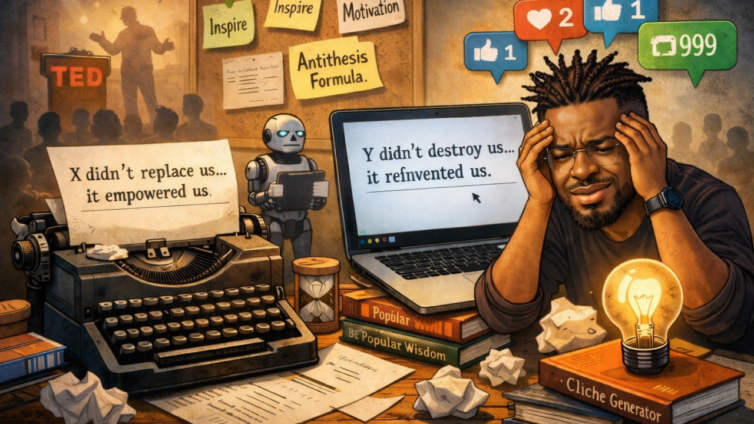
Somewhere along the way, LLMs like ChatGPT and its cousins learned how to write like motivational speakers.
And suddenly the internet is full of lines that sound like this:
X didn’t destroy us… It enabled us.
Y didn’t replace humans… it replaced limits.
You know the type.
The kind that reads like a cross between a TED Talk and a late-night thread on Twitter (X) where someone is trying very hard to sound profound in 280 characters or less.
At first, I thought maybe it was just a coincidence… but then I started seeing it everywhere.
LinkedIn posts.
YouTube scripts.
Instagram captions.
Even corporate emails are beginning to look like they were written by a philosopher who recently discovered bullet points.
And once your brain notices the pattern… that’s it. Game over.
You start seeing the skeleton of the sentence before you even finish reading it.
So I did what any curious person would do… I researched.
Turns out what’s happening there actually has a name.
It’s called antithesis, or more specifically, antithetical mirroring… a rhetorical trick where you repeat the same sentence structure but flip the meaning.
Same skeleton. Opposite conclusion.
It’s actually a fascinating rabbit hole… one I’ll share more of in my next post.
Apparently, we humans have loved this structure for centuries.
Politicians use it.
Speechwriters use it.
Advertisers have practically built careers on it.
One of the most famous examples comes from John F. Kennedy:
“Ask not what your country can do for you… ask what you can do for your country.”
Same structure.
Mirror-image idea.
Instant applause.
The problem now is that AI has learned this trick a little too well.
Large language models are trained on enormous datasets of speeches, articles, books, and social media posts. Research from institutions like Stanford and MIT suggests that LLMs tend to reproduce rhetorical patterns that appear frequently in persuasive writing… and this parallel-structure style shows up a lot in inspirational and motivational content.
So when you prompt an AI with something like:
“Write something inspirational about technology and humanity.”
The model basically goes:
Ah, yes… human inspiration detected.
Deploy the TED-Talk Sentence Generator™.
And out comes something like:
Technology didn’t replace humanity… it amplified it.
Clean.
Symmetrical.
Shareable.
Also… increasingly predictable.
Because the truth is, this format compresses complicated ideas into neat little intellectual snack packs.
Instead of explaining how mechanisation transformed labour over several paragraphs, you get something like:
Mechanisation didn’t replace humans… it replaced limitations.
It’s tidy.
It’s quotable.
It’s extremely LinkedIn-friendly.
But like any spice in cooking… once everyone starts pouring it on everything, the dish stops tasting good.
What started out as clever rhetorical seasoning has now become the literary equivalent of autotune.
You hear it once… interesting.
You hear it everywhere… and suddenly your brain starts begging for a different song.
These days, the moment I see that structure, my brain almost immediately loses interest in the content.
Well… not always.
But often enough that I start thinking:
“Ah. Someone probably typed a topic into ChatGPT, pressed generate, and pasted the result like freshly printed wisdom.”
Which is ironic… because I use AI constantly.
I use it to explore ideas.
Challenge assumptions.
Pressure-test arguments.
But when it comes to writing… the actual craft of arranging words so they hit emotionally… that’s still a human playground for me.
Because writing, at least the kind I enjoy, isn’t just information transfer.
It’s choreography.
(See what I did there?)
The rhythm of sentences.
The pauses.
The humour that sneaks in.
The little exaggerations that make people smile.
It’s less like assembling Lego blocks… and more like composing music.
An LLM would probably have written that last thought as:
“Writing isn’t about words… It’s about impact.”
But that’s not creative enough for me.
I’d rather write something like this:
“Writing isn’t mechanical assembly, it’s creative orchestration. One is snapping pieces together. The other is conducting an orchestra of ideas.”
Now that feels less like a slogan… and more like someone thinking out loud.
So yes… I’ll keep using AI to explore perspectives, challenge ideas, and occasionally argue with a robot at 2 am about philosophy and technology.
But when it comes to my words…
I suspect I’ll keep writing them myself until I stumble onto new rhythms, new structures, new patterns worth experimenting with.
And who knows…
Maybe someday I’ll teach those patterns to the machines too.
But before I go… let me indulge in one last example of the very thing I’ve been complaining about.
It’s not just writing…
…it’s an artistic arrangement of words designed to unlock emotion.
And yes… I’m fully aware of the irony.
Latest Stories
-
Obuasi SHTS abuse: Sanction all officials who failed to act – Moving Masculinity
5 minutes -
Lucy Agyepong honoured for excellence in engineering education at maiden GAAS Women’s Awards
8 minutes -
Harriet Afia Konadu Asiedu
15 minutes -
AFCON 2027: Sports Minister ‘convinced’ Black Stars will qualify despite losing opening two games
16 minutes -
CUTS welcomes VAT collection on cross-border digital services, urges fair treatment of Distance Learning students on overseas programmes
20 minutes -
Leave the Chiefs and fix the Galamsey Problem: Dr Solomon Owusu Advises President Mahama
23 minutes -
Pay attention to teachers and give them what is due – Ho District GNAT tells government
26 minutes -
Authorities knew of abuse allegations against Obuasi headmaster months before suspension – JoyNews investigation
31 minutes -
US teenager appears in court over alleged Hindu temple shooting plot
34 minutes -
Academic City donates paediatric rehabilitation staircase to Ga East Hospital
37 minutes -
Services drive 7.4% expansion in Ghana’s economic activity
49 minutes -
‘I don’t make music for awards, I make it to connect people’ – Rocky Dawuni
1 hour -
Farmer jailed for three months over assault on wife in viral video
1 hour -
Police arrest eight in Okaishie operation targeting illicit drugs and medicines
1 hour -
David Agyemang Yeboah: Marriage is not the problem; your approach is
1 hour