

Audio By Carbonatix
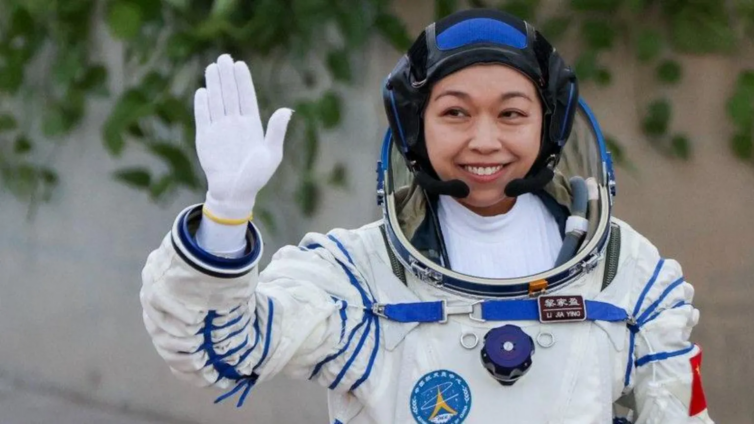
A Hong Kong astronaut has been launched into space for the first time, aboard China's Shenzhou-23 spacecraft.
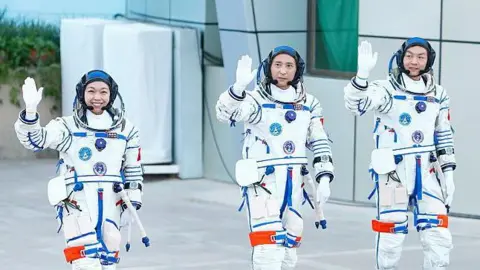
Li Jiaying, a 43-year-old police officer and mother of three, serves as the payload scientist in the three-member crew who made their way to China's Tiangong space station on Sunday night.
At least one member of the crew will spend a full year in orbit as part of a key experiment. Authorities will determine who that will be at a later date.
The mission is the latest in China's ambitious space program to send humans to the moon by 2030. It comes amid an accelerating race with the US, which is looking to achieve a crewed lunar landing by 2028.
The Shenzhou-23 is tasked with studying the effects of microgravity on the human body, among many experiments.
Apart from Li, the two other astronauts on the mission are Zhu Yangzhu, a 39-year-old space engineer and Zhang Zhiyuan, a 39-year-old former air force pilot.
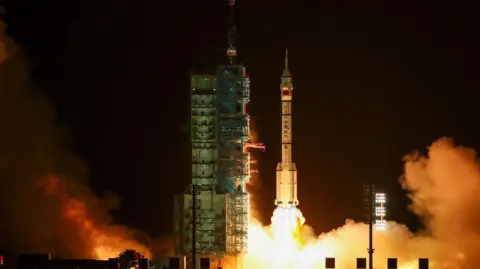
Large crowds waved Chinese flags as the rocket launched from the north-west Gobi desert on the Long March 2-F rocket at 23:08 local (15:08 GMT) Sunday. A few hours later, it docked on the Tiangong space station.
Hong Kong Chief Executive John Lee said Li's inclusion in the mission was a "historic" moment.
Li said she was inspired by Yang Liwei, the first person sent to space by China's space programme.
"This is a rare chance. Why not try?" Li said, according to Xinhua news agency.
As she made her way to the launch on Sunday, Li said, according to state broadcaster CCTV: "How high our Chinese spacecraft flies, that's how high we can hold our heads high".
Stories of successful Hong Kong figures like Li could help Chinese authorities stir patriotism, especially among the youth, analysts told BBC Chinese.
Since 2021, China has been sending astronauts to its Tiangong space station on six-month stays.
The year-long stay will be among the longest in history, just shy of the 14-month record set by a Russian cosmonaut Valery Polyakov in 1995.
"A year in orbit pushes both hardware and humans into a different operational regime compared with the shorter Shenzhou missions of the programme's earlier phases," Richard de Grijs, an astrophysicist and professor at Macquarie University in Australia, told AFP news agency.
This shows how China is building its expertise in long stays in space as well as deep space exploration, de Grijs said.
In 2024, China's Chang'e-6 craft recovered rock samples from the far side of the Moon for the first time and brought them back to Earth.
Later this year, China is set to mount an orbital test flight for its Mengzhou spacecraft, which is designed to carry astronauts to the moon.
Latest Stories
-
Hubtel willing to contribute to Ghana’s proposed AI fund – CEO
1 minute -
Nkrumah family pays tribute to Gamal, says he died after prolonged illness
11 minutes -
Police arrest eight suspects in anti-narcotics operation at Okaishie Drug Lane
22 minutes -
Benjamin Danso pledges grassroots empowerment in NDC regional chairmanship bid
24 minutes -
GES recommends reposting of Obuasi SHTS headmaster after August 2026 campus riot
27 minutes -
Rocky Dawuni celebrates King Ayisoba for taking traditional music global
39 minutes -
Ghana targets $5bn in annual economic gains from AI – Sam George
40 minutes -
From childhood dreams to future careers: Ecobank’s Big Pitch seeks to promote early savings and investment
43 minutes -
Public office demands make party work difficult for NDC appointees – Mahdi Gibril
44 minutes -
AI could deepen rural-urban inequality without better connectivity – Sam George
47 minutes -
One of six inmates who escaped from Konongo police cells rearrested
52 minutes -
Sam George cautions ministers against reading unverified AI-generated speeches
56 minutes -
Ghanaian entrepreneur Mary Nyamekye Asamoah wins Africa Travel 100 award
59 minutes -
Obuasi SHTS abuse: Sanction all officials who failed to act – Moving Masculinity
1 hour -
Lucy Agyepong honoured for excellence in engineering education at maiden GAAS Women’s Awards
1 hour