

Audio By Carbonatix
The Ghana Investment Promotion Centre (GIPC) has encouraged Ethiopian businesses to use Ghana as a gateway to the West African market, citing the country’s strategic location and expanding industrial opportunities.
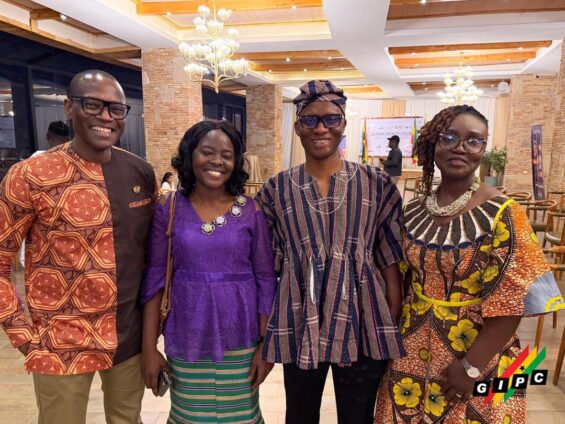
Afua Tekyi-Mills, Head of Marketing and Communications at GIPC, said Ghana offered investors access not only to the domestic market but also to the wider ECOWAS and AfCFTA markets.
She made the call during a panel discussion at the Ghana Business and Cultural Expo held at the Kuriftu Resort Africa Village in Addis Ababa, Ethiopia.
The event brought together business leaders, investors, policy makers and cultural stakeholders from Ghana and Ethiopia to strengthen cooperation in trade, tourism, culture and investment.
Addressing participants on the theme: “Creating an Enabling Environment for Cross-Border Investment,” Ms Tekyi-Mills outlined the practical steps Ethiopian businesses could take to establish operations in Ghana.
She said companies seeking to enter Ghana should first define their business objectives and preferred entry model, whether through trading, manufacturing, joint ventures or export-oriented production.
“At this stage, I would encourage them to engage GIPC early because GIPC can provide investment information, sector guidance, project profiles and advice on relevant incentives,” she said.
Ms Tekyi-Mills explained that the second step involved formalising business registration with the Office of the Registrar of Companies.
The third step, she added, was registration with GIPC for enterprises with foreign participation, followed by the acquisition of sector-specific licences and approvals where necessary.
Ms Tekyi-Mills said Ghana’s investment framework was designed to support investors through incentives, legal protections and facilitation services that encouraged long-term business growth.
She noted that Ghana’s investment framework offers tax incentives including concessionary corporate income tax rates for eligible agro-processing businesses during their first five years of operation.
She added that manufacturing companies operating outside Accra and Tema also benefit from reduced tax rates, as part of efforts to encourage regional industrialisation and more balanced economic development.
She further disclosed that strategic investments valued at US$50 million and above could qualify for customised incentives under Ghana’s Exemptions Act.
Ms Tekyi-Mills said Ghana continued to position itself as an investor-friendly economy through protections against expropriation, access to dispute resolution mechanisms and guarantees for profit repatriation.
She added that GIPC also supported investors through business facilitation, investment advisory services, technology transfer registration, aftercare support and investor grievance mechanisms.
Highlighting immediate opportunities for collaboration between Ghana and Ethiopia, Ms Tekyi-Mills identified agro-processing, textiles, garments, logistics and specialty food trade as sectors with strong growth potential.
She said Ghana could supply cocoa products, shea butter and processed foods, while Ethiopia could contribute coffee, spices, sesame and garment manufacturing expertise.
“This is an opportunity to build a stronger West Africa and East Africa business corridor using sectors where both countries already have complementary strengths,” she said.
Ms Tekyi-Mills expressed optimism that the Ghana Business and Cultural Expo would help deepen commercial relations between the two countries and create new opportunities for African businesses under the AfCFTA framework.
Latest Stories
-
He entered at eight. He is now 16: Ghana’s children growing up in prayer camps
1 hour -
‘Development must not always begin from Accra’ — Anwelle Foundation launched in Jirapa
1 hour -
PKO trio eye victories at Odwira Festival
4 hours -
346 Ghana Navy recruits pass out after 26 weeks of intensive training
4 hours -
Newsfile to discuss EOCO-MP arrest, drug trafficking, speech arrests and $235m water debt
5 hours -
JoyNews gets results as listeners raise GH¢40,000 to help 17-year-old student with cerebral palsy attend SHS
5 hours -
Vice President calls for stronger local pharmaceutical production to reduce medicine imports
5 hours -
The brewing tension at KNUST; Beware the Ides of October….
6 hours -
Health Ministry moves to integrate traditional medicine into mainstream healthcare
6 hours -
550 pupils in Kintampo South get educational lifeline as ‘Seeds of Hope’ reaches farming communities
6 hours -
Opoku Mensah urges Christian Council, House of Chiefs to speak up on democratic freedoms
7 hours -
Teacher unions’ strike: Minority demands immediate payment of teacher arrears, 20% deprived area allowance
7 hours -
The Accra-Kumasi Expressway: Building it right
7 hours -
Beyond gold exports: Building value and economic resilience from Ghana’s gold
7 hours -
2027 AFCONQ: Ghana under pressure as Gambia beat Somalia 2-1
7 hours