

Audio By Carbonatix
An endangered plant known as the "corpse flower" for its putrid stink is about to bloom in Australia - and captivated the internet in the process, with thousands already tuned in to a livestream ahead of its grand debut.
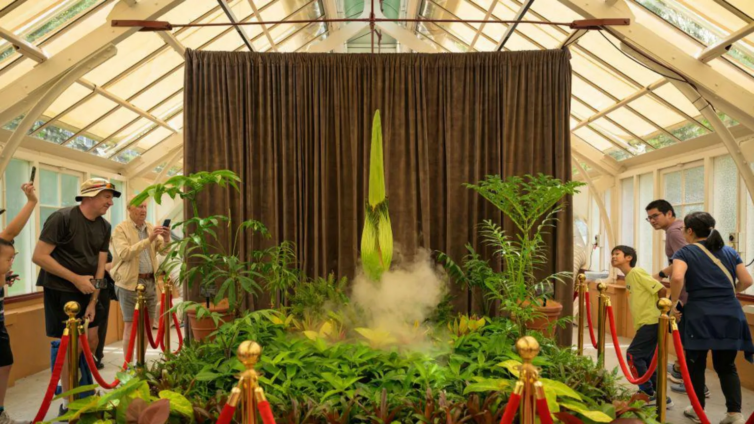
The titan arum plant, housed in the Royal Botanic Gardens of Sydney, blooms only once every few years for just 24 hours.
Affectionately dubbed Putricia, it will release a smell described as "wet socks, hot cat food, or rotting possum flesh".
The long wait and uncertainty as to when Putricia will bloom - have spawned jokes and even a unique lingo in the livestream's chat, with thousands commenting "WWTF", or "We Watch the Flower".
The current view is not much: Putricia stands silent and tall in front of a brown curtain, comfortably ensconced behind a red velvet rope. Occasionally, a visitor pops into the frame as they snap a selfie with the plant.
But once she blooms, viewers can expect to see Putricia unfold a vibrant maroon or crimson skirt, known as a spathe, around her spadix which is the large spike in the middle of the plant.
The Gardens have said it is "hard to predict exactly when" Putricia will bloom, but that has not stopped the thousands gathered online.
"I'm back again to see how Putricia is going and I can see she's still taking her time like the queen she is, fair play," wrote one commenter. "This is the slowest burlesque ever," said another.
Yet another person wrote: "Overnight I watched, fell asleep, awoke, watched, fell asleep. I am weak, but Putricia is strong. WWTF."
Other popular acronyms among viewers are WDNRP (We Do Not Rush Putricia) and BBTB (Blessed Be The Bloom).
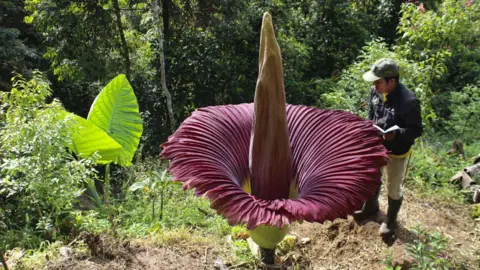
The plant can only be found in the rainforests of Sumatra, Indonesia, where it is known as bunga bangkai - or "corpse flower" in Indonesian. Its scientific name is Amorphophallus titanum, which is derived from Ancient Greek and means "giant misshapen penis",
It has the world's largest flowering structure, as it can grow up to 3m (10 feet) tall and weigh up to 150kg. The plant contains several hundred flowers in the base of its spadix.
It is endangered in the wild due to deforestation and land degradation.
Putricia is one of several titan arums in Sydney's Royal Botanic Gardens, which last saw one bloom 15 years ago.
But there have been other corpse flower blooms across Australia in recent years, including Melbourne and Adelaide's botanic gardens, each time attracting thousands of curious visitors keen on having a whiff.
There are also a few housed in Kew Gardens in London, where one bloomed in June last year. The titan arum first flowered outside of Sumatra in 1889 in Kew.
Latest Stories
-
KNUST boosts petroleum engineering output with largest MSc cohort
19 minutes -
NIB returns to profitability with over GH₵343M Profit After Tax – 2025 financial report
30 minutes -
Government to borrow GH¢15.231bn via T-bills, bonds between March and June 2026
53 minutes -
UN resolution just the beginning – Mahama on adoption of slave trade declaration
1 hour -
UN adoption of resolution declaring transatlantic slave trade gravest crime historic – Mahama
1 hour -
“This is a proud moment for Ghana, Africa” – Mahama after UN slave trade resolution
2 hours -
New Town building collapse: Two dead, 14 rescued so far as mission intensifies
2 hours -
Prolonged Middle East conflict poses significant risk to economy – BoG
2 hours -
Kafui Dey suggests seat fillers to fix late TGMA start
3 hours -
World Bank, GCEA provide FIDIC contract management training in Accra
3 hours -
T-bills auction: Government records 20.1% undersubscription; interest rates continue to surge
3 hours -
Scientists from Ghana, Brazil and UK gather in Kumasi to tackle biodiversity crisis with technology
3 hours -
ECG announces power outages in Amasaman and Western Region for maintenance and cable fault repairs
3 hours -
Rescue efforts for trapped worshipers intensify in Accra New Town building collapse
4 hours -
49 Years On: Shirley Graham Du Bois remembered as a force beyond W.E.B. Du Bois’ legacy
4 hours