

Audio By Carbonatix
Demonstrators hoped nationwide protests called by the Nigeria Labour Congress (NLC) umbrella union would pile pressure on the government, which brought in reforms last year that have had a devastating effect on citizens of Africa's biggest economy.
As inflation skyrockets, many poor Nigerians have had to skip meals and give up products such as meat, eggs and milk.
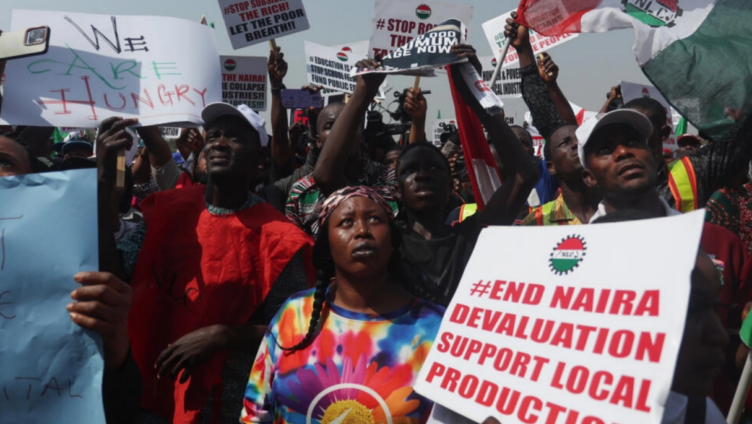
Over 1,000 demonstrators marched on the National Assembly in the capital Abuja, watched over by vigilante groups and armed police.
The protesters chanted and carried signs saying "Let the poor breathe" and "End naira devaluation".
"The government needs to wake up," said protester Roland Bamiche, who works for a hospitality union.
"People are dying, people are suffering, people are going through hell," the 45-year-old said. "The high cost of living is becoming unbearable."
Since coming to office last year President Bola Ahmed Tinubu has ended a fuel subsidy and currency controls, leading to a tripling of petrol prices and a spike in living costs as the naira has slid against the dollar.
The inflation rate reached a three-decade high of almost 30 percent in January, according to the national bureau of statistics.
Tinubu has called for patience to allow his reforms to take effect, saying they will help attract foreign investment, but the measures have hit Nigerians hard.
"Tinubu promised a change but now look where we are," said activist Aghedo Kehinde Stephen in Lagos where more than 1,000 people also turned out.
"There is no food and no security in the country."
'Reduced to beggars'
In the north, the economic crisis has forced people to eat poor-grade rice used as fish food.
To feed their children, women have even resorted to digging up anthills in search of grain stored by the insects, videos on social media show.
Hundreds of demonstrators marched to the governor's office in the northern city of Kano, the capital of a key state which also bears the same name.

"The population has been reduced to beggars. The government must take drastic measures," said protester Saudatu Ibrahim.
The government says it is working to address the crisis and on Tuesday Nigeria's central bank announced it was raising interest rates by four percentage points to 22.75 percent in a bid to tame inflation.
"We need prices to come down," said NLC worker Mercy Adeyemi at the Abuja demonstration.
The price of rice has more than doubled in the past year and the 48-year-old mother of four said she has been missing meals to make ends meet.
Protests have already taken place across the country this month and are set to continue tomorrow.
Latest Stories
-
Manhyia South MP launches Soloku Festival 2026 to promote unity and youth development
3 minutes -
Chleo-Patra A. Azantilow writes: Ghana – a grand strategy without its youth
18 minutes -
Oppong Nkrumah boosts Brenase Polyclinic with theatre equipment to expand surgical care
53 minutes -
SSNIT honours oldest pensioner on Scheme at 115
1 hour -
4 MPC members voted for 150bps cut in policy rate to 14%
1 hour -
Bond market: Turnover declines sharply by 60% to GH¢941.11 million
2 hours -
Two Legacy Girls adjudged overall best and second best in Africa
2 hours -
Today’s Front pages : Wednesday, March 25, 2026
2 hours -
‘He liked the fear in our eyes’, Epstein survivors tell BBC
5 hours -
We’re not removing money – Roads Minister defends Suame Interchange redesign
5 hours -
Suame Interchange issue is political, nothing to do with engineering – Roads Minister Agbodza
5 hours -
Roads Minister clarifies ‘Big Push’, says 54 new projects, 23 inherited contracts
6 hours -
Big Push: Kwame Agbodza reveals major road projects hit 50% completion
6 hours -
Ghana hosts ICC Men’s T20 World Cup Africa qualifiers at Achimota Oval
6 hours -
Ghana open T20 World Cup qualifiers with emphatic win over Seychelles
6 hours