

Audio By Carbonatix
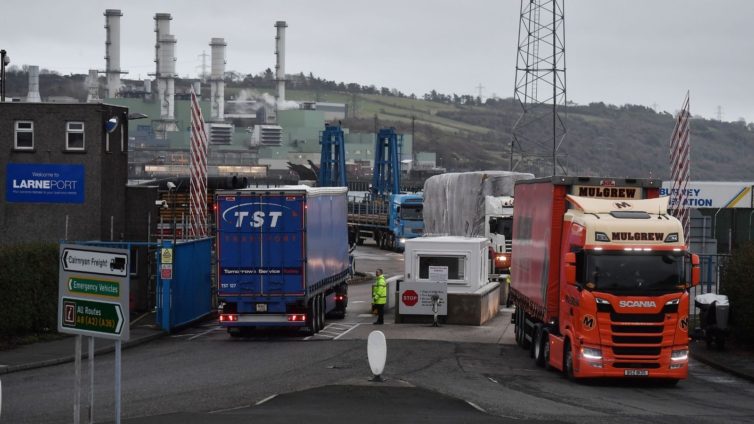
The British government estimates it will spend at least 4.7 billion pounds ($6 billion) on implementing post-Brexit border arrangements, after repeated delays in setting new rules, parliament's spending watchdog said on Monday.
Britain voted to leave the European Union in 2016 but, such was the scale of the task to untangle supply chains and erect customs borders, that it is only this year setting new rules.
The first phase of Britain's so-called new Border Target Operating Model, requiring additional certification, came into force on Jan. 31.
A second phase started on April 30, introducing physical checks at ports. A third phase, requiring safety and security declarations is slated for Oct. 31.
The National Audit Office (NAO) said the 4.7 billion pounds figure is the amount the government forecasts it will spend on the 13 most significant programmes to manage the passage of goods across the border post-Brexit and improve performance over the lifetime of the programmes.
The government delayed the implementation of full controls five times since the end of the EU exit transition period on Dec. 31 2020.
This caused uncertainty for businesses, extra costs for government and ports and increased the biosecurity risk to the UK, the NAO said.
"The repeated delays in introducing import controls, and difficulties forecasting requirements, have resulted in government expenditure on infrastructure and staff that were ultimately not needed," it said.
"Late announcements about policy and uncertainty about the implementation of controls have also reduced the ability of businesses and ports to prepare for changes."
The NAO noted that while post-EU exit border processes have operated "relatively smoothly", businesses trading goods between the UK and the EU have faced additional costs and administrative burdens.
The watchdog was also critical of the government's 2025 UK Border Strategy, which was published in 2020, saying it "lacks a clear timetable and an integrated cross-government delivery plan, with individual departments leading different aspects of implementation."
The government also needed "a more realistic approach" to digital transformation, the NAO said.
($1 = 0.7895 pounds)
Latest Stories
-
We must preserve Aŋlɔ, our history and our future — V. L. K. Djokoto
3 minutes -
University of Bayreuth marks 100 years of Black History Month with exhibition, dialogue
3 minutes -
Ethiopia launches 10-year golden visa for foreign investors
21 minutes -
Today’s front pages: Monday, March 30, 2026
28 minutes -
Evelyn Nsiah Asare: From breaking barriers in sports to doctoral excellence in logistics
34 minutes -
Cocoa Marketing Company MD engages WAMCO ahead of 50% local cocoa processing reform
50 minutes -
Students raise concerns over accommodation and road safety at UniMAC Dzorwulu
1 hour -
Paul Afoko interacts with other NPP aspirants and party executives in Jamasi
1 hour -
60 outstanding students from 14 Fanteakwa South schools receive awards inspired by Assor Foundation
1 hour -
Ghana shines at WTO MC14, secures gains for food security, industry and trade
1 hour -
Ghana, Japan, UNICEF launch US$2.3m partnership to tackle child labour
2 hours -
Ghana finish second, Tanzania top as both qualify for T20 African World Cup regional stage
2 hours -
You cannot cover up Goldbod probe forever – Oppong Nkrumah to Majority
2 hours -
Seminar on competition policy and law held in Accra
2 hours -
From promised jobs to the frontlines: How Ghanaian recruits signed irregular Russian military contracts
2 hours