

Audio By Carbonatix
Some Ghanaians have begun tightening their budgets to make ends meet due to the incessant increase in the cost of goods and services in the country.
Although the government has not announced an increase in utility tariffs, many suspect the tariffs have been adjusted, a development that is causing people to realign their priorities.
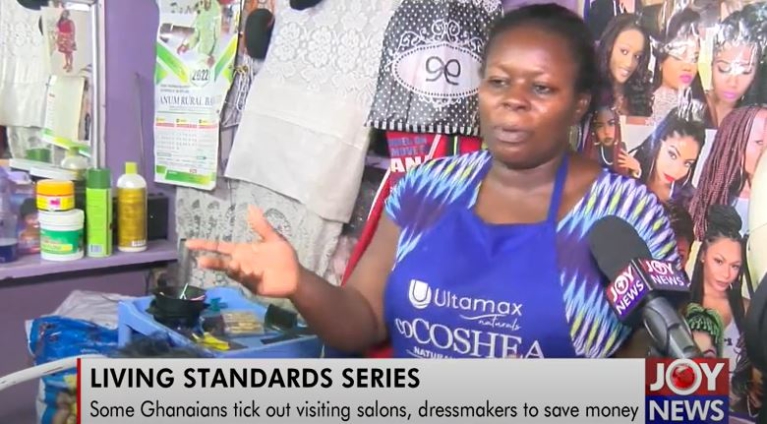
In the current episode of the JoyNews’ Living Standard Series, some residents of Kaneshie, a suburb of Accra, said they have identified a number of items, including visits to the salon and dress makers, which they have removed from their budget.
Shops in the Kaneshie market do not have their own electricity meters; administrators share electricity bills per the number of gadgets in the shop, a situation some traders have complained about.
Jennifer works inside the market as a hair stylist. She targets traders who may be too busy to visit hairdressing salons in their residential communities.
Despite the affordability of her services due to her target market, her customers have not been frequent lately.
The situation is affecting her ability to make her offset her bills, talk less of making profit.
Previously, she had four hair driers and paid over GH¢300 for electricity, but because few customers show up in her shop, paying electricity bills has become a challenge.
To solve the problem of over-billing, she has sent two hair driers home.
For two weeks, not even a single customer visited her shop. Luckily, two customers visited her shop this week. One went to braid and the other to wash her hair.
Her customer, Daavi who had not visited her for weeks, said economic difficulties are to blame. She had to relocate to beat down rent charges.
“This is where I braid my hair but for some time, financial difficulty is making it difficult. Paying of bills in my house always turns into arguments. The bills are high and I would prefer to have my own bill,” she said.
Emmanuella, who is a church administrator, joined the conversation.
She simply cannot explain how her water bills keep rising even though the Public Utilities and Regulatory Commission has not announced an adjustment of tariffs.
“For me, it’s been going high because I usually pay, so I know how much I’ve been paying over the period. Recently, the bill that came was almost GHC130 for water; so, I am wondering why the water is still going high.”
Seamstresses are also reporting low patronage because food prices are high, fuel prices are high and transport fares have equally skyrocketed.
People are left with no option than to kick out many things from their priority lists to survive.
Latest Stories
-
Kwaku Azar writes: A-G vs OSP
13 minutes -
Mfantsipim–Adisadel rivalry built excellence, not division – Sam Jonah
37 minutes -
Vice President launches Mfantsipim’s 150 years of shaping Ghana’s greatest mind
54 minutes -
I assure Otumfuo, Mahama will join him to commission KNUST Teaching Hospital by end of this year – Haruna Iddrisu
2 hours -
Gov’t to roll out free special education for persons with disabilities from July 1 – Education Minister
2 hours -
“We used it to test our officiating officials’ readiness” – Bawah Fuseini after CAA Athletics event
2 hours -
Volleyball emerges as Ghana’s fastest rising sport
3 hours -
National Sports Fund needs strong leadership from the top – Administrator David Wuaku
3 hours -
JoySports Exclusive: Steve McLaren in talks with GFA after expressing interest in Black Stars job
3 hours -
Fire guts auto parts warehouse at Bubuashie, one fire officer injured
3 hours -
I owe my victory to coach Ofori Asare – Allotey after winning WBA Africa Gold Super Flyweight belt
3 hours -
Church of Pentecost supports over 2,000 BECE candidates in Obuasi with career guidance seminar
5 hours -
Brandon Asante and Coventry all but promoted to Premier League despite Sheffield Wednesday draw
5 hours -
GPL 2025/26: Late Kwartemaa strike downs Hearts in Tema
5 hours -
Ghana Faces Sierra Leone Moment as Prosecutorial Powers come under strain
5 hours