

Audio By Carbonatix
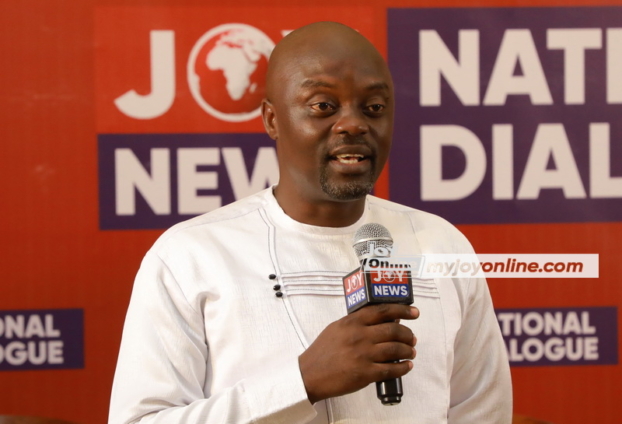
JoyNews investigative journalist Erastus Asare Donkor has questioned the government’s commitment to ending illegal mining, locally known as galamsey, arguing that the fight cannot succeed as long as excavators used in galamsey operations continue to “disappear and reappear like ghosts.”
Delivering the keynote address at the Kronti ne Akwamu Lecture on Thursday, November 27, under the theme “Galamsey: A Country’s Search for a Solution in Plain Sight,” Mr Donkor criticised the weak enforcement system that allows heavy equipment to be moved in and out of mining zones without accountability.
He stressed the urgent need for the Minerals Commission to operationalise the long-delayed excavator tracking system, insisting that every excavator in the country must be registered and monitored in real time.
According to him, any unregistered machine found within a mining area should be seized without hesitation.
“This is not a suggestion. It is common sense,” he said, adding that no government can claim to be serious about fighting galamsey while refusing to adopt basic tracking measures.
Mr Donkor also called for water bodies and major biodiversity zones to be declared national security areas where mining is strictly prohibited.
However, he warned that such measures would require robust enforcement, something he said is currently lacking.
He pointed out that the National Anti-Illegal Mining Taskforce (NAIMOS) remains under-resourced, without a dedicated budget, adequate logistics, or political protection.
These gaps, he argued, undermine the taskforce’s ability to safeguard rivers and forest reserves.
“How do we expect them to protect rivers when we don’t protect them?” Mr Donkor asked, calling for stronger collaboration with local police and the decentralisation of NAIMOS to enforce security zones effectively.
To ensure transparency and accountability, he recommended that NAIMOS establish internal watchdog structures to prevent corruption and institutional weakness.
Mr Donkor further proposed the creation of a credible intelligence network made up of journalists, community leaders, forestry officers, and civic groups who can report directly to the President with unfiltered information from the ground.
He also urged major reforms within the Forestry Commission, which he accused of enabling the plunder of forest reserves under the guise of reclamation.
To fix this, he suggested upgrading the Commission to a paramilitary-level institution capable of enforcing demarcations and protecting Ghana’s forest frontiers.
Latest Stories
-
Ghana to lose GH¢18.15bn in revenue by 2027 from abolishing Covid levy, E-levy – CPS study
31 minutes -
Reintroduce scrapped taxes to close revenue gap – Tax expert
46 minutes -
GRA applauds CPS study, urges continuous policy scrutiny
57 minutes -
Wear blue or green hat to survive – IBAG president says insurance industry ‘captured by politics’
1 hour -
AGI commends government’s move to resolve the power crisis in Volta and Oti Regions
1 hour -
Broker sector worse hit by state interference – IBAG president reveals
2 hours -
IBAG president alleges political interference driving kickbacks in insurance sector
2 hours -
Trump agrees to two-week ceasefire, Iran says safe passage through Hormuz possible
2 hours -
Dozens killed as Angola flood death toll rises
2 hours -
Russia confirms deaths of 16 Cameroonians fighting in Ukraine war, Yaounde says
3 hours -
Plan to scrap presidential elections puts Zimbabweans at loggerheads
3 hours -
Guinea-Bissau transporters strike over higher fuel prices
3 hours -
Iran ceasefire deal a partial win for Trump – but at a high cost
3 hours -
Oil slides below $100 after Trump announces two-week ceasefire
3 hours -
Madagascar declares state of emergency over energy situation due to Iran war
3 hours