

Audio By Carbonatix
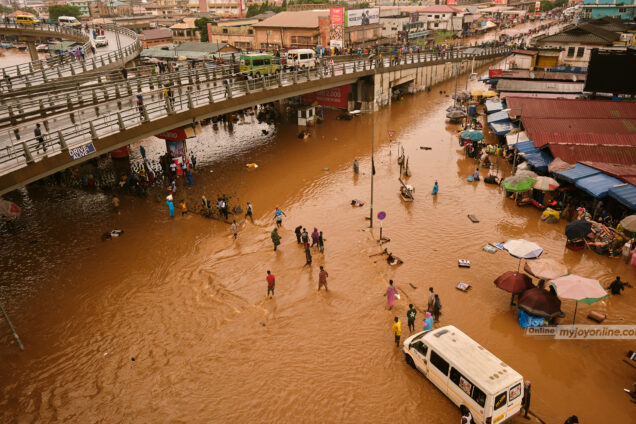
When the floodwaters finally receded across parts of Accra, they left behind more than submerged homes, damaged businesses, and grieving families.
They left behind a public health emergency. For many, flooding ends when the rain stops. For public health professionals, that is often when another crisis begins.
Contaminated water increases the risk of cholera, typhoid fever, and diarrhoeal diseases. Stagnant water creates breeding grounds for mosquitoes, increasing the risk of vector-borne diseases. Displaced families face overcrowded living conditions that heighten the spread of infectious diseases. Beyond the physical impact, floods also leave psychological wounds like anxiety, trauma, and uncertainty that can linger long after communities begin rebuilding.
Floods are therefore not simply environmental disasters. They are public health events. Every flood exposes more than blocked drains. It exposes weaknesses in urban planning, environmental management, emergency preparedness, institutional coordination, risk communication, and leadership.
As expected, the national conversation has once again centred on blame.
Many citizens argue that the government has failed to invest sufficiently in drainage infrastructure, enforce planning regulations, and prepare communities for predictable disasters. Government, on the other hand, points to indiscriminate waste disposal, illegal construction on waterways, and resistance to lawful enforcement.
There is truth in both positions. But if every flood ends with mutual accusations, we will continue rebuilding the same vulnerabilities instead of preventing the next disaster.
The more important question is not who is to blame. It is what must change.
Government carries a profound responsibility. Protecting lives is one of the most fundamental obligations of the state. That responsibility extends beyond emergency relief after disasters. It requires investing in resilient infrastructure, strengthening early warning systems, enforcing planning regulations consistently, coordinating institutions effectively, and prioritising prevention over reaction.
Public health has always taught us that prevention is more effective and far less costly than treatment. The same principle applies to flooding.
The true measure of disaster management is not how efficiently relief items are distributed after communities are submerged. It is whether those communities are protected from being submerged in the first place.
Yet government alone cannot build resilient cities. Communities matter. Every plastic bottle discarded into a drain, every illegal structure erected on a waterway, every refusal to comply with planning regulations weakens the systems designed to protect all of us.
Flood resilience is therefore not only an engineering challenge. It is a behavioural challenge. It is a governance challenge. It is a leadership challenge. Ultimately, it is a public health challenge.
One of the most important lessons in public health is that health is shaped long before anyone arrives at a hospital. Housing, sanitation, education, environmental management, urban planning, and human behaviour all influence whether people become sick or remain healthy.
Flood prevention follows the same principle. Healthy communities are built not only through hospitals but through clean environments. Safer cities are built not only through concrete, but through responsible institutions and responsible citizens.
This conversation becomes even more urgent as climate change continues to increase the frequency and intensity of extreme weather events across Africa. Flooding can no longer be treated as an occasional emergency. It is becoming a recurring public health risk that demands long-term planning rather than seasonal responses.
That requires political will. It requires institutional discipline. It requires effective risk communication. It requires civic responsibility. Above all, it requires leadership. Leadership is not exercised only from the Presidency, Parliament, ministries, or metropolitan assemblies.
Leadership is exercised by the engineer who refuses to compromise standards. By the assembly officer who enforces regulations fairly. By the developer who chooses not to build on waterways. By the trader who disposes of waste responsibly. By every citizen who understands that protecting public spaces ultimately protects human lives.
The success of our response should not be measured by aerial inspections after floods or the volume of emergency assistance distributed. It should be measured by whether next year's rains produce fewer deaths, fewer displaced families, fewer disease outbreaks, and fewer preventable losses.
When the waters recede, our responsibility must not recede with them. If we truly want a safer Accra and a more resilient Ghana, we must move beyond reacting to disasters and begin preventing them. Because the strongest flood defence any nation can build is not only concrete and steel.
It is responsible leadership. Strong institutions. Informed citizens. And a collective commitment to prevention before tragedy. That is not simply good governance. It is good public health.
*********
About the author:
Enoch Kpevor Agbo is a Ghanaian communications professional, entrepreneur, and emerging public health advocate working at the intersection of media, marketing, and social impact.
He is the Media and Communications Manager at VODEC Africa.
Latest Stories
-
GNAT, NAGRAT, PTTA-GH tell teachers in Volta and Oti to stay out of classrooms
17 minutes -
Salaga North MP calls for immediate implementation of NADMO fund
24 minutes -
La Dade-Kotopon MP protests Pleasure Beach demolition, says authorities were not informed
25 minutes -
Diplomatic Seeds and Cultural Roots: Russia’s Growing Soft Power Footprint in West Africa
28 minutes -
Anthony Karbo dismisses claims of Bawumia-backed candidates in NPP executive elections
28 minutes -
Kurt must go
33 minutes -
St Augustine’s, Mfantsipim, Prempeh and Corpus Christi battle for 2026 Investment Quiz crown
35 minutes -
Nepal avalanche kills at least 15 expedition workers
35 minutes -
Photos: Mahama tours Mercy Ships hospital, commends life-changing medical mission
36 minutes -
‘Government has no knowledge’ – La MP questions Labadi Beach demolition
39 minutes -
President Mahama tours flood-hit Hohoe communities, presents relief items
41 minutes -
Baffour Awuah should be granted bail as EOCO probe continues – Boakye Agyarko
44 minutes -
I wasn’t going to let others die, says Indian pilot who opened cockpit door during attack
47 minutes -
GNFS removes large bee swarm from metal container at Suhum-Okorase
48 minutes -
Mahama reaffirms healthcare commitment as Global Mercy begins 10-month Ghana mission
50 minutes