

Audio By Carbonatix
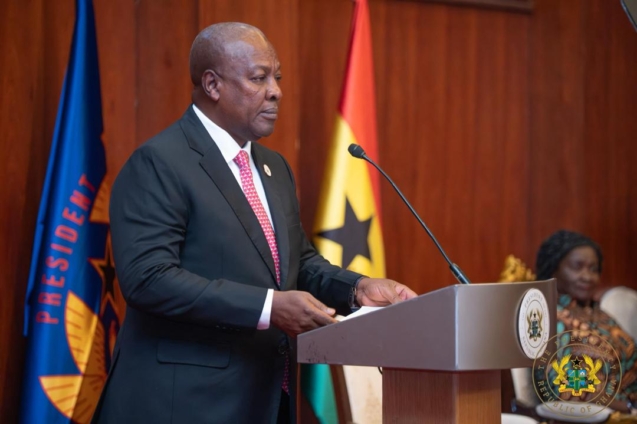
President John Dramani Mahama has requested the Majority Leader, Mahama Ayariga, and the Majority Chief Whip, Rockson-Nelson Dafeamekpor, to suspend their move to introduce a Private Members’ Bill seeking to abolish the Office of the Special Prosecutor (OSP).
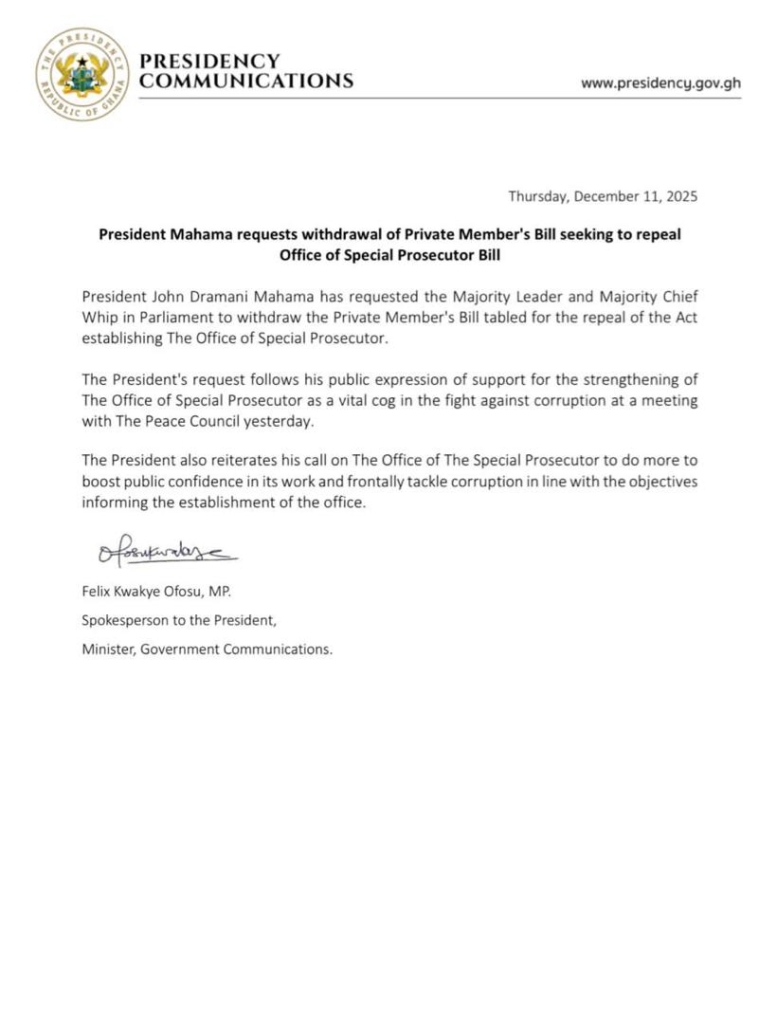
This was made known in a statement issued on Thursday, December 11, amid growing public debate after the two lawmakers drafted the Office of the Special Prosecutor (Repeal) Bill, 2025, aimed at abolishing the office.
Felix Kwakye Ofosu, Spokesperson to the President and Minister for Government Communications, in the statement said, "President John Dramani Mahama has requested the Majority Leader and Majority Chief Whip in Parliament to withdraw the Private Member’s Bill tabled for the repeal of the Act establishing The Office of Special Prosecutor."
"The President’s request follows his public expression of support for the strengthening of The Office of Special Prosecutor as a vital cog in the fight against corruption at a meeting with the Peace Council yesterday."
The statement added that, "The President also reiterates his call on The Office of The Special Prosecutor to do more to boost public confidence in its work and frontally tackle corruption in line with the objectives informing the establishment of the office."
Before this request, however, the President had already stated that it was premature to shut down the office, insisting that it must be given time to deliver on its mandate.
Read Also: It’s premature to call for the scrapping of OSP – President Mahama
The proposed bill, dated 8 December 2025, argues that the OSP has faced structural and constitutional challenges over the past eight years, including duplication of prosecutorial functions with the Attorney-General’s Office and operational inefficiencies.
The memorandum accompanying the draft legislation also cites high administrative costs and limited impact relative to budget allocations as reasons Parliament should return corruption prosecution powers solely to the Attorney-General, as provided under Article 88 of the Constitution.
Supporters of the repeal contend that the existence of two separate prosecutorial bodies has created jurisdictional overlap, policy fragmentation and avoidable delays in criminal proceedings.
They propose that a specialised anti-corruption division within the Attorney-General’s Office would offer a more coherent and cost-effective model for fighting corruption.
The bill outlines transitional measures to integrate the OSP’s work into the Attorney-General’s structure without a significant additional costs.
Latest Stories
-
Damang takeover: There is not going to be any job loss; it is a lease change – Bobby Banson
22 minutes -
Gold Fields didn’t stop mining at Damang mines; such claims are untrue – Bobby Banson
25 minutes -
Engineers and Planners currently operate only in Ghana – Bright Simons
42 minutes -
Lands Minister has no legal basis to restrict lease to Ghanaian firms – Bright Simons
47 minutes -
Gov’t’s refusal to renew Gold Fields’ lease was simply untenable – Bright Simons
50 minutes -
SOS Children’s Villages Ghana deepens partnership with Gender Ministry
1 hour -
Gender Ministry celebrates Christina Koch, reaffirms commitment to empowering girls
1 hour -
Live stream: Newsfile digs into E&P’s takeover of Damang Mines, OSP powers and Anti-LGBTQ Bill
1 hour -
Moody’s maintains Ghana’s rating at Caa1, revises outlook to positive
2 hours -
Zambia elevates tourism education to national priority as President Hichilema backs continental summit
3 hours -
Activa promotes credit insurance to boost SME export growth
3 hours -
ILTM Africa 2026 opens doors to inbound and outbound luxury travel in Cape Town
3 hours -
“BP Soul Travel and Tours scored the highest marks” – Sports Minister Kofi Adams endorses agency for World Cup travel
3 hours -
‘At the age of 12, I was teaching people and collecting money from them’ – Forty Under 40 Awards
4 hours -
I broke my virginity at the age of 26 after university – Richard Abbey Jnr.
5 hours