

Audio By Carbonatix
The Ghana Statistical Service (GSS) has released the findings of its latest Integrated Business Establishment Survey (IBES), providing a comprehensive map of the nation’s 2,644,358 recorded businesses.
The data paints a picture of a resilient and evolving enterprise landscape where non-traditional operations play a critical role in national commerce.
While the majority of businesses, approximately 1.87 million (70.6%), are conducted within fixed structures, the survey highlights the massive scale of the informal and semi-formal sectors.
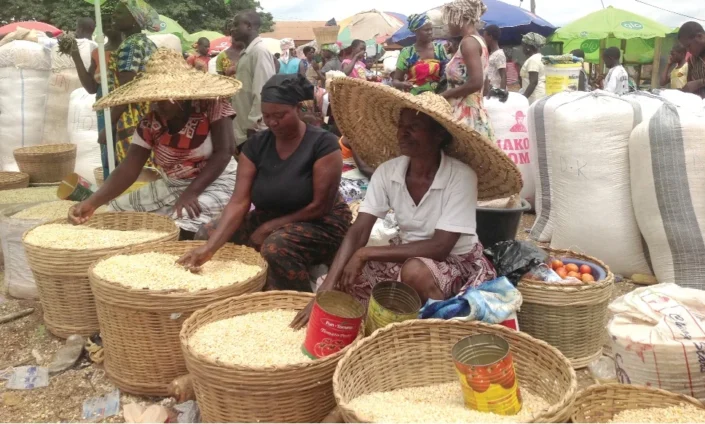
Enterprises operating in open spaces and mobile units now account for nearly 30% of all businesses in Ghana. These 776,668 entities are more than mere points of trade; they are essential pillars of daily access to goods and services.
The economic footprint of open-space businesses is particularly striking:
- Employment: These businesses alone provide livelihoods for over 922,000 people.
- Urban Concentration: Activity is heavily concentrated in the Greater Accra and Ashanti regions, reflecting the high commercial demand of Ghana’s primary urban centres.
- Operating Hours: Nationally, 63.7% of these businesses operate at least six days a week. This figure rises to 77.5% in Greater Accra and 73.1% in Ashanti, while in the Northern Region, nearly half (48%) remain open seven days a week.
Gender and ownership dynamics
The IBES data reveals a significant gender lean within the sector. Nearly 80% of all persons engaged in open-space, fixed-location businesses are women, underscoring the sector's role as a primary engine for female economic empowerment in Ghana.
Furthermore, the data reinforces the indigenous nature of this micro-economy, with 99.2% of all open-space businesses being entirely Ghanaian-owned.
Beyond fixed spots and open stalls, the survey identified 82,920 mobile businesses operating nationwide.
These "businesses on wheels" or on foot further bridge the gap in local commerce, ensuring that even the most remote or transient populations have access to essential trade.
The GSS findings suggest that while formalisation remains a policy goal, the informal and semi-formal sectors remain the heartbeat of Ghanaian economic activity.
With high employment levels and a deep-rooted presence in every region, these non-traditional enterprises continue to be the primary source of income generation for millions across the country.
Latest Stories
-
Telecel Foundation supports safer pregnancies with ultrasound outreach in Naaha
30 minutes -
AU’s 10-year reparations agenda is essential to address historic injustices – Spio-Garbrah
52 minutes -
Ghana can’t remain vulnerable to global economic disruptions— Dr Tutu-Boahene
1 hour -
‘No nepotism’ – Former NSA Board Chairman demands world-class coach after Otto Addo exit
1 hour -
Volta Region seen as top choice for luxury weekend breaks — V. L. K. Djokoto
1 hour -
Halt small-scale mining for one year to fight galamsey – Hopeson Adorye
1 hour -
Sammy Gyamfi marks 37th birthday with donations to Special School and Korle Bu
1 hour -
President Mahama orders full probe into ‘Big Push’ procurement exposé
2 hours -
Weija-Gbawe MP calls for commissioning of Weija paediatric hospital
2 hours -
Ghanaians dying in Russia–Ukraine war: The danger is real
2 hours -
Player ratings: Oppong earns high marks as Sibo and Adjetey draw low scores in Germany defeat
2 hours -
Pres. Mahama pledges action on 1.2m out-of-school children after School for Life raises concern
2 hours -
Suhum MP vows NPP will probe Gold-for-Reserves in 2029
2 hours -
Ghana to host Zimbabwe’s President Mnangagwa on three-day state visit
3 hours -
Ghana pushes for stronger West African blue economy partnership at Liberia fisheries investment conference
3 hours