


Audio By Carbonatix
Hundreds of thousands of workers have taken take part in strike action across France on Thursday, after trade unions called for a day of protests against budget cuts.
Organisers said one million people turned out, while the interior ministry put that number at 500,000, with 80,000 police officers deployed.
Scuffles were reported in the cities of Lyon and Nantes, and in Paris small-scale clashes broke out between police and protesters.
Officers in riot gear used tear gas and shields to disperse crowds in the centre of the capital after some protesters damaged a small number of businesses and buildings.
The strikes come barely a week after Sébastien Lecornu, a close ally of President Emmanuel Macron, was appointed prime minister following the toppling of François Bayrou's government.
Public transport was heavily disrupted on Thursday, with many metro lines in Paris reported shut, while protesters blocked roads and streets in major cities across France.
Students gathered in front of schools and universities in the capital and beyond, blocking entrances and chanting slogans. Around a third of teachers walked out.
Pharmacists are also adhering to strike action in droves, with 98% of pharmacies expected to stay closed.
More than 140 people were detained across France by late afternoon, the interior ministry said.
Unions have called for more spending on public services, higher taxes on the wealthy and for the budget cuts outlined by the short-lived Bayrou government to be axed.
Cyrielle, a 36-year-old IT worker, told the BBC she was striking because "Macron's economic and social policies don't suit me, nor did Bayrou's budget". She was taking part in a tightly-policed, large demonstration in central Paris.
"I would like more resources invested in public services and culture. Perhaps a percentage of people with enormous wealth could contribute a little more," she said, adding that if the new government "leaned more to the left, that would be the beginning of a solution."
Sophie Binet, the leader of one of France's major trade union groups, the General Confederation of Labour (CGT), said: "We need to be out in force, that's how we gather strength to keep fighting... to force the government and the employers to put an end to policies that only serve the richest."
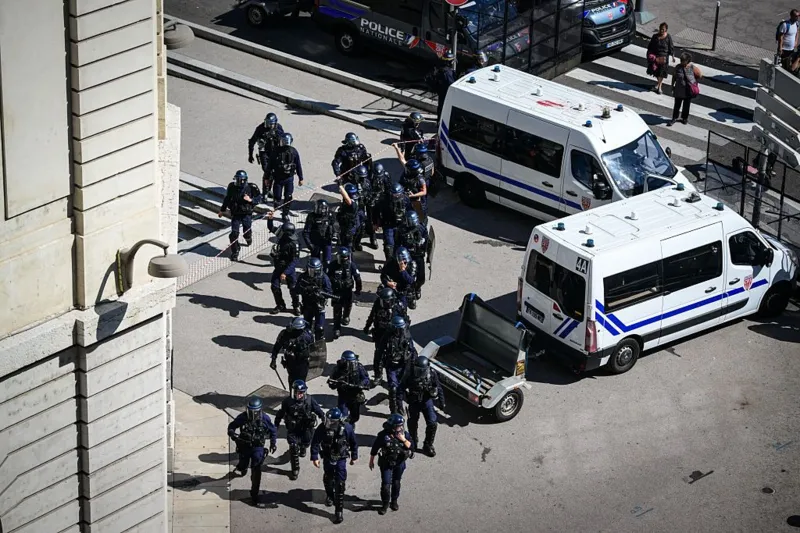
"We will be uncompromising and relentless," warned Bruno Retailleau, the outgoing interior minister, adding that he had given police instructions to make arrests "as soon as there is the slightest slip-up".
Jean-Luc Mélenchon, the leader of the radical left party France Unbowed (LFI), asked participants to the strike to be "disciplined".
"Any violent actions would only serve one person - Mr Retailleau," he said.
Ahead of the protests, Laurent Nunez, the Paris prosecutor, had expressed concerns that the demonstrations would be "derailed" by far-left groups and urged shops in the city centre to close for the day.
Thursday's strikes come after around 200,000 people took part in protests organised by the grassroots Bloquons Tout (Let's Block Everything) movement last week, which caused some disruption across France.
Bayrou's unpopular budget proposal - aimed at bringing down France's high public debt with €44bn (£38bn) worth of cuts - caused him to lose a confidence vote in the National Assembly last week when parties across the political spectrum united to topple him.
New Prime Minister Sébastien Lecornu, who is yet to assemble a ministerial team, has not entirely renounced the cuts and has held talks with opposition parties in an attempt to reach a compromise on the budget.
Lecornu's position is perilous. Like his two predecessors, Bayrou and Michel Barnier, he faces a hung parliament divided into three blocs with deeply differing political leanings, making it difficult to craft a budget palatable to a majority of MPs.
But France is also staring down the barrel of spiralling public debt, equivalent to almost €50,000 per French citizen.
Barnier and Bayrou were also brought down as a result of their proposed budgets, which would have entailed substantial cuts - with politicians on the left instead calling for tax rises.
"Of course, we'd like more stability in government, but whether it's Lecornu or someone else, we want workers to be truly taken into account," trade unionist Alexandre Dubois told the BBC.
"And we need to move away from this logic of short-term economic performance."
Latest Stories
-
OnlyFans owner Leonid Radvinsky dies at 43
5 hours -
Nigerian police arrest 15 after viral videos of alleged sexual assault at festival
5 hours -
Ethnic, political exclusion, not theology alone drives Muslim sectarian violence in Ghana, KNUST study finds
5 hours -
Semenyo reports to Black Stars camp after Carabao Cup win
6 hours -
Journalism out loud: Defending truth in a divided world
11 hours -
Heath Goldfields partners local firm, receives new mining fleet to revive Bogoso-Prestea mine
11 hours -
Korle-Bu overcrowding driven by broken referral system, not just bed shortage – Doctors
11 hours -
MC Portfolio named red carpet host for 2026 Ghana Music Awards USA
11 hours -
Oda-Akyem Swedru road develops dangerous potholes
11 hours -
U.S. Embassy explains Visa process for Ghanaians ahead of World Cup
12 hours -
Viral video on emergency care at Korle-Bu Teaching Hospital is ‘authentic’ – Emergency Medicine Residents
12 hours -
Ahmad Abdul-Samad, Rachael Quarcoo dominate 1st quarter All Ghana Badminton Championship
12 hours -
ActionAid calls for strong partnerships to advance water, gender, and climate justice
12 hours -
DVLA begins nationwide clampdown on expired DV plates from March 24
12 hours -
Ghanaian Commonwealth Youth Leader meets King Charles III, pushes for youth economic empowerment
13 hours