

Audio By Carbonatix
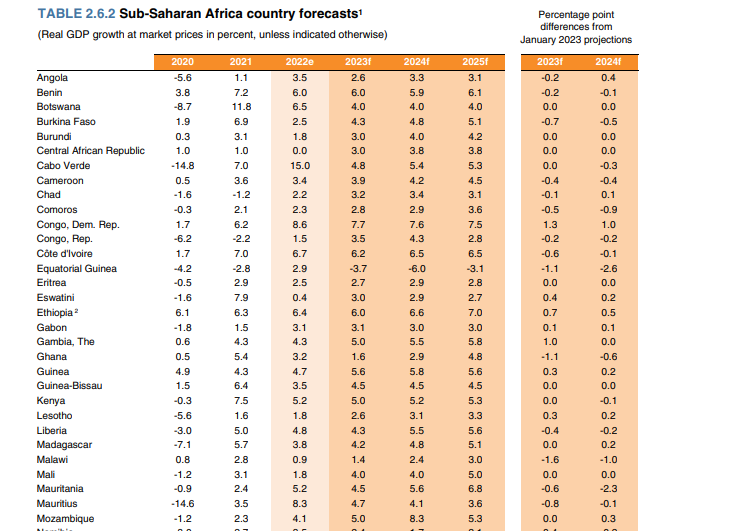
The World Bank has maintained its 1.6% Gross Domestic Product (GDP) growth forecast for Ghana in 2023, far lower than the expected 3.2% for Sub-Saharan Africa.
This places it in the 42nd position in Sub-Saharan Africa. The International Monetary Fund also projected a 1.6% growth rate for Ghana in 2023.
According to its June 2023 Global Economic Prospects Report, Ghana’s economy is however projected to expand by 2.9% in 2024.
The report stated that the slowdown in the economy is due to the challenges facing the economy, as the Ghana government is undertaking an International Monetary Fund support programme.
“In Ghana, more timely data highlight the weakness of economic activity amid the deleterious global shocks and heightened macroeconomic instability”.
Five African countries, Malawi (1.4%), Sudan (0.4%), South Africa (0.3%), South Sudan (-0.4%) and Equatorial Guinea (-3.7%) are expected to grow lower than Ghana in 2023.
Risks to outlook
The World Bank said its baseline projections remain subject to multiple downside risks amid uncertainty about developments in global commodity markets, the degree of additional global and domestic policy tightening needed to subdue persistent inflation, and the resilience of the world economy and global financial system to a prolonged period of tight monetary policies.
It pointed out that commodity prices may remain unusually volatile and vulnerable to further shocks if disruptions to the supply of major commodities worsen—for instance, due to intensifying geopolitical tensions or conflicts. Furthermore, global activity may decelerate faster than envisioned if the reopening of China’s economy fails to generate a durable recovery.
Sub-Saharan Africa’s growth to slow down to 3.3%
Growth in Sub-Saharan Africa (SSA) is expected to slow from 3.7% in 2022 to 3.2% this year—a 0.4 percentage point downgrade from January forecasts—with a moderate improvement to 3.9% next year.
Over half of the 2023 downgrade, it said, is attributable to an abrupt slowdown in South Africa. However, downgrades are widespread across energy and metal producers, and non-resource-rich countries.
Excluding South Africa, the Bretton Wood institution, however, said growth in SSA is expected to slow from 4.2% in 2022 to 3.9% this year.
Latest Stories
-
Knights and Ladies of Marshall group backs Catholic Bishops’ stance on anti-LGBTQ+
6 minutes -
Bright Simons writes: All the Filla in the Ibrahim Mahama/E&P – Gold Fields Saga
31 minutes -
Monetise Idiocy In Ghana
38 minutes -
The Ghanaian prophet and the mysterious death of his scottish wife Charmain Speirs
1 hour -
Nearly 400 sentenced in Nigeria for links to militant Islamists
2 hours -
Ghana’s recovery supported by gold strength despite global oil price pressures – Standard Bank Research
2 hours -
‘Excellence is our inheritance’ – Nana Sam Brew-Butler hails Mfantsipim’s 150-year reign in leadership
2 hours -
Kwaku Azar writes: A-G vs OSP
2 hours -
Mfantsipim–Adisadel rivalry built excellence, not division – Sam Jonah
3 hours -
Vice President launches Mfantsipim’s 150 years of shaping Ghana’s greatest mind
3 hours -
I assure Otumfuo, Mahama will join him to commission KNUST Teaching Hospital by end of this year – Haruna Iddrisu
4 hours -
Barcelona dominate derby to extend La Liga lead
4 hours -
Gov’t to roll out free special education for persons with disabilities from July 1 – Education Minister
4 hours -
Importers and Exporters Association declares full support for Publican AI port system
4 hours -
“We used it to test our officiating officials’ readiness” – Bawah Fuseini after CAA Athletics event
5 hours