

Audio By Carbonatix
Former Vice President, Dr. Mahamudu Bawumia, has cautioned against the use of tariffs as a solution to trade imbalances, stressing that such deficits are macroeconomic in nature and not the result of trade policy failures.
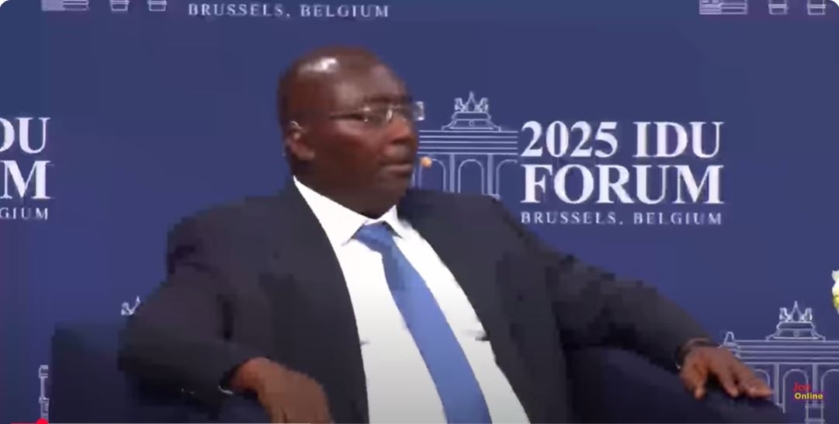
Speaking at the International Democracy Union (IDU) Forum in Brussels on Saturday, May 17, Dr. Bawumia responded to a question on how the weaponisation of trade is affecting African economies, particularly Ghana, and what strategies can enhance the continent's economic resilience.
“Policymakers are increasingly ignoring both economic fundamentals and the lessons of history,” he said.
“If you look at the share of global trade, Africa contributes just 2.5% of global exports and 2.9% of imports, while Asia, Europe, and the U.S. dominate global trade flows with significant imbalances.”
Dr. Bawumia argued that despite these imbalances, imposing tariffs does not address the root cause of trade deficits.
“You cannot fix a trade deficit with tariffs, it simply doesn’t work,” he emphasised.
Explaining further, he referenced the national income identity, noting that a trade deficit reflects a gap between a nation’s savings and investment.
“If a country spends more than it saves, it will run a trade deficit. That’s a macroeconomic problem, not a trade policy problem,” he said.
He cited historical examples, such as the 1930s Smoot-Hawley Tariff Act in the U.S., which contributed to the Great Depression, and the U.S.-China tariff war in 2018–2019, which negatively impacted global trade.
“The recent increase in average U.S. tariff rates from 2.4% to 10% is the largest since 1943, and its effects will be significant,” he warned.
Turning attention to Africa, Dr. Bawumia acknowledged that the continent is somewhat insulated from U.S. trade shocks, with Africa exporting 6.5 per cent and importing 4.4 per cent of goods to and from the U.S.
However, he highlighted countries like Lesotho, whose textile exports to the U.S. account for 50 per cent of their total exports under the African Growth and Opportunity Act (AGOA), are vulnerable.
Dr Bawumia predicted that Africa’s response to global trade disruptions will include a renewed push for self-reliance and stronger intra-African trade ties.
Latest Stories
-
Mid-March hearing expected after Ofori-Atta bond case stalls
8 minutes -
Legend of the week – Daddy Lumba
14 minutes -
No hearing took place on February 19 — Ofori-Atta’s lawyers clarify
22 minutes -
GPL 2025/26: Hohoe United defeat Samartex to move closer to safety
34 minutes -
GPL 2025/26: Asante Kotoko held by 10-man Vision FC
36 minutes -
Today’s Front pages: Monday, March 2, 2026
43 minutes -
Africa’s Energy sovereignty is being tested in the Strait of Hormuz
50 minutes -
TikToker “Duabo King” arrested for spreading false claims about Kumasi police officers
1 hour -
Senyo Amekplenu pledges seed funds to re-energize TESCON in Volta Region ahead of 2028
1 hour -
Paediatric Society of Ghana warns galamsey threatens children’s brain development
1 hour -
Volta Regional Minister reaffirms government’s commitment to promote quality education
1 hour -
Goldfields optimistic about Tarkwa lease renewal, confirms Damang exit
1 hour -
NPA raises fuel price floor for March 1 window; petrol now GH¢10.46, diesel GH¢11.42
2 hours -
UCC to honour Veep Prof. Jane Opoku-Agyemang with Distinguished Fellow Award
2 hours -
Rugby Africa enters a new chapter as national unions approve structural reforms at 17th AGM in Kampala
2 hours