

Audio By Carbonatix
The International Monetary Fund (IMF) has made it clear to the Government of Ghana that it cannot impose or intensify import restrictions for balance of payments purposes.
This is an agreement contained in the IMF bailout package which has pledged to support Ghana’s balance of payment with some $3 billion between 2023 and 2026.
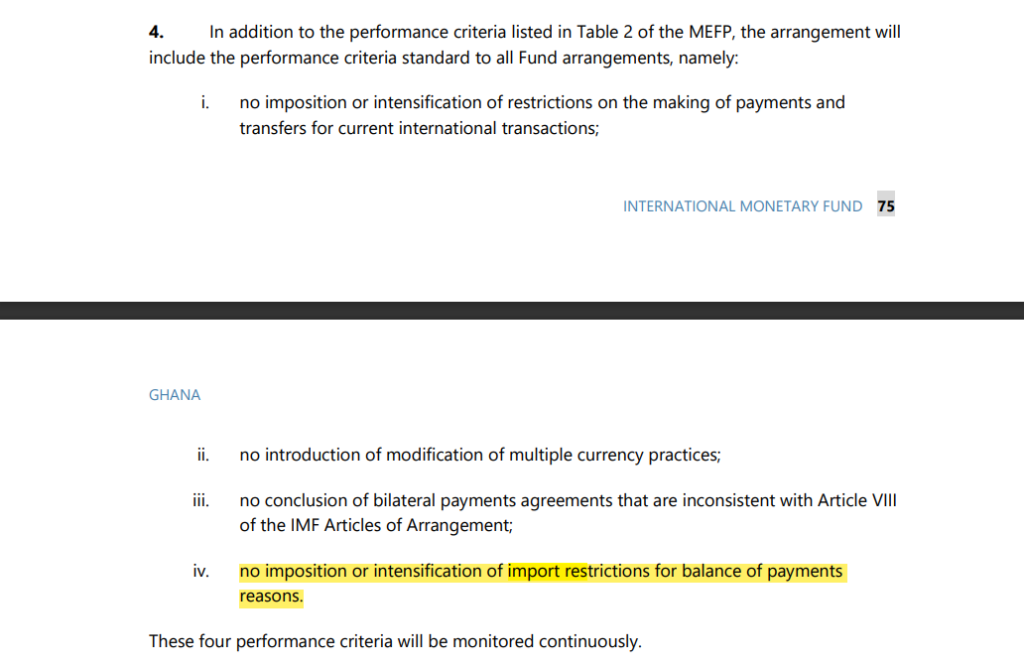
“No imposition or intensification of import restrictions for balance of payments reasons”, the Fund stressed on page 76 of the programme document. Amongst other things, there are four decisions the Government of Ghana cannot take while it is still under the IMF programme. These decisions align with performance criteria common to all Fund arrangements, which include:
- No imposition or intensification of restrictions on making payments and transfers for current international transactions.
- No introduction or modification of multiple currency practices.
- No conclusion of bilateral payments agreements inconsistent with Article VIII of the IMF Articles of Arrangement.
- No imposition or intensification of import restrictions for balance of payments reasons.
The Fund emphasised that these four performance criteria will be monitored continuously.
The Government of Ghana on Thursday made a surprising suspension of the decision to put the L.I. before parliament, which sought to place the importation of 22-listed products under restrictions. It had tried on three occasions, without success, to lay the bill before the house.
The Minority in Parliament urged President Akufo-Addo to immediately withdraw the regulation seeking to restrict the importation of rice, cement, fish, sugar, guts, bladders, and animal stomachs, known as 'yemuadie'.
The Trade Minister, K.T Hammond, who was pushing this regulation hoped it will help the cedi appreciate as well as help grow local industries.
Per the proposed regulation, any person seeking to import the selected products would have been required to obtain permission from the Trade Minister.
Ghana’s import bill according to Finance Minister Ken Ofori-Atta, exceeds $10 billion annually and is accounted for by a diverse range of items including palm oil, toilet roll, and even toothpick. While Ghana needs over $500 million to import rice, the trade minister says the importation of ‘yemuadie’ cost the state some $164 million in imports.
Latest Stories
-
US, Iran fail to reach peace agreement after marathon talks in Pakistan
55 minutes -
Port crises loom as 11,000 drivers threaten four-day strike
2 hours -
A source of excellence across generations – Vice President Opoku-Agyemang lauds Mfantsipim
2 hours -
(Photos) Mfantsipim School launches historic 150th anniversary
3 hours -
Knights and Ladies of Marshall group backs Catholic Bishops’ stance on anti-LGBTQ+
4 hours -
Bright Simons writes: All the Filla in the Ibrahim Mahama/E&P – Gold Fields Saga
4 hours -
Monetise Idiocy In Ghana
4 hours -
ECG kicks off Phase Two of transformer upgrades at Lashibi; brief outages expected
5 hours -
The Ghanaian prophet and the mysterious death of his scottish wife Charmain Speirs
5 hours -
Nearly 400 sentenced in Nigeria for links to militant Islamists
5 hours -
Ghana’s recovery supported by gold strength despite global oil price pressures – Standard Bank Research
5 hours -
Methodist Church hails Mfantsipim@150; calls for “fresh consecration” to excellence
6 hours -
‘Excellence is our inheritance’ – Nana Sam Brew-Butler hails Mfantsipim’s 150-year reign in leadership
6 hours -
Kwaku Azar writes: A-G vs OSP
6 hours -
Mfantsipim–Adisadel rivalry built excellence, not division – Sam Jonah
6 hours