

Audio By Carbonatix
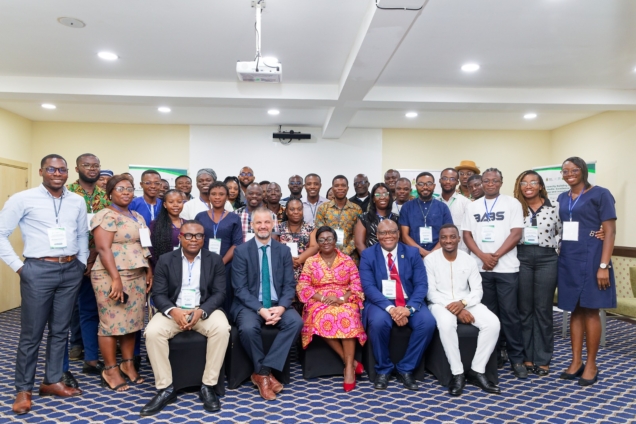
Thirty journalists from across Ghana are being empowered and equipped with skills to report Science, Technology and Innovation, and other related stories.
The Science, Technology, and Innovation (ST&I) training by the British High Commission in collaboration with Responsible AI Lab (RAIL) –KNUST and the Ministry of Environment, Science and Technology (MEST) is to enhance journalists ability to translate complex ST&I developments into accessible stories for the public.
The Capacity Building for Media Excellence in Science, Technology, and Innovation Reportage program will equip reporters with the necessary tools and understanding of scientific innovations and foster better communication between scientists and journalists.

The training saw an increase in participation compared to last year when 20 journalists took part.
Principal Investigator and Scientific Director of RAIL KNUST, Prof. Jerry John Kponyo shared concerns about the disconnect between scientists and media in reporting scientific breakthroughs.
He highlighted the importance of science reporting as a specialized skill and stated that KNUST, through RAIL, is working to address this need by building the capacity of journalists.

Prof. Kponyo emphasized that “science research and reporting are skills that require training, and being a scientist or journalist does not automatically make someone a good reporter on science, technology, and innovation (STI).
To address this pressing need to build skills and capacity in Science, Technology, and Innovation reporting, the university seeks to mount the workshop as a short course.
The training is funded by the UK Foreign, Commonwealth, and Development Office and in partnership with the Ministry of Environment, Science and Technology (MEST).
Development Director at the British High Commission, Richard Sandall reiterated the need for journalists to use their platforms to translate the important scientific breakthroughs to ensure impact, growth and also avoid misinformation.

He also emphasized the importance of accuracy in reporting and noted that the training would help improve journalists’ skills while addressing misinformation.
"We don't often read scientific papers, we don't often attend academic symposium. Most journalists and the public don't. There is often a big barrier between what scientist know and understand and getting that information to the people who can use it - decision makers, activists, teachers, general public- and that barrier is essentially creating a vacuum where information should be. Where there is a knowledge vacuum, misinformation rushes in. That vacuum has to be filled and it will be filled with bad information when the good information is not provided” he said.
As part of the Ghana UK Science Technology and Innovation (STI) Strategy initiative, the top 10 journalists will receive £1,000 each for the stories they pitch.
Winners will receive training and knowledge exchange at the Imperial College London to further hone their skills in science reporting from other science journalists across the globe.
Vice-President of the Ghana Journalists Association (GJA), Linda Asante Agyei encouraged journalists to improve their science literacy to handle the complexities of science reporting.
She also suggested that scientists involve journalists from the beginning of their research to aid understanding and respect journalistic ethics.
Director of Science, Technology and Innovation, Ministry of Environment, Science, Technology and Innovat (MEST), Mr Kwamena Quaison highlighted the role the ministry is poised to support journalists and urged the participants to learn more on STI reporting to shape society.
He expressed his gratitude to RAIL-KNUST, British High Commission and other stakeholders for enhancing professional development of media practitioners in STI reporting.
The panel discussion held at the opening of the workshop explored the UK-Ghana STI strategy, discussing ways to strengthen partnerships and improve the translation of STI impacts into public-friendly messages
Latest Stories
-
NPP must aim for decisive 2028 parliamentary Majority — Minority Leader
14 minutes -
Ghana not afraid of Germany like a few years ago – Kurt Okraku
19 minutes -
UNESCO-Ghana, Manhyia Palace Museum seal partnership as 2026 Otumfuo Art Awards launched
43 minutes -
Ibrahim Mahama faces Police board as assault probe continues
52 minutes -
UK–Ghana study tour strengthens partnership on roads and future transport systems
53 minutes -
Renting out your Accra apartment: Should you short-let or long-let in 2026?
1 hour -
Government communication alone won’t fix tomato shortage – Dr Charles Nyaaba
1 hour -
Ghanaian community in Switzerland champions inclusive governance at Diaspora Dialogue Series
1 hour -
UN slavery resolution isn’t binding, but revives calls for reparations – Prof Appiagyei-Atua
2 hours -
Ablakwa expresses deep gratitude to UN member states for backing Ghana’s slavery resolution
2 hours -
Gender Minister engages management, introduces new Chief Director at MoGCSP
2 hours -
Last Gallop: The rise, fall and fight for Horse Racing in Ghana
2 hours -
Communications Minister launches Ghana Climate Atlas to strengthen planning and climate resilience
2 hours -
Maintain credibility, reduce commentary — NDC elections director advises Mussa Dankwah
2 hours -
NDPC urges time discipline and stronger systems to accelerate Ghana’s development
2 hours