

Audio By Carbonatix
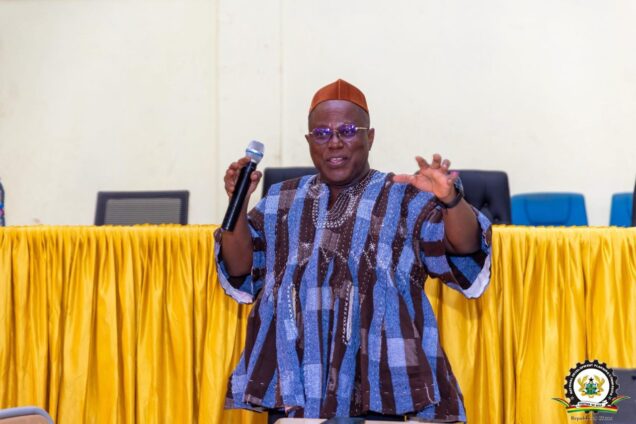
The Chairman of the National Development Planning Commission (NDPC), Dr Nii Moi Thompson, has called for a national shift in attitudes towards time management, stressing that discipline and efficiency are critical to driving Ghana’s development agenda.
Speaking at a regional consultative meeting in the Bono Region on the preparation of the Consolidated National Development Plan, Dr Thompson underscored that development must be intentional and well-managed.
He noted that while attention is often placed on financial and human resources, time remains an overlooked but crucial asset.
“We often speak about financial and human resources, but rarely about time. Yet it is the only resource that, once lost, cannot be recovered,” he stated, warning that habitual delays in public programmes carry significant long-term consequences.
He further illustrated the impact of poor time management, saying: “When a programme scheduled for 10:00 a.m. begins at 10:30 a.m., those 30 minutes are gone forever. If this becomes routine, we are not just losing time—we are losing development opportunities.”
He urged Metropolitan, Municipal and District Assemblies to embed time discipline into their institutional culture.
Beyond time management, Dr Thompson highlighted the importance of improving service standards, particularly within the tourism sector.
According to him, Ghana’s competitiveness depends not only on its attractions but also on the quality of experience offered to visitors. “Tourism is about experience. Customer care is not optional; it is an economic strategy,” he said.
On revenue mobilisation, he pointed to the dominance of the informal sector as a key structural challenge, noting that nearly 90 per cent of businesses operate outside the formal tax system.
“If we do not formalise our local economies, we will continue to rely heavily on central government transfers,” he cautioned, adding: “Development requires resources. Resources require systems. Systems require discipline.”
The Director-General of the Commission, Dr Audrey Smock Amoah, also emphasised the importance of credible planning in ensuring accountability and effective outcomes.
“Planning is not merely a procedural requirement; it is a strategic obligation. It is not about producing documents, but about delivering a credible roadmap for development,” she said.
Representing the Bono Regional Minister, Nar-Ire Puobenyere David reaffirmed the region’s commitment to the national planning process, stressing that development must translate into tangible improvements in people’s lives.
Certificates were later presented to districts whose Medium-Term Development Plans for 2026–2029 have received approval, marking a key milestone in the planning process.
Latest Stories
-
Police restore calm at Larteh following Odwira festival disturbance
5 minutes -
‘All the camps will dissolve’ – Bawumia demands one NPP for 2028
7 minutes -
There is no time to waste – Bawumia orders NPP to begin 2028 work
15 minutes -
Sarkodie visits MobileMoney Fintech LTD
17 minutes -
John Boadu unveils new NPP strategy to win back youth and modernise party
22 minutes -
Hawa Koomson elected NPP National Women’s Organiser
25 minutes -
John Boadu begins NPP rebuild from grassroots ahead of 2028 election
26 minutes -
Titus Glover wins NPP National Organiser race on second attempt
29 minutes -
Winning 2028 election won’t be easy; we must work harder – Bawumia
30 minutes -
You’ll be part of 2028 campaign; there’s enough work for all of us – Bawumia to NPP aspirants
38 minutes -
John Boadu moves to unite NPP after heated leadership contest
40 minutes -
Today is not a day of victory but a day of responsibility and great unity – John Boadu
41 minutes -
Let us choose unity over division – John Boadu to NPP
44 minutes -
Our task is to build a renewed NPP – John Boadu
47 minutes -
Teamwork, discipline will drive NPP’s 2028 victory – Justin Kodua after retaining General Secretary position
54 minutes