


Audio By Carbonatix
Letting a toddler spend lots of time using screens may delay their development of skills such as language and sociability, according to a large Canadian study.
The research, which tracked nearly 2,500 two-year-olds, is the latest piece of evidence in the debate about how much screen time is safe for kids.
In Canada and the US, experts say children should not use screens before they are at least 18 months old.
But UK guidelines set no such limit.
The Royal College of Paediatrics and Child Health says there is not enough evidence, even when you include this new study, for a "direct toxic effect".
What did the new research find?
Mums were surveyed (between 2011 and 2016) about screen use, and filled out questionnaires about their child's skills and development at ages two, three and five.
Screen time included watching TV programmes, films or videos, gaming, and using a computer, tablet, phone or any other screen-based device.
At the age of two, the children were clocking up around 17 hours of screen time per week.
This increased to around 25 hours a week by the age of three but dropped to around 11 hours a week at the age of five, when the children started primary school.
The findings, published in the JAMA Paediatrics, suggest increased viewing begins before any delay in development can be seen, rather than children with poor developmental performance then going on to have more screen time.
But it is not clear whether screen time - including how much or what type - is directly to blame. Screen use might just go hand-in-hand with other things linked to delayed development, such as upbringing and how a child's remaining leisure time is spent.
What do the researchers think?
When young children are observing screens, they may be missing important opportunities to practise and master other important skills.
In theory, it could get in the way of social interactions and may limit how much time young children spend running, climbing and practising other physical skills - although they may still eventually catch up.
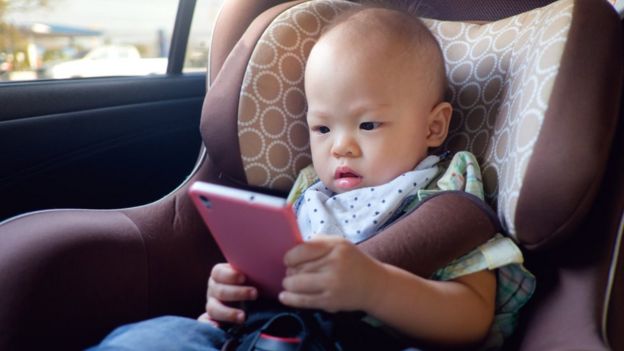
Even without solid proof of harm, Dr Sheri Madigan and colleagues say it still makes sense to moderate children's screen time and make sure it doesn't interfere with "face-to-face interactions or family time".
They also said that, with hindsight, perhaps they should have followed the children from an even younger age because it is becoming increasingly common for 12-month-old babies to be watching and using screens.
How much is too much?
It is a good question, without a satisfactory answer.
The new study does not make any recommendation about how much is too much. Some of the two-year-olds were getting more than four hours a day or 28 hours a week of screen use, according to their mums.
The American Association of Paediatrics' (AAP) guidelines on screen time say:
- For children younger than 18 months, avoid use of screen media other than video-chatting
- Parents of children 18 to 24 months of age who want to introduce digital media should choose high-quality programming, and watch it with their children to help them understand what they are seeing
- For children ages two to five years, limit screen use to one hour per day of high-quality programmes. Again, parents should be watching it with their children.
- For children ages six and older, place consistent limits, making sure screen time does not get in the way of sleep and physical activity.
The Canadian Paediatric Society goes further, saying screen time for children younger than two is not recommended.
Tips on cutting back
The AAP advises families to designate media-free times together, such as dinner or driving, as well as media-free locations at home, such as bedrooms.
The RCPCH says adults should consider their own use of screens and set a good example.
Most experts also advise that children are not exposed to screens for an hour before bed, so that their brains have time to wind down for sleep.
Dr Bernadka Dubicka, from the Royal College of Psychiatrists, said: "We still need more research to tell us which children are most vulnerable to the harms of screen use and the impact it may have on a child's mental health.
"We also need to look at the effects of different content as there are also many positive ways of using screens."
Latest Stories
-
Bohyen chief appeals for fire station
5 minutes -
Martin Kpebu says legal vacation could delay Wontumi’s bail application
14 minutes -
Duncan Amoah renews call for Ofori-Atta to account for stewardship
29 minutes -
Researchers urged to make academic work useful beyond journals
45 minutes -
Unemployed man gets six-month jail term for committing three offences
59 minutes -
Chaos mar NDC branch elections in Assin Central Constituency
4 hours -
Wontumi knew he would be convicted – Appiah-Kubi
4 hours -
GIMPA graduates tasks to master modern digital tools to be competitive
4 hours -
Oti High Court adjourns NPP Krachi East Organiser election dispute to October
4 hours -
Court issues bench warrant for man accused of threatening EOCO staff
4 hours -
Vice President Opoku-Agyemang engages Ghanaians in Maryland, United States
4 hours -
UG graduates urged to uphold integrity, excellence
4 hours -
Gabonese President to begin three-day official visit to Ghana on July 28
5 hours -
Accra-Tema residents advocate stricter enforcement of sanitation laws
5 hours -
Financing key to unlocking Africa’s energy potential – John Jinapor
5 hours