

Audio By Carbonatix
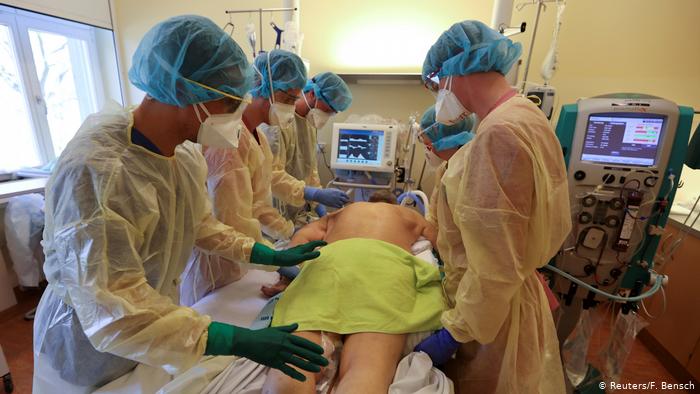
Germany's top intensive care expert has said hospitals need to make sure they have enough resources to treat an expected influx of Covid-19 patients.
German ICUs have added nearly 2,000 Covid-19 patients in four weeks.
As the number of Covid-19 cases continues to surge across Germany, hospitals are under pressure to prepare for treating severely ill patients.
Staff in many hospitals in Germany are currently "working at the limits of their capacity," Uwe Janssens, President of the Interdisciplinary Association for Intensive Care and Emergency Medicine (DIVI), told a press conference on Tuesday.
Speaking alongside German Health Minister Jens Spahn, Mr. Janssens urged hospitals in regions with high infection numbers to "end normal operations as soon as possible."
"Where it is medically justified, procedures must be halted and postponed," Janssens said, adding hospitals need to conserve resources.
Although Germany currently has enough beds and ventilators available nationwide, Janssens said a "key problem" would be the lack of medical personnel to treat patients needing treatment like anesthesia and ventilation.
More coronavirus patients in intensive care
According to the latest numbers from DIVI's register of intensive care beds in Germany, there are currently around 7,230 free intensive care beds across Germany out of a total of more than 28,700.
On November 3, there were 2,388 Covid-19 patients receiving intensive care treatment in Germany, with that number currently rising every day, and adding nearly 2,000 patients since October 3. More than half of those cases are receiving invasive ventilation, according to DAVI.
A nationwide partial lockdown began Monday in Germany. On Tuesday, Germany added over 15,350 Covid-19 cases, according to the Robert Koch Institute.
Regional differences
Spahn, who recently recovered from a Covid-19 infection, said the situation in Germany was "serious," albeit with large regional differences.
The percentage of Covid-19 patients occupying intensive care beds ranges from 18% in Berlin to less than 3% in Saxony-Anhalt and Schleswig-Holstein, according to DAVI.
During the first wave of coronavirus in the spring, the German government ordered hospitals to delay non-emergency procedures and operations. Such a blanket order has not yet been reissued, and Spahn said Tuesday that a decision requiring hospitals to redirect resources rests with the leaders of Germany's 16 federal states.
Spahn added that he agreed with Janssens that it was "very important" to delay operations when medically possible, adding that Berlin would provide hospitals with support to deal with the crisis.
"No clinic should be economically disadvantaged because of the coronavirus," he said.
Latest Stories
-
At least 22 dead after two boats collide on Congo river, official says
1 hour -
Heavy rains lead to Senegal floods, government reports several deaths
1 hour -
FTBLRLIFE targets Ghana in expansion of global grassroots football network
3 hours -
Former ‘American Idol’ contestant sentenced to life without parole for wife’s murder
4 hours -
Education Ministry commends Ghanaian teachers on World Teachers’ Day 2026
4 hours -
NPP can reconcile with aggrieved members who want to return – Nana Akomea
5 hours -
Tamale Child Deaths: Vehicle owner arrested as IGP deploys homicide team
5 hours -
From ShattaFest to MoMo Fest: Entertainment takes centre stage in youth engagement
5 hours -
Nigerian military aircraft crashes, killing 32
5 hours -
MTN encourages Ghanaians to use MoMo for saving, investing and financial planning
5 hours -
Absa Bank Ghana names Stephen Ato Frimpong as Board Chair
5 hours -
Pickford ‘almost caused crash’ with careless driving
5 hours -
Author and former politician Jeffrey Archer dies aged 86
5 hours -
No education reform can succeed without teachers – Education Ministry
5 hours -
Gauff condemns racist abuse after China Open win
6 hours