

Audio By Carbonatix
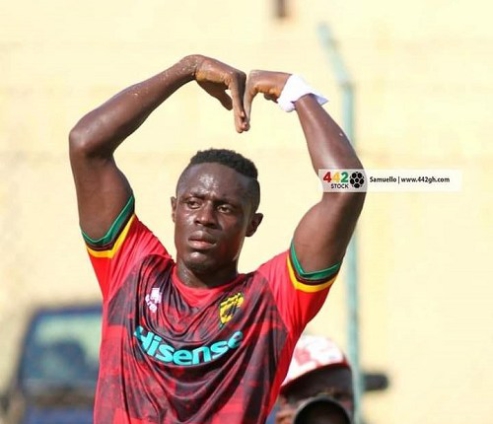
A year ago, Kwame Opoku was anxiously waiting to make his Asante Kotoko debut after signing for the Porcupine Warriors from second-tier side Nkoronza Warriors.
Kotoko acquired the striker's services in a move to strengthen their team for the second round of the 2019/20 season. Opoku caught the attention of Kotoko and other top-flight clubs after he registered an impressive 10 goals in the NC special competition.
But the unexpected - Covid-19 - happened and that led to the suspension and later cancellation of the season due to a ban on football.
The ban was lifted in September, however, competitive football returned in November. Thus, Kwame Opoku waited for nine months to play his first competitive match for Kotoko.
On his competitive debut, Opoku scored against Eleven Wonders in the Ghana Premier League. He has never looked back since then, with his tally now eight goals after 19 games across all competitions.
It is no surprise, Opoku is close to sealing a three-year deal with Algerian side USM Alger.
In recent years, footballers who have excelled in the local league have secured lucrative contracts abroad and Opoku will join the long list when the transfer is complete.
Joy Sports understands Kotoko will earn €300,000 (approximately 2 million Ghana cedis) from the transfer.
Meanwhile, the player will earn a monthly salary of €10,000 (approximately 65,000 Ghana cedis), potentially 20 times more than what he earns at Kotoko.
It is believed he will also get extra incentives including a personal car.
The deal is expected to be finalised this week.
How can local clubs compete?
It is reported that Daniel Lomotey, who left WAFA to Sétif in February after scoring eight goals this season, is on a monthly salary of $8,000.
With Opoku also on €10,000 a month, the question arises: how can Ghana Premier League clubs ever hope to keep their best stars long enough to create a bond with fans?
Even more damaging to the credibility of the local league is that Asante Kotoko and Hearts of Oak, the two biggest teams, have been reduced to feeder clubs. With all their tradition and pedigree, they cannot pay their players well enough to stave off interest from ordinary clubs right here on the African continent.
The question, then, about whether the local league can create megastars any time soon becomes moot.
Because the simple answer is no.
Latest Stories
-
US seeks changes to rejected $109m health compact with Ghana – Mahama
3 minutes -
Nine dead in mass shooting at Pennsylvania home
21 minutes -
‘Time for Ukraine to get new president,’ says Trump after Zelensky condemns diesel deal
24 minutes -
Hincapie injury adds to Arsenal issues after Guimaraes rescue act
32 minutes -
Henderson scores twice as Chelsea thumb Bournemouth
42 minutes -
Photos: Mentapulse Africa convenes health and labour summit to address talent retention
54 minutes -
Mahama inspects Nkokɔ Nketenkete plant, eyes Bechem as chicken capital
1 hour -
Ghana not seeking full BRICS membership, applying as Partner Country – Ablakwa
1 hour -
Woman injures three people in third Poland school knife attack in a week
1 hour -
Ghana should join BRICS as partner, not member – NPP Bono East Regional Secretary
1 hour -
Ghana High Commission warns nationals in South Africa over protests in Johannesburg, Durban
1 hour -
Mahama praises Roads Minister for keeping Big Push contractors on their toes
1 hour -
World Cup Visa Scandal: ‘My client has not collected money for visas’ – Ampofo Ankrah’s lawyer
1 hour -
US immigration officials defend ICE agents who shot man in same car as child
2 hours -
Commentator Katie Zacharia picked as new White House press secretary
2 hours