

Audio By Carbonatix
The $10bn James Webb telescope has left Earth on its mission to image the first stars to light up the Universe.
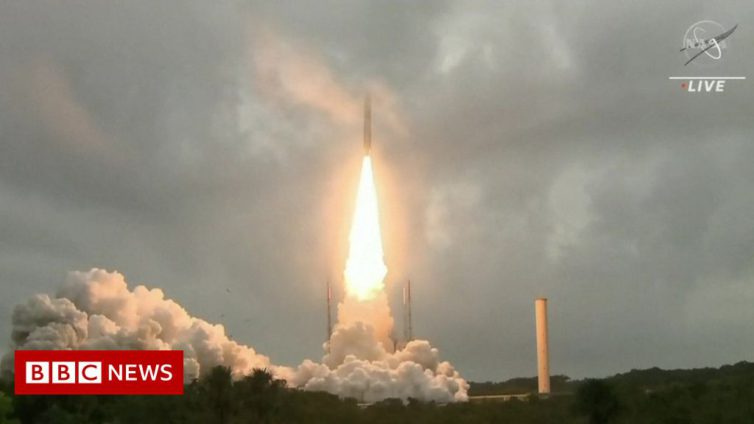
The observatory was lifted skyward by an Ariane rocket from the Kourou spaceport in French Guiana.
Its flight to orbit was expected to last just under half an hour, with a signal confirming a successful outcome due to be picked up in Kenya.
Webb, named after one of the architects of the Apollo Moon landings, is the successor to the Hubble telescope.
Engineers working with the US, European and Canadian space agencies have built the new observatory to be 100 times more powerful, however.
Lift-off was eagerly awaited but accompanied also by a good deal of anxiety. Thousands of people worldwide have worked on the project over the past 30 years, and even though the Ariane is a very dependable vehicle - there are no guarantees when it comes to rockets.
"Webb is an extraordinary mission," US space agency administrator Bill Nelson said before lift-off.
"It's a shining example of what we can accomplish when we dream big. We've always known that this project would be a risky endeavour. But, of course, when you want a big reward, you have to usually take a big risk."
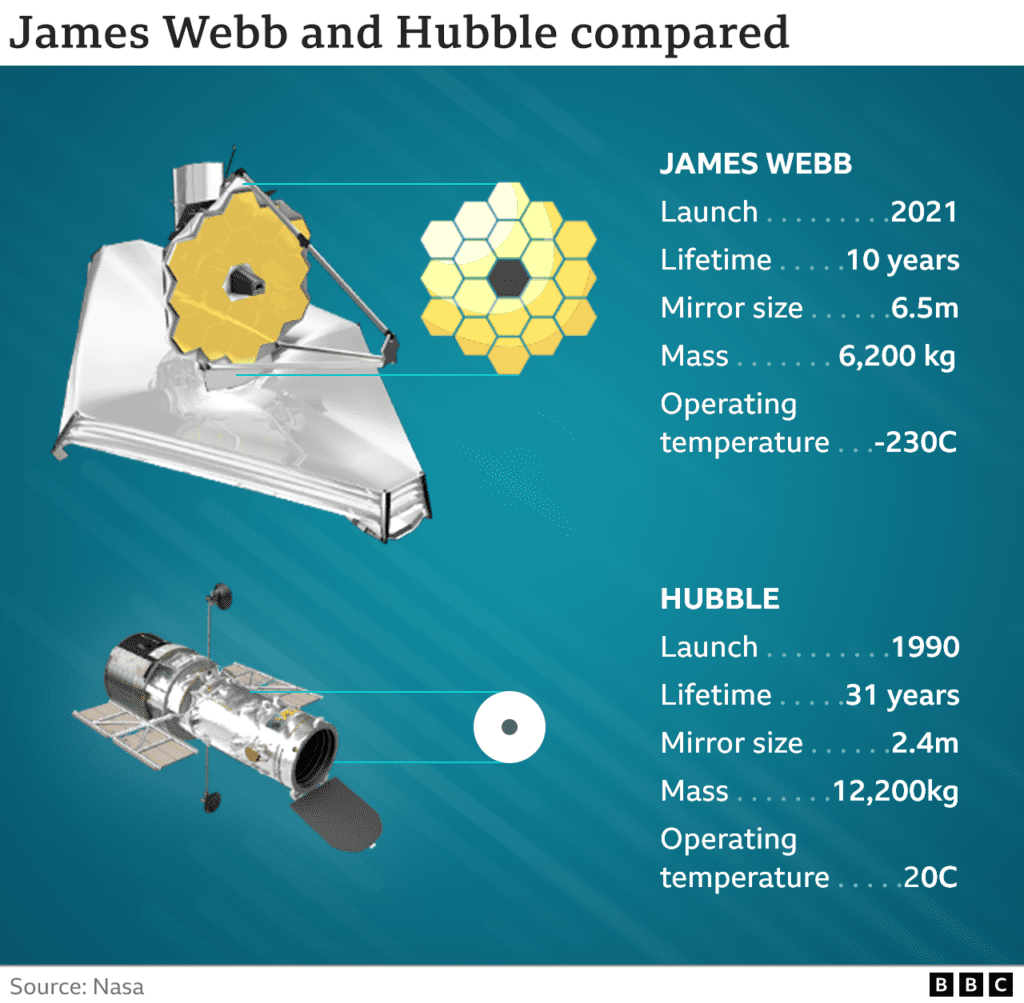
At the core of the new facility's capabilities is its 6.5m-wide golden mirror. This is almost three times wider than the primary reflector on Hubble.
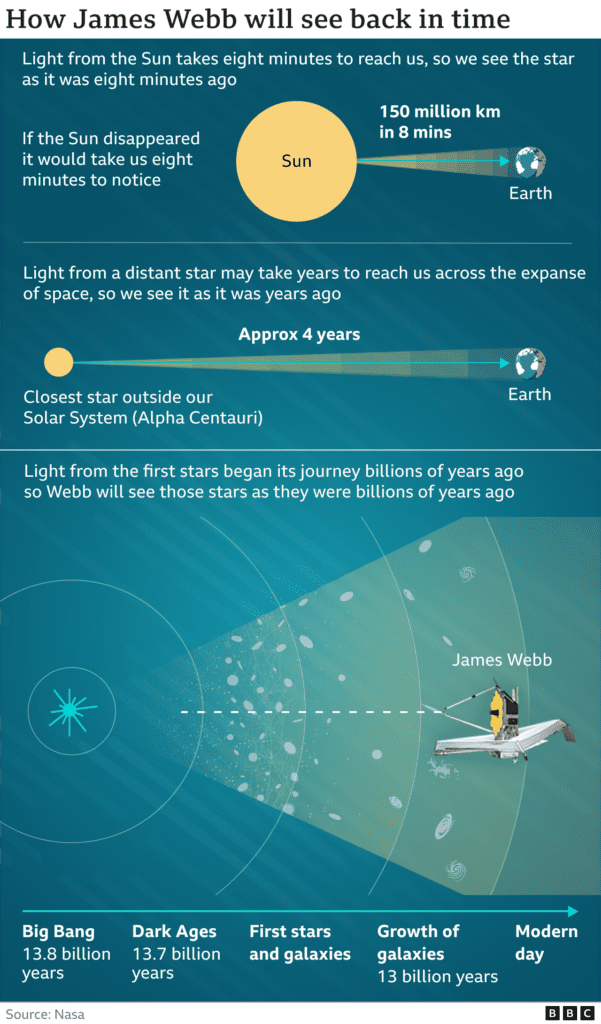
The enlarged optics, combined with four super-sensitive instruments, should enable astronomers to look deeper into space - and thus further back in time - than ever before.
A key target will be the epoch of the pioneer stars that ended the darkness theorised to have gripped the cosmos shortly after the Big Bang more than 13.5 billion years ago.
It was the nuclear reactions in these objects that would have forged the very first heavy atoms essential for life - carbon, nitrogen, oxygen, phosphorus, and sulphur.
Another overarching goal for Webb will be to probe the atmospheres of distant planets. This will help researchers gauge whether these worlds are in any way habitable.
"We're going to be entering a whole new regime of astrophysics, a new frontier; and that is what gets so many of us excited about the James Webb Space Telescope," said Heidi Hammel, a planetary astronomer and an interdisciplinary scientist on the mission.
Webb's launch is only the start of what will be a complex series of initial activities over the next six months.
The telescope is being put on a path to an observing station some 1.5 million km beyond the Earth.
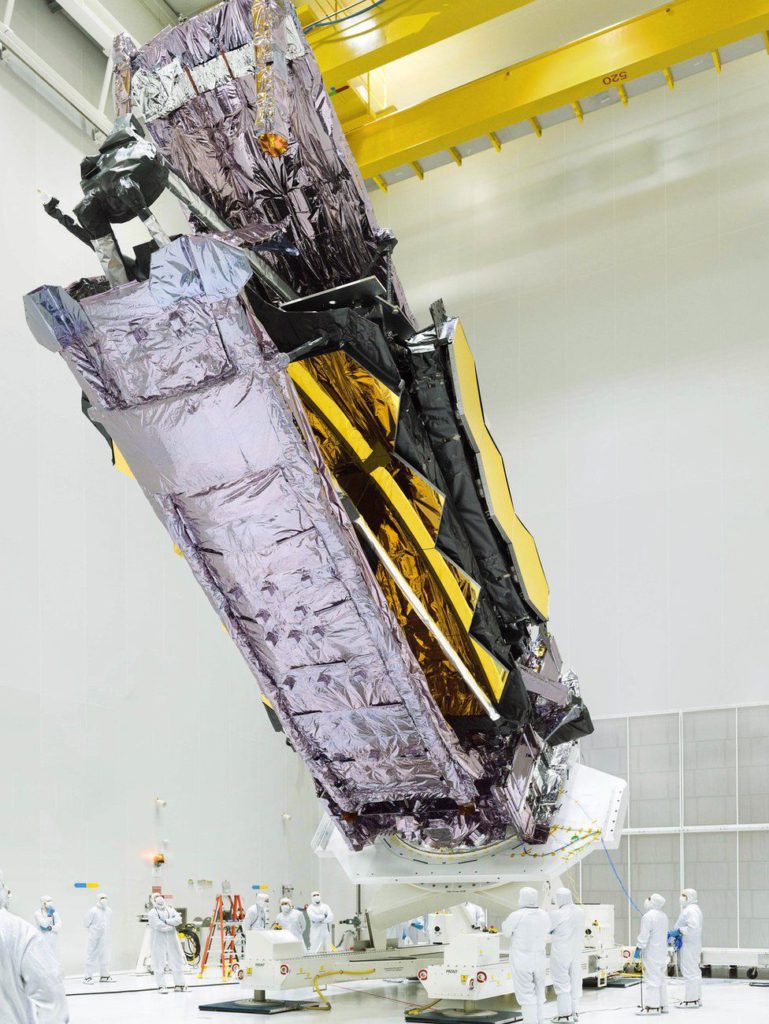
In the course of travelling to this location, Webb will have to unpack itself from the folded configuration it adopted at launch.
"And then the critical thing is that it all has to get very cold," explained Mark Mark McCaughrean, a senior science adviser with the European Space Agency.
"This telescope actually will be at minus 233 degrees Celsius. Only then will it stop glowing at the infrared wavelengths beyond the visible where we want this telescope to work. And only then will it be able to take sensitive pictures of the distant Universe where the first galaxies were born, and of planets going around other stars. So there's a long way to go."
Latest Stories
-
African banks’ foreign subsidiary contributions increasing; Access Bank records fastest cross-border growth
29 seconds -
Fiscal economy to remain firm despite execution risks – Databank Research
10 minutes -
Bond market: Turnover nearly doubled by 94.65% to GH¢4.13bn
32 minutes -
Valencia sack Corberan and chief executive
3 hours -
Ronaldo demands lifetime bans over Jota chants
3 hours -
Arsenal to contact Pro Ref over Konsa penalty
4 hours -
No weekend game for Manchester derby VAR officials
4 hours -
AI ‘kill switch’ may need to be mandatory, Anthropic co-founder says
4 hours -
‘Culture shift’ needed in how UK does business, PM urges
4 hours -
SHS placement crisis? GES says 95% of students are already placed
4 hours -
ITF World Tennis Tour Juniors: J60 stage begins in Accra
4 hours -
Absa Bank named winner of Bancassurance Leadership Award at 2026 Ghana Insurance Awards
5 hours -
Mr. Aloysius Kwesi Acquah Snr aka Kwesi Anfo
5 hours -
NACOC’s cocaine suspects arrest commendable, but it cannot run on ‘charity’ to fight drug cartels
5 hours -
Gov’t cannot deny what it has already set in motion – Former NaCCA boss challenges Mahama on Arabic, Chinese policy
5 hours