

Audio By Carbonatix
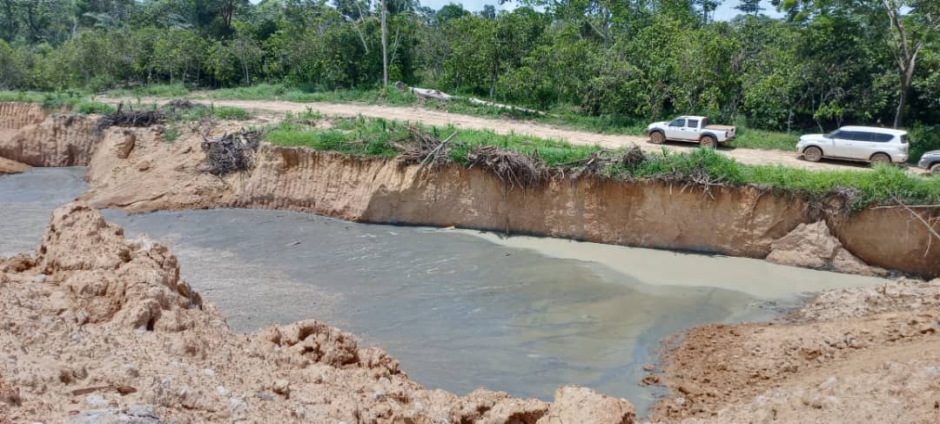
Activities of illegal small-scale miners have made the Aboabo stream found in the Asutifi district of the Bono Ahafo region dangerous to the health of residents.
That is one of the findings from a study by the materials engineering department of the Kwame Nkrumah University of Science and Technology.
The study which assessed the impacts of illegal small-scale mining activities on the water quality was published in the journal of Earth Sciences Malaysia.
Samples of the stream water, sediments and plants around the stream were collected from three points which were the upstream, mid-stream and downstream for analyses.
Apart from the high cloudiness of the river, the scientists found contaminations with harmful bacteria like E-coli and heavy metals like Mercury.
“Faecal coliforms and E-coli readings exceed the permissible limit of 5 NTU and 0 MPN/100ml respectively as required by Ghana’s Environmental Protection Agency and World Health Organisation (WHO).
“Total suspended solids readings at the midstream were higher than the permissible limit. However, levels of total dissolved solutes and dissolved oxygen recorded, were below the limit.
“The sediments were also heavily polluted with Mercury, Arsenic and Cadmium,” lead scientist, Ebenezer Asante Boafo Brobbey, said.
There was, however, a ray of hope as the scientist found plants like the Christmas bush scientifically known as Alchornea cordifolia could salvage mercury from the river.
“Alchornea cordifolia, Chromolaena odorata and Spigella anthelmia growing within the stream were taken to assess their efficiency in removing the heavy metals from the stream. It was observed that the plants species had bioaccumulation factor (BF) greater than 1 for cadmium.
“Alchornea cordifolia was the only plant with BF greater than 1 for mercury. The plants species are potential hyper accumulators for mercury and cadmium hence are suitable for phytoremediation,” he said.
The scientists are advising the residents to desist from using these untreated streams as a source of drinking water to prevent any future bacterial epidemics.
They again advice that effluents from the illegal mining activities be diverted from entering the stream.
Waste rock dumps should be sited far away from the stream to avoid contamination by run-off water from the waste rocks.
Latest Stories
-
GNFS contains fire outbreak at Teshie Lekma Road near Lekma Hospital
5 hours -
Samia Nkrumah rejects the narrative that Ghanaians were happy after Nkrumah’s overthrow
6 hours -
A Mother’s pain: Tribute by Ivan Baidoo’s mother
6 hours -
‘Forgive us for staying away’ — Samia Nkrumah leads family back to Nkroful, pledges to preserve Nkrumah’s legacy
6 hours -
Ernest Nuamah scores twice as Lyon beat Rennes
6 hours -
‘My dear Ivan’ – A father’s tribute to a son tragically killed
6 hours -
GNPC Explorco advances Voltaian Basin drilling preparations with 13.5km access road
7 hours -
Cabinet approves facility manager for Borteyman Sports Complex – Kofi Adams
7 hours -
Sanitation is improving; critics may be ‘living in another world’ – Salaga South MP replies Bekwai MP
7 hours -
Government must do more to tackle sanitation crisis – Bekwai MP
8 hours -
World Cleanup Day: GFF begins sanitation education in local communities
8 hours -
EU Ambassador, IGP discuss stronger cooperation on policing and security
8 hours -
Africa Nations Volleyball Championship: Ghana set up quarterfinal clash with Cameroon after beating Chad
8 hours -
Meet Dr Benjamin Appiah Osei — Ghana’s three-time tourism awards winner
9 hours -
UEFA & CONCACAF demand Fifa pays $10m to all 211 members
9 hours