

Audio By Carbonatix
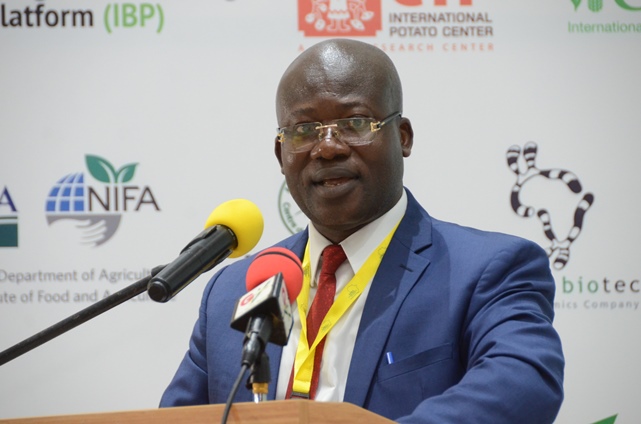
Ghana needs a comprehensive science policy that puts science on the top of the agricultural transformation agenda, Prof. Eric Danquah of the University of Ghana has said.
He said, “a food secure and healthy Ghana, ‘a Ghana Beyond Aid,’ can never be attained without huge investments in science, technology, and innovation (STI).”
Prof. Danquah who is also founding director of the West Africa Center for Crop Improvement (WACCI) told a science communication workshop in Accra; “if we fail to prioritise investments in STI in the agricultural development space, we shall continue to battle with the challenges of food and nutrition security.”
He questioned why government has not fully set up a fund to support science and technology research in the country.
“How long shall it take our government to operationalize the National Research Fund Act, 2019 which was passed in Parliament and has received Presidential assent?” he quizzed.
Prof. Danquah observed Ghana has some excellent agricultural research institutions including WACCI which he founded about 15 years ago, that deserve more support.
“Today, WACCI is one of the finest institutions in the world for training plant breeders at the PhD level. Our past, present and plans for the future provide compelling evidence that Ghana needs more agricultural Centres of Excellence….We need political will from our leaders and investments in first-class Centres of Excellence,” he added.
Prof. Danquah was speaking at a science communication workshop in Accra organised by Alliance for Science, WACCI, International Institute for Tropical Agriculture (IITA), and the Open Forum on Agricultural Biotechnology (OFAB).
He was speaking on the theme “communication as a tool for science-based evidence in decision making - a case for GMOs.”
The 4-day workshop themed, Speaking Science Ghana, brought together senior and junior scientists with academic institutions and research organisations across the country for training on best practices in science communication.
He said the use of science for sustainable agriculture has been an important subject to him because scientific knowledge allows us to develop new technologies, solve practical problems, and make informed decisions.
“We are still far from putting innovation in the hands of farmers. We know that even before the Covid-19 pandemic and the Russian-Ukraine war, Africa was not on track to meet Sustainable Development Goal 2 (on zero hunger),” he said.
“I dare say that our efforts today and tomorrow will come to nought if there was no political will for prioritizing the use of STI in our agri-food systems prioritization agenda,” he noted.
Prof. Danquah observed Ghana's population is currently 32.37 million as of 2022. By 2030, there would be an additional over five million mouths to feed, and by 2063, when Africa is predicted to become the rich continent we desire, our population will be over 61 million.
“This is alarming because crop yields are declining in farmers' fields as a result of climate change—rains are falling at inconvenient times, floods occur unexpectedly, diseases and pests have become more destructive, and heat worsens issues in farmers' fields,” he noted.
“Additionally, the soils are deteriorating. Reduced yields will require that we spend more foreign exchange (more than the current over $2.5 billion spent annually) to import additional food for people and animals. This is not efficient and effective, and not sustainable for several reasons.
“The Covid-19 pandemic has taught us that self-sufficiency in food production should be a national imperative if we are desirous about ending hunger, achieving food security and improved nutrition and sustainable agriculture in our lifetime.
"There is an urgent need for more food to be produced on less land with fewer chemicals. We must, therefore, use new thinking in our development agenda else we risk worsening the plight of a significant number of Ghanaians who go to bed hungry, who are malnourished and stunted,” he added.
Latest Stories
-
Stonebwoy makes history at OVO Arena Wembley with monumental BHIM Festival
16 minutes -
Qatar denies capturing three Iranian pilots after downing fighter jets
28 minutes -
Tano North chiefs petition Mahama over galamsey destruction in River Tano
52 minutes -
Kalpohin SHS, NOBISCO qualify to represent Northern Region at National Public Speaking Competition
59 minutes -
Missing records of illegal gold purchases in Ghana raise concern – Duncan-Williams
1 hour -
Duncan-Williams warns of powerful interests targeting GoldBod
2 hours -
We need to pray for GoldBod – Duncan-Williams
2 hours -
Strong favourites or tougher task – will Arsenal defend their title?
3 hours -
Passengers escape death as VIP travelling from Kumasi to Sunyani catches fire
3 hours -
Ariana Grande leaves problems at home as her tour hits the UK
3 hours -
Multiple suspects at large after five shot at Virginia State University, police say
3 hours -
Three killed as Russia launches fresh aerial attacks across Ukraine
3 hours -
Boxing: John Laryea disqualified in WBA Featherweight title eliminator
3 hours -
Hawaii battles strong winds and rain as Hurricane Lala threat looms
4 hours -
Twelve killed as Polish bus veers off Hungarian motorway
5 hours