

Audio By Carbonatix
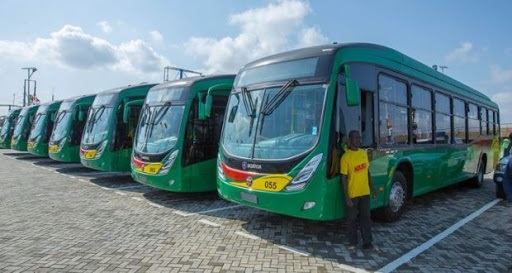
A video in circulation on social media shows that a number of buses operated under the Bus Rapid Transit (BRT) has been grounded.
The video has raised concerns over why such huge investment by the state could be allowed to go waste.
Here are 10 facts on the operations of the BRT.
1. The Bus Rapid Transit (BRT) transportation system was to be implemented under the Urban Transport Project (UTP) to deliver fast and affordable transportation for commuters in Accra and Kumasi. When you read the June 2012 World Bank mission agreement with the government on an action plan to right track the implementation, the project was to start in the Greater Accra (Ga East, Accra, Ga West, Tema) and Ashanti region (Ejisu-Juaben Kumasi).
2. The UTP was jointly funded by the World Bank, Agence Francaise de Development (AFD), the Government of Ghana, and the Global Environment Facility Trust Fund at the cost of $95 million.
3. The 16th July 2014 report of the Parliament’s Committee on Roads and Transport puts the procurement sum of the agreement between the Government of Ghana and Sweden’s SCANIA CV AB at $110,733,461,00. SCANIA CV Aktiebolg of Sweden was to supply 295 buses built at their plant in South America, Brazil.
4. The government took delivery of 245 buses in 2016. Scania brought Marco Polo Low Entry City buses which cost Ghana $251,600 per bus, making the total cost of the buses $61,642,000. This cost did not include VAT, NHIL and customs duties at the port. Per the contract agreement, the supplier of the buses Scania CV Aktiebolg of Sweden was also to supply spare parts, and training of local staff and technicians.
5. Together with the cost of developing the infrastructure, and the dedicated lanes in the earmarked areas in Greater Accra and Ashanti region, the project cost the country about $151 million. Out of this, only $ 7 million is a grant from the Global Environmental Fund. The rest are loans from the International Development Association, Agence Francaise de Development (AFD) and the World Bank.
6. The Project Appraisal Document of the World Bank and the Credit Agreement covering the UTP suggest that the BRT should have been completed by December 2012. Then President, John Mahama promised the BRT was going to be ready by September 2012 when he cut the sod for the commencement of works for the BRT on the Graphic Road on the 2nd of February, 2011.
7. The promises moved from December 2012, March 2013, September 2013, June 2014, June 2015 and September 2015. All these deadlines were not honoured. All this while, as of December 3, 2012, the World Bank had made available $45m for this project.
8. In 2012, the project shifted focus from the Kasoa-CBD corridor to the Amasaman corridor. It was believed that since the Kufuor Government had invested in and opened up the Achimota-Ofankor road network it was going to be possible and relatively easy to insert a functional BRT system with very minimal investments. That did not work too.
9. Some months ago, Joy News wrote to the World Bank for a comment on this project and the Bretton Woods institution said “In a post-completion assessment of the project, the Bank rated the implementation performance unsatisfactory. The procurement of buses by the government represented a deviation from the original plan of establishing a limited competitive regime for public transport operations along major routes. The project envisaged that the private sector operators would be responsible for providing the specified quality of buses for operations along designated routes, based on a route license issued by the regulator. Government intervention in purchasing buses meant that the element of private sector initiative and investment in passenger transport in the bid to improve mobility is lost.”
10. Per the parliament record, the useful economic life of the SCANIA buses was noted to be 10 years. This means we have barely 3 years to generate productivity from these 245 buses. They are now essentially nearing a liability stage that can offer the country no viability to generate returns to defray the cost of the loans accrued.
Latest Stories
-
Brighton humbling ‘a big lesson’ for Arsenal – Arteta
4 minutes -
Arsenal handed first loss by brilliant Brighton
11 minutes -
Video: Akwatia MP clashes with Kofi Bentil over 3.9-tonne cocaine seizure
13 minutes -
Ratcliffe ‘must go’ says Man Utd Muslim fan group
17 minutes -
Ignite Social Enterprise targets global market for Ghanaian shea butter
32 minutes -
Eviction notice leaves retired, serving railway workers in Kumasi in limbo
59 minutes -
Asiedu Nketia: Why I remain an unrepentant Nkrumahist
1 hour -
Kudus, Djiku return a boost to Black Stars – Agyemang-Badu
2 hours -
‘If the world, Africa honoured Nkrumah as the Millennium Man, why are we not doing same?’ – Asiedu Nketia
2 hours -
Yaw Preko backs renewed push to revive Colts football
2 hours -
UMB Speed Stars defeat Black Stars Legends 6-2 in friendly
2 hours -
Dafeamekpor hails Kwasi Pratt Jnr as ‘scholar of formidable proportions’
2 hours -
The BECE exam and placement conundrum: Necessary evil or failing system?
2 hours -
‘Who did this to you and what was your crime?’ – Father grives over late Ivan Baidoo
2 hours -
Israeli strikes kill three people in Gaza, medics say
2 hours