

Audio By Carbonatix
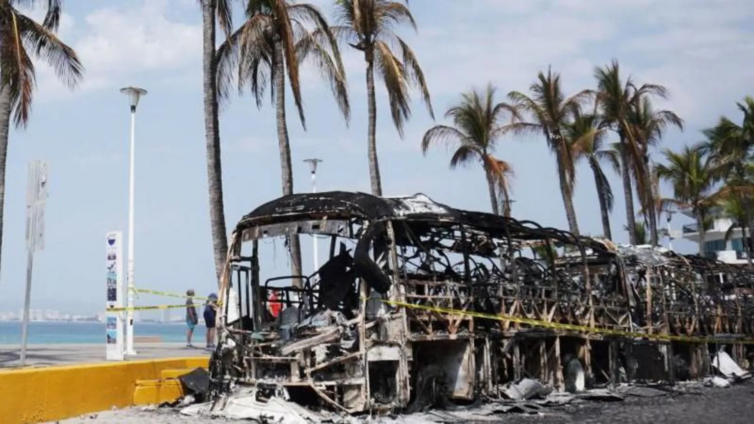
Driving into Mexico's western city of Guadalajara, the evidence of Sunday's terrifying cartel rampage is still visible.
The charred debris of burnt cars sits on roadsides, and there are scorched patches of asphalt on the highways after the Jalisco New Generation Cartel (CJNG) - one of the most powerful and feared cartels in the country - set scores of vehicles alight in response to the killing of their boss, Nemesio "El Mencho" Oseguera.
This and the sight of ransacked or burning convenience stores projected exactly the message the CJNG wanted: that with or without their chief, they remain powerful, with the ability to unleash havoc and chaos on the streets - sowing fear and intimidation on a mass scale.
Mexico's President Claudia Sheinbaum has been trying to counter this narrative. In her daily press conference on Monday, she spoke of "peace and tranquillity" returning to much of the nation and praised the security forces' response.
Meanwhile, convoys of troops and police officers circulate around Guadalajara. They are meant to bring reassurance but, for many residents, add to the sense of unease.
Despite their presence, the streets are emptier than usual - a sign that people fear more violence, both in Guadalajara and in the wider Jalisco state. Most small businesses were shuttered, and schools were closed as workers stayed at home, lying low with their families.
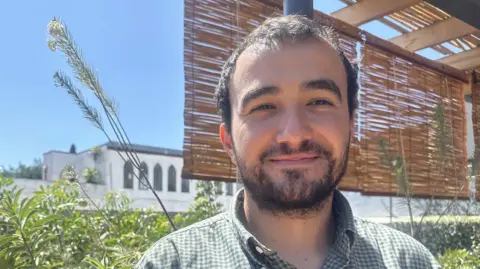
The owner of the Severo café, Anwar Montoya, was not among them.
"I had to open today. We're a new business, and I have a lot of things to pay for," he tells the BBC, laughing.
Speaking about the recent violence, he says: "It was a strange and difficult day – everybody was scared. And now some are afraid about what might still happen."
Montoya felt that opening his café would be welcome, in order to provide "a secure area for a lot of friends".
His customers appeared to appreciate the decision, with most tables full of young people, laptops out or quietly chatting in the shade of the roof terrace.
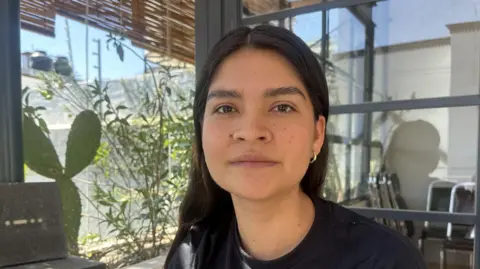
Among his customers was left-wing parliamentary deputy Mariana Casillas. She sees many things wrong with what has happened in Jalisco – both in the cartel's violence and the government's response.
"This is not a new scenario," she says of Mexico's ongoing drug war. "Only on this occasion, because it involved the killing of a top capo [high-ranking member of a crime syndicate], the violence exploded in a much more potent fashion than normal."
Organised crime, roadblocks set up by cartels, the burning of buses and the kidnapping of ordinary citizens are things her community has endured for two decades, she says, since the state's conflict with the cartels was launched during the presidency of Felipe Calderón in 2006.
"As a local representative, it's my duty to ask why this model or this script has continued to be repeated for more than twenty years," Casillas adds.
It is a model in which life in Mexico is considered disposable by the drug cartels, she argues, and in which the government remains focused on taking out high-profile cartel leaders rather than tackling the environment of violence and poverty that underpins the gangs – and contributes to young people joining their ranks.
With more than 60 funerals being organised – for both CJNG foot-soldiers and National Guard troops – it is an argument which will resonate with many people venturing out in Jalisco for the first time since Sunday's violence.
Many fear that the strategy of taking down top leaders will only beget more fighting.
"The execution of the kingpin strategy in Mexico over the last two decades – the extraction or the killing of major leaders like El Mencho – has always resulted in the same thing: more violence," says drug war expert Deborah Bonello, who is the managing editor of the Insight Crime think tank.
She continued: "When you take out a major leader, there's a detonation of a struggle to take control in that vacuum. So, you'll see these squabbles for power in different parts of the country."
One of those parts could well be Guadalajara, which is due to host thousands of international football fans for the Fifa World Cup in June. One of the exciting prospects on the pitch is the line up between Spain and Uruguay at the city's main stadium.
But fans would be forgiven for thinking twice about attending the game following this week's shocking scenes.
Anwar Montoya emits a short whistle of disbelief when I mention the competition.
"I've never been to a World Cup, so I don't know how they work in other countries. But I don't think this is a safe place for the World Cup," he says.
Mariana Casillas agrees, telling the BBC there are several "very painful crises" unfolding in Jalisco. These include what she describes as the "crisis of violence, which we just saw in its maximum expression", as well as the "crisis of the disappeared".
Tens of thousands of people have been reported as missing in Mexico - almost all since 2007, when Calderón launched his "war on drugs".
In many cases, those disappeared have been forcibly recruited into the drug cartels – or murdered for resisting.
The Mexican government insists Guadalajara is ready and able to host tens of thousands of visitors from around the world in a colourful celebration of sporting excellence.
But Casillas is adamant: "The people here don't want the World Cup. They want security, they want clean water and they want their disappeared relatives back."
Latest Stories
-
Stronger GTA-private sector partnership needed to grow tourism – GHATOF
3 minutes -
Amazon eyes Ghana for broadband expansion after talks with Mahama
47 minutes -
National Investment Quiz 2026: Six schools qualify for quarter-finals
1 hour -
‘Do not let Russia pay for its madness with lives of your people’ – Zelensky to Ghana, 46 other countries
1 hour -
6,079 promotion cases fully processed and paid – CAGD says amid nationwide teachers’ strike
2 hours -
Teacher unions to meet government Monday over nationwide strike
2 hours -
Photo story: Republic Bank-JoyNews Habitat Fair clinic wraps up after three days of housing solutions, expert engagement
2 hours -
National Peace Council urges investment in youth to sustain Ghana’s peace
2 hours -
Afenyo-Markin urges youth to speak up against injustice
3 hours -
CAF annuls Edo Queens victory, orders WAFU B final to resume from extra time
3 hours -
Interior Minister urges traditional authorities to enforce anti-bushfire bye-laws
3 hours -
3rd Republic Bank-JoyNews Habitat Fair Clinic ends on a high note after three days of strong patronage
3 hours -
Ten climbers missing after avalanche hits Himalayan base camp
4 hours -
NPP had more permanent fuel relief measures than current GH¢2 diesel cut – Amin Adam
4 hours -
Photos from the 3rd Republic Bank-JoyNews Habitat Fair Clinic
4 hours