

Audio By Carbonatix
An off-the-cuff remark by Nigeria's new president during his inaugural speech caused chaos with snaking queues across the country at petrol stations.
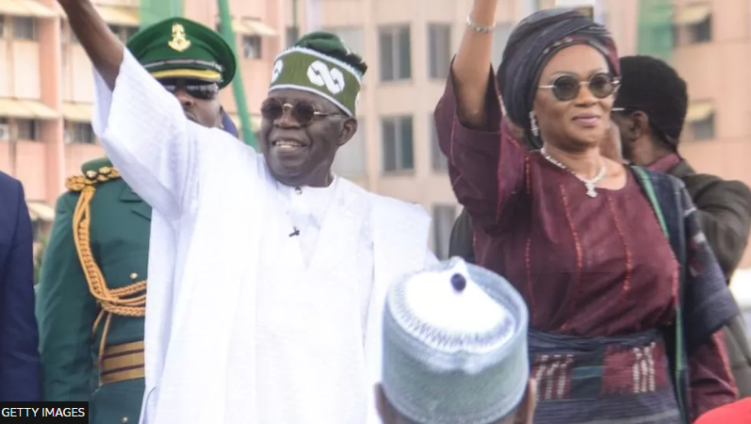
After he had been sworn in on Monday, Bola Tinubu took his eyes off the teleprompter during his address to say: "The fuel subsidy is gone."
He was referring to a decades-long subsidy that has kept down the price of petroleum products.
The 71-year-old politician gave no timeframe or any more details about what is a major policy move. When a president last tried to remove the subsidy 11 years ago, protests erupted.
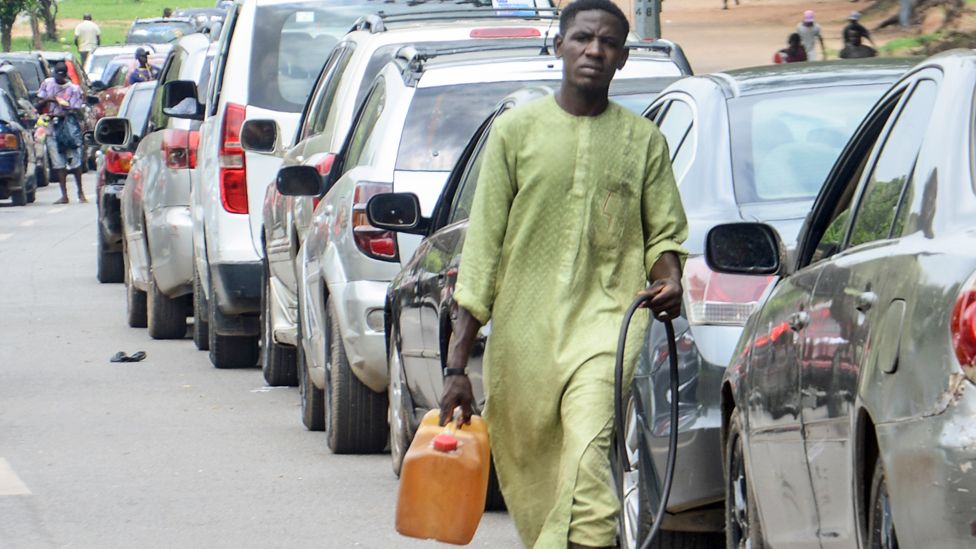
Within hours of Mr Tinubu's first address, hundreds of people had poured on to the streets, either in their cars or on foot with yellow jerrycans, to grab what they believed to be the last drops of fuel to be sold at a government-fixed price.
But only a few were lucky - many filling stations stopped selling altogether, while others unilaterally increased prices by more than 200%, triggering chaos and an artificial scarcity.
By the time the president's team clarified that the scrapping of the subsidy would not come into effect until the end of June - in line with the outgoing administration's budget - it was too late to stop the panic.
By Wednesday, even the state-owned oil company had said it would be raising the price of petrol.
Transport fares have already shot up, commuters are stranded at bus stops and the powerful labour union is now readying itself for a confrontation with the new government.
"By his insensitive decision, President Tinubu on his inauguration day brought tears and sorrow to millions of Nigerians instead of hope," Nigeria Labour Congress (NLC) leader Joe Ajaero said in a statement.
Despite its oil riches, Nigeria is unable to refine crude locally to meet demands.
The four state-owned refineries are moribund, forcing the country to import refined petroleum products which are then sold at a price fixed by the government.
So while people in the UK and Ghana, for example, were forking out £1.44 ($1.80) or 14 cedis ($1.24) respectively for a litre of petrol in May, Nigerians paid 185 naira ($0.40) - despite all three countries buying it from the same international market.
This has been the practice in Nigeria since the 1970s and most residents have grown up insulated from paying the actual price of petrol.
But Mr Tinubu says Nigeria can no longer do this because of dwindling revenue: the government has already set aside $7bn to subsidise fuel for the first six months of this year.
This amounts to 15% of the budget, more than the combined allocations for education (8.2%) and health (5.3%).
Subsidies are not necessarily bad. Many countries offer them in sectors ranging from agriculture to electricity in order to keep costs down for citizens.
But of major concern to Nigerians is corruption. Government agencies give conflicting figures for the amount of fuel imported, while dubious sellers have been known to divert the fuel to nearby countries to get higher rates.
Ironically, President Tinubu was at the head of the resistance in 2012 when a government last tried to end the subsidy.
He wrote then that the government had "tossed the people into the depths of the midnight sea", in a blistering attack on the policy, which was subsequently reversed.
Yet there is more of an acceptance now that the subsidy should be scrapped to free up money for essential public services like transport, health and education.
Analysts expect fuel to sell from anywhere between 250 naira and 350 naira after the current upheavals.
The increase may not seem huge, but it is likely to have far-reaching repercussions in a country where one in three people are unemployed, inflation is at a record 22% and 96 million live below the poverty line of $1.90 per day.
The situation is made worse by the fact that economy is run on thousands of fuel-sucking generators that power businesses, from barbershops to corporate skyscrapers, because of a lack of electricity.
Nigerians are already spending more than 60% of their income on food and transport. With the minimum wage stuck at $64 a month, many are fearing that they will be further impoverished.
"It is not sustainable," muttered one man at a petrol station in the capital, Abuja, after filling the tank of his SUV.
Mr Tinubu's announcement was not preceded by the usual talks with the unions to find common-ground.
In late 2021 when the last government toyed with the idea, it proposed a monthly cash advance of 5,000 naira to poor Nigerians to cover transport fares.
Many struggling Nigerians, used to seeing politicians mismanage the country's oil wealth, fear they may already be victims of a profiteering racket.
They are questioning why the pump price has already increased at both private and state-owned filling stations for what is likely to be older and cheaper stock.
They also wonder what will happen to the money the government has set aside to subsidise fuel for the month of June. Will it disappear or will it be used for their benefit?
There is a feeling that politicians want the people to make sacrifices without making any of their own.
"Had the president also reeled out cost-cutting measures by the government, such as selling a jet from the presidential fleet or reducing Aso Rock's [a reference to the presidential office] budget on refreshments, the message might have been better received," said another man at the Abuja petrol station.
It was also not the sort of first-day pronouncement many were expecting from a president who does not have a large dose of goodwill - he was elected by less than 10% of registered voters.
It is unlikely that Mr Tinubu will reverse the policy. Unlike his predecessor, Muhammadu Buhari, who leaned towards welfarism, he favours free market-driven forces.
Many Nigerians wanted Mr Tinubu to hit the ground running, but many wish he had stuck to the script at his inaugural address, which should have mentioned the "phasing out" of the petrol subsidy.
Latest Stories
-
NSMQ 2026: Kadjebi-Asato SHS holds off Ahantaman Girls’ SHS to book one-eighth spot
11 minutes -
The Law 101: A critique of the injunction ruling for trials in the legal vacation
13 minutes -
‘4.3m JHS, 9.5m primary textbooks’ – Opoku Mensah tells Education spokesperson to check records
13 minutes -
TanoBoase Sacred Grove: Dzifa Gomashie pledges year-end commissioning as eco-tourism gem awaits revival
15 minutes -
AK24 Entertainment makes history with sold-out ‘R2Bees Live in Ohio’ concert
20 minutes -
NPP acting lawlessly by allowing Wontumi to pursue chairmanship – Rashid Tanko
24 minutes -
‘Hungry to win’ – Villa’s Konsa joins Arsenal in £55m deal
35 minutes -
Argentina’s Paredes banned for 10 games
36 minutes -
Republic Bank Ghana and Enterprise Life launch enhanced insurance products for customers
42 minutes -
Patrons explore property, construction solutions as Day 1 of Republic Bank-JoyNews Habitat Fair ends
51 minutes -
NSMQ 2026: Anglican SHS cruise to one-eighth stage as Namong SHTS shine on debut
52 minutes -
Obaahemaa Nana Aframoa Fri
1 hour -
Oppong Nkrumah challenges Deputy AG’s claim that his court application was based on ‘falsehoods’
1 hour -
Germany investigates Russia links to weapons cache discovered in woods, reports say
1 hour -
Two teenagers seriously injured after sword attack at Swedish school
1 hour