


Audio By Carbonatix
Misogyny, sexual discrimination and harassment are still everyday problems for female musicians in the UK, a damning new report has found.
It says that one-third of women in the music industry have been sexually harassed at work, with many reporting it as a barrier to their careers.
Women are also eight times more likely to face discrimination than men.
The findings come from the first-ever UK Musicians' Census, conducted by the Musicians' Union and Help Musicians.
It surveyed more than 6,000 music industry professionals, of whom 2,526 identified as women.
The report said women are paid less than men, and often experience shorter careers, despite being trained and educated to a higher level.
More than a quarter of female musicians (27%) said they did not earn enough from music to sustain a career, compared to 20% of men.
On average, women earn 10% less than their male counterparts, with an average annual income of £19,850 compared to £21,750 for men.
'Tidal wave of revelations'
The authors called the inequality "alarming", adding that women were facing ingrained, structural barriers to their career progression.
"It's vital that the industry makes genuine commitments and takes decisive actions" to "prevent" the findings being repeated, said Nadia Khan, founder of the non-profit music development organisation Women in CTRL.
"True progress can only be achieved when we address these systemic issues head-on and create a more equitable landscape for women in music."
The new findings echo a report made by MPs on the Women and Equalities Committee in January.
They described the music industry as a "boys' club" where sexual harassment and abuse are "endemic", and called for legislation to tackle the problem.
The report, by a cross-party group of MPs, followed an inquiry into misogyny in the music industry, which began in June 2022.
It heard evidence from people including the former BBC Radio 1 DJ Annie Macmanus, known as Annie Mac, who said there was a "tidal wave" of revelations about sexual assault in the music industry waiting to be told.
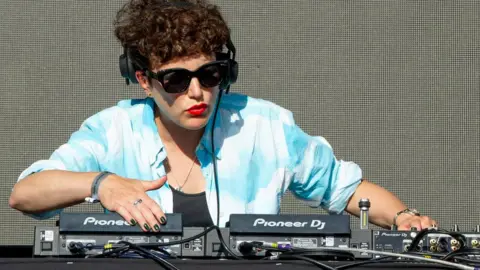 Annie Macmanus, known as Annie Mac, has described the music business as "a boys' club"
Getty Images
The broadcaster and writer told the committee about a female photographer who was taken on tour by an all-male band, only to be sacked after spurning the advances of the lead singer.
"She couldn't have won," said Macmanus. "If she had gone with him, she would have been fired for being unprofessional, and she didn't want to go with him anyway."
Singer and former X Factor contestant Rebecca Ferguson said in her evidence that misogyny in music was just "the tip of the iceberg".
She said she was bullied by her management company when she tried to leave them, telling MPs that staff "were instructed to ruin my personal relationships [and] ignore calls from my children".
At one point, she was told: "'When you earn as much money as you do, you do as we effing say'."
'Attacked on stage'
Women who responded to the Musicians' Census had similar stories, with 51% saying they had experienced gender discrimination at work.
A DJ from the East Midlands said she had been sexually assaulted on stage, and while travelling home late at night.
Another young musician, from London, said that harassment had affected her "confidence and anxiety" while playing gigs.
The report also highlighted that women face unique barriers to their career progression, particularly regarding childcare and age discrimination.
"Since the birth of my daughter I have had to turn down several pieces of work due to a lack of available, reasonably priced childcare," said one anonymous respondent. "I have the impression that fewer offers have come my way as a result."
"There has been a certain amount of discrimination I've experienced especially when I started out as a DJ because I didn't look the right way compared to other female DJs of the time," added a Scottish musician. "Now I'm older and facing a new type of discrimination because of my age."
Jobs are often stereotyped by gender, too, the report said. Only 12% of studio engineers, 8% of rappers, and 24% of DJs are women. By contrast, women account for 59% of the roles in classical music.
Naomi Pohl, general secretary of the Musicians' Union, said stories like these illustrated how women were still being "held back" in the music industry.
"We have long advocated for better pay gap reporting, and hope the census findings will encourage the industry to take action, be more transparent and make change."
Latest Stories
-
GMTF Administrator hails Mintah Akandoh’s support as Fund marks first year
6 minutes -
GPHA honours 410 staff for outstanding service
20 minutes -
BoG slashes September FX support to $500m as GoldBod boosts dollar supply
24 minutes -
GNFS rolls out automated fire compliance system
26 minutes -
SOE profit at GH¢19.8bn: I call it a miracle, but it’s not operational efficiency – Dr Atuahene
28 minutes -
SHS violence: Government must review discipline policy – IFEST
36 minutes -
Nana Akomea leads NPP First Vice Chairman race in new poll
41 minutes -
Ato Forson begins groundwork for Mahama’s $10bn New Economy agenda
44 minutes -
SHS violence: Peter Anti demands intelligence-led security in schools
47 minutes -
‘Presidents can’t have unfettered powers’ – Sophia Akuffo
48 minutes -
Kwame Agbodza cuts Wenchi-Bole road contracts by 25km over slow work
54 minutes -
Ghana’s borrowing costs plunge as inflation eases sharply – World Bank
60 minutes -
Unnecessary appeals delaying justice – Sophia Akuffo calls for tighter Supreme Court limits
1 hour -
Breastfeeding can reduce breast cancer risk – but it does not rule out the disease
1 hour -
Kadjebi gets Farmer Service Centre
1 hour