

Audio By Carbonatix
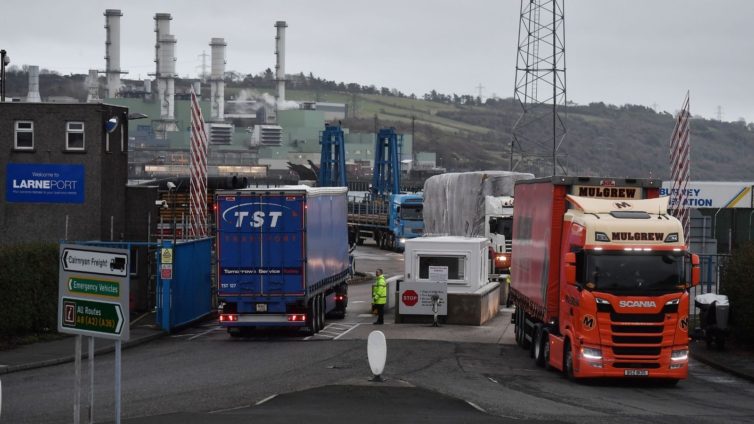
The British government estimates it will spend at least 4.7 billion pounds ($6 billion) on implementing post-Brexit border arrangements, after repeated delays in setting new rules, parliament's spending watchdog said on Monday.
Britain voted to leave the European Union in 2016 but, such was the scale of the task to untangle supply chains and erect customs borders, that it is only this year setting new rules.
The first phase of Britain's so-called new Border Target Operating Model, requiring additional certification, came into force on Jan. 31.
A second phase started on April 30, introducing physical checks at ports. A third phase, requiring safety and security declarations is slated for Oct. 31.
The National Audit Office (NAO) said the 4.7 billion pounds figure is the amount the government forecasts it will spend on the 13 most significant programmes to manage the passage of goods across the border post-Brexit and improve performance over the lifetime of the programmes.
The government delayed the implementation of full controls five times since the end of the EU exit transition period on Dec. 31 2020.
This caused uncertainty for businesses, extra costs for government and ports and increased the biosecurity risk to the UK, the NAO said.
"The repeated delays in introducing import controls, and difficulties forecasting requirements, have resulted in government expenditure on infrastructure and staff that were ultimately not needed," it said.
"Late announcements about policy and uncertainty about the implementation of controls have also reduced the ability of businesses and ports to prepare for changes."
The NAO noted that while post-EU exit border processes have operated "relatively smoothly", businesses trading goods between the UK and the EU have faced additional costs and administrative burdens.
The watchdog was also critical of the government's 2025 UK Border Strategy, which was published in 2020, saying it "lacks a clear timetable and an integrated cross-government delivery plan, with individual departments leading different aspects of implementation."
The government also needed "a more realistic approach" to digital transformation, the NAO said.
($1 = 0.7895 pounds)
Latest Stories
-
Mahama opens 28th AMCOA Conference
16 minutes -
Let there be a ceasefire – Agalga urges calm as extortion allegations rock Parliament
21 minutes -
Let’s satisfy everyone’s curiosity – Agalga backs early GoldBod probe
41 minutes -
GoldBod is ready to account – Agalga defends Gold Board as calls for probe intensify
58 minutes -
Don’t limit GoldBod probe to 2025 – Agalga demands full audit of gold trading scheme
1 hour -
GoldBod has never incurred losses – Agalga challenges claims as Minority pushes probe
2 hours -
NAIMOS raids Ankobra, destroys 86 chanfang machines in fresh galamsey crackdown
2 hours -
GoldBod is the tool behind Ghana’s stability – Agalga defends gold strategy
2 hours -
Trump administration moves to impose more than $100,000 fee for H-1B worker visas
3 hours -
Oil prices steady as investors weigh impact of expanded US sanctions against Iran
4 hours -
Trump administration plans to revoke visas of foreigners seeking asylum
4 hours -
US appeals court considers reassigning case from judge over AI use
5 hours -
Trump bought shares in Elon Musk’s SpaceX in June, financial disclosure shows
5 hours -
MTN approves $375 million share buyback after profit rise
5 hours -
Ghana gold buyers went weeks without funds, sources say
5 hours