


Audio By Carbonatix
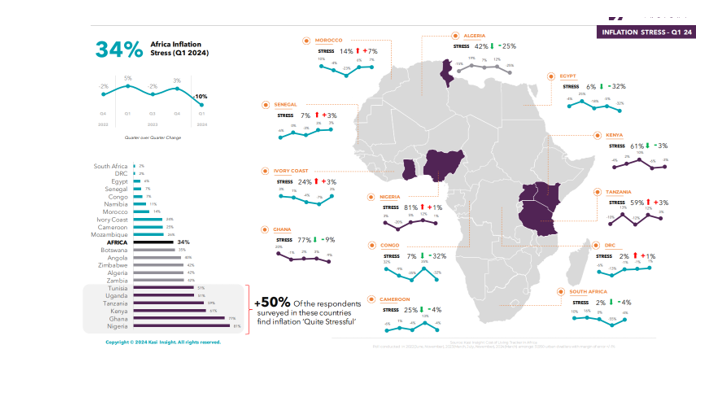
Seventy seven percent of Ghanaians are reporting a significant stress on their livelihood due to the rising costs of living, the impact on their daily life and consumer behavior.
This is according to a recent data from Maverick Research and Kasi Insights which revealed a troubling picture for consumers and the Fast-Moving Consumer Goods (FMCG) industry.
This statistic underscores the severe strain that inflation is placing on households, eroding purchasing power and compelling difficult choices in spending.
“The new data indicate that Ghana and Nigeria are at the forefront of this economic stress. With a staggering 81% of respondents in Nigeria and 77% in Ghana reporting significant stress due to rising costs of living, the impact on daily life and consumer behavior is profound. This statistic underscores the severe strain that inflation is placing on households, eroding purchasing power and compelling difficult choices in spending”.
Economic Strain and Consumer Behavior
The report revealed that the consumer feedback collected since the beginning of the year highlights a palpable anxiety among retail owners and clients, now quantified by this recent research.
“The financial squeeze is not merely anecdotal but a widespread reality affecting a vast majority of the population. In Ghana and Nigeria, where inflation rates are particularly high, the stress manifests in reduced disposable income and altered consumption patterns. Consumers are forced to prioritize essentials, often cutting back on non-essential goods and services”, it mentioned.
“This shift in consumer behavior has significant implications for the FMCG industry. Companies operating within this sector are finding it increasingly challenging to maintain sales volumes and profitability”, it added.
The report continued that the strain on household budgets means that brands must innovate to remain relevant and accessible to their customers, adding, pricing strategies, product sizes, and promotional tactics are all under scrutiny as businesses seek to align with the new economic realities faced by their consumers.
The Regional Perspective
Beyond Ghana and Nigeria, the stress of inflation is felt to varying degrees across other African nations.
In Kenya, the report said 61% of respondents report high stress levels, while in Tanzania, the figure stands at 59%. These numbers, though slightly lower, still reflect a significant portion of the population grappling with economic pressures.
Countries like Tunisia and Uganda show similar trends, with over half of their populations reporting substantial stress.
Interestingly, the data revealed that regions less impacted by extreme inflationary pressures, such as South Africa and Egypt, report relatively lower stress levels at 2% and 7%, respectively. This disparity highlights the uneven economic landscape of the continent, where some nations are more resilient or perhaps have better mechanisms to manage inflation and its impacts.
Latest Stories
-
GSE showed strong performance in August 2026 despite recording more stock losses
44 minutes -
If CJ needs ethics law to know SOE comments were wrong, he may not be worthy of office – Arthur Kennedy
2 hours -
Stop touring state agencies and focus on the Judiciary’s problems – Arthur Kennedy to CJ
2 hours -
Apologise and don’t do it again – Arthur Kennedy to Chief Justice over SOE comments
2 hours -
Chief Justice remains committed to judicial independence, justice and equality – Judicial Service
2 hours -
Ghana concludes evacuation of citizens from South Africa; total returnees reach 1,900 – Ablakwa
3 hours -
Africa must define its own green transition path – Prof Fatima Denton
3 hours -
WASSCE 2026: English Language performance falls to 62.4% – WAEC
4 hours -
WASSCE 2026: Social Studies records sharp rebound as Maths, Science also improve
4 hours -
2026 WASSCE entry rises by 11% as 512,862 candidates sit exams
4 hours -
WASSCE 2026: English Language performance falls to 62.4% – WAEC
4 hours -
WAEC cancels 2026 WASSCE results of 8,295 candidates over examination irregularities
4 hours -
WAEC releases provisional 2026 WASSCE results for 512,862 candidates
5 hours -
CJ’s remarks on SOEs were made in good faith, not to undermine judicial independence – Judicial Service
8 hours -
Bright Future Alliance pays courtesy call on Akufo-Addo, invites him to African Leaders of Influence Lectureship Series
8 hours