

Audio By Carbonatix
The Dean of the Ghana Armed Forces Command and Staff College (GAFSC), Prof Vladimir Antwi-Danso, has warned that escalating tensions in the Middle East involving the United States, Israel and Iran could have significant economic implications for Ghana, even though the country is not directly involved in the conflict.
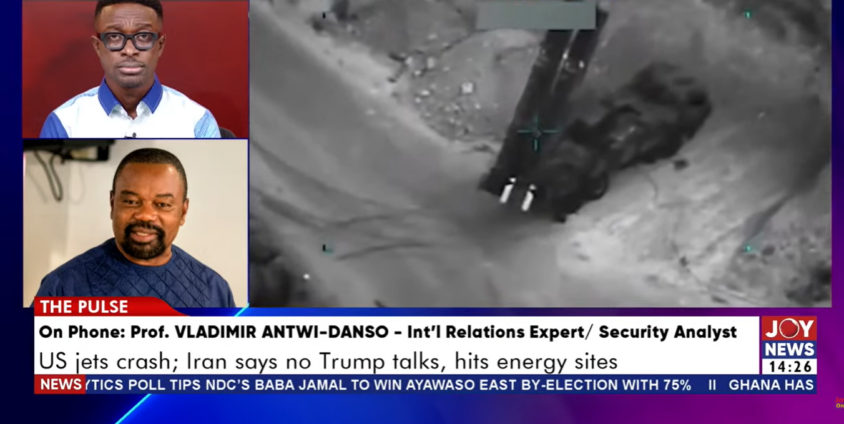
Prof Vladimir Antwi-Danso offered the caution in an interview on the Pulse on JoyNews on Monday, 2 March, noting that the unfolding crisis carries geopolitical, political and economic ramifications that extend far beyond the region.
Middle East Conflict: What’s Happening
The current confrontation spiralled into open conflict on 28 February 2026, when the United States and Israel launched coordinated military strikes against Iran — an operation involving air and missile attacks on Iranian cities and military facilities. The offensive marked a significant escalation in long-standing tensions over Tehran’s nuclear programme, regional proxy influence and decades of strained diplomacy.
In response, Iran has carried out missile and drone attacks on Israeli territory and US military bases, while allied militias such as Hezbollah in Lebanon have joined the exchanges with cross-border strikes.
The conflict has disrupted shipping through the Strait of Hormuz — a vital route accounting for about 20% of the world’s seaborne oil trade — raising the risk of broader supply shocks.
International actors, including the United Nations, have urged de-escalation, warning that the escalating confrontation undermines regional stability and global security.
Ghana Could Feel the Ripples
Prof Antwi-Danso warned that although Ghana is not a participant in the conflict, global instability could affect domestic economic stability.
“These actions have global implications — economic instability and political instability regionally — so even countries not directly involved will experience the consequences,” he said.
He cautioned that if the situation worsens — particularly if allied US partners respond collectively — the conflict could heighten uncertainty and volatility in global markets.
The Dean cited examples from previous interventions in Libya, Afghanistan and Iraq, which produced prolonged instability and spill-over effects that were felt even in West Africa.
Economic Risks for Ghana
One of the most immediate potential impacts for Ghana is through energy markets: disruptions in the Middle East can trigger spikes in global oil prices, which in turn push up fuel and transport costs domestically. Economists have warned that higher global oil prices could undermine Ghana’s recent gains in controlling inflation and push up the cost of essential goods and services.
Fuel price volatility also could strain Ghana’s foreign exchange reserves, as the country remains a net importer of refined petroleum products, spending hundreds of millions of dollars each month on fuel imports.
Prof Antwi-Danso highlighted that any shock to the dollar or banking sector triggered by the conflict would have a toll on the economy.
“If the dollar hiccups because of this, if the markets also react negatively, then it will show that things are going badly. If the banking sector is affected, it will take a toll on the economy,” he explained.
He warned that economic shocks could have serious consequences for livelihoods and national stability, particularly if fuel and transport costs rise sharply.
Limited Political Leverage, Calls for Preparedness
Prof Antwi-Danso noted that Ghana’s influence on global power politics is limited and urged the government to use soft diplomacy to advocate for de-escalation.
“Politically, we are very insignificant when it comes to global power politics. The only thing we can do is use soft diplomacy to call for de-escalation,” he said.
He also emphasised the need for proactive government measures to cushion the economy against possible shocks, urging the media to help prepare the public for potential impacts.
“I think the government must do well. Journalists must also help in preparing us for what may happen,” he said.
Prof Antwi-Danso added that the crisis presents an opportunity for the international community to defend multilateralism and strengthen the UN system, warning that without robust international institutions, unilateral actions may become more common.
The Middle East conflict continues to evolve rapidly, with global markets and political actors closely monitoring developments that could further influence economic and security landscapes worldwide.
Latest Stories
-
950,000 barrels of Sankofa crude head to TOR as GNPC deepens domestic refining
5 minutes -
Scales of deception removed – Annoh-Dompreh attacks new cocoa price
17 minutes -
Young Positivist Writes : My Experience with GCLP
2 hours -
Strong Day 1 turnout sets tone for Day 2 of Republic Bank-JoyNews Habitat Fair Clinic
2 hours -
Ghana Army warns new soldiers against social media misuse, uniform abuse
2 hours -
AMA calls for science-led action to tackle environmental health risks in Accra
2 hours -
NPP Canada Organizer BigMo urges Diaspora to support Kodua Frimpong
3 hours -
He entered at eight. He is now 16: Ghana’s children growing up in prayer camps
6 hours -
‘Development must not always begin from Accra’ — Anwelle Foundation launched in Jirapa
6 hours -
PKO trio eye victories at Odwira Festival
9 hours -
346 Ghana Navy recruits pass out after 26 weeks of intensive training
9 hours -
Newsfile to discuss EOCO-MP arrest, drug trafficking, speech arrests and $235m water debt
9 hours -
JoyNews gets results as listeners raise GH¢40,000 to help 17-year-old student with cerebral palsy attend SHS
10 hours -
Vice President calls for stronger local pharmaceutical production to reduce medicine imports
10 hours -
The brewing tension at KNUST; Beware the Ides of October….
11 hours