

Audio By Carbonatix
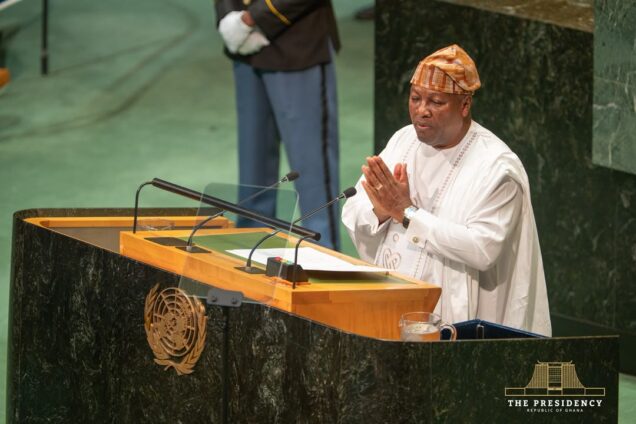
President John Dramani Mahama has challenged Ghanaian businesses to expand domestic production of goods the country currently imports, saying the shift is necessary to create jobs and build a stronger productive economy.
He said Ghana could no longer afford to rely heavily on exporting raw commodities while importing finished products that could be produced locally, particularly in areas where the country has the resources, skills and market to compete.
“Ghana must produce more of the goods we currently import where we have the capacity to do so. We must also expand exports and earn more foreign exchange and broaden the productive base of the economy. Most importantly, we need jobs,” he said.
President Mahama said the urgency was heightened by Ghana’s rapidly growing youth population, arguing that economic expansion must generate employment at a pace that matches the number of young people entering the labour market.
“Our young population is growing, and the economy must create opportunities at a pace that responds to that growth,” he added.
He identified the 24-hour economy and the Accelerated Export Development Programme as key mechanisms for converting recent economic stabilisation into increased production, exports and employment.
The government’s 24-hour economy framework is intended to allow businesses with viable markets to increase output through additional shifts rather than requiring every company to operate continuously.
“The 24-hour economy is not a directive requiring every business to remain open 24 hours a day. It is a framework that enables enterprises with a market and commercial basis to create additional shifts, raise outputs, and employ more people,” President Mahama explained.
He said the expansion of production would also generate opportunities beyond factories and farms, including transport, logistics, warehousing, cold-chain services and digital businesses that support increased economic activity.
President Mahama made the remarks at the US-Ghana Presidential Roundtable in New York, where he outlined his administration’s strategy to move Ghana from macroeconomic stability towards higher productivity, stronger exports and broader employment opportunities.
Latest Stories
-
Richard Owusu of Debibi United named NASCO September player of the month
2 minutes -
Day 1: Republic Bank–JoyNews Habitat Fair underway in Ho as firms showcase housing solutions
3 minutes -
Children aged 5, 8 and 11 killed in US school shooting before suspect shot by bystander
4 minutes -
FC Samartex coach Nana Agyemang scoops NASCO coach of the month award for September
4 minutes -
Ghana Association of University Administrators suspends nationwide strike
14 minutes -
Dr. Mohammed Amin Adam writes: Ghana’s 2026 domestic debt financing
31 minutes -
Kosmos Energy, Eni, TotalEnergies and AGL Win Big at African Energy Awards
42 minutes -
Government secures financing to fix water shortages in Tamale, Yendi and Damongo
1 hour -
NSA extends 2026/2027 National Service registration deadline to October 23
2 hours -
Mahama reaffirms commitment to private investment and industrial growth
2 hours -
‘We have been used and dumped’ – NDC’s James Agbey warns over grassroots neglect
2 hours -
Ghana defender Marvin Senaya begins training ahead of comeback
2 hours -
Joyce Bawah Mogtari urges women leaders to build strong support networks
2 hours -
Bawumia engages GUTA over import duties, VAT and rising business costs
2 hours -
Fuel prices begin to fall as Star Oil cuts petrol to GH¢16.45
2 hours