

Audio By Carbonatix
Russia has deployed up to 200 military instructors to Equatorial Guinea in recent weeks to protect the presidency, sources told Reuters, showing Moscow is expanding its footprint in West Africa despite a recent defeat in Mali.
The sources said the Russians were training elite guards in the two main cities of the tiny oil-exporting country of 1.7 million people, where U.S. energy firms invested billions of dollars in the first decade of the century before scaling down.
The deployment fits into a wider pattern of waning Western influence and increasing Russian interventions in West and Central Africa, where Moscow has sent thousands of mercenaries to protect military regimes and help them fight insurgents.
For Russia, the assignments are a way to make money from government fees and economic opportunities in mining or energy, while defying the West as part of a global geopolitical confrontation playing out most dramatically in Ukraine.
In Equatorial Guinea, where 82-year-old President Teodoro Obiang Nguema Mbasogo has ruled since seizing power in a coup in 1979 and is grooming his favourite son to succeed him, Russian security could ward off any threat to the ruling dynasty.
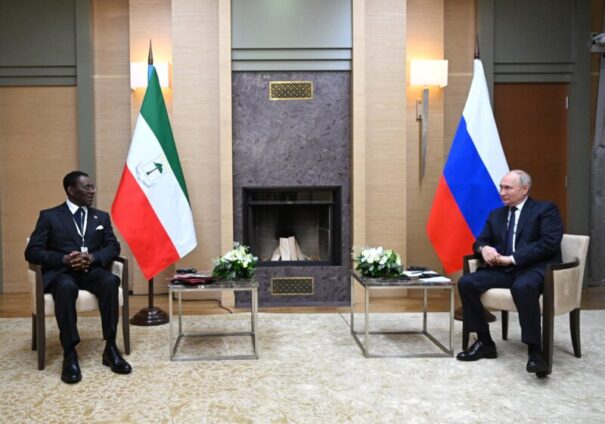
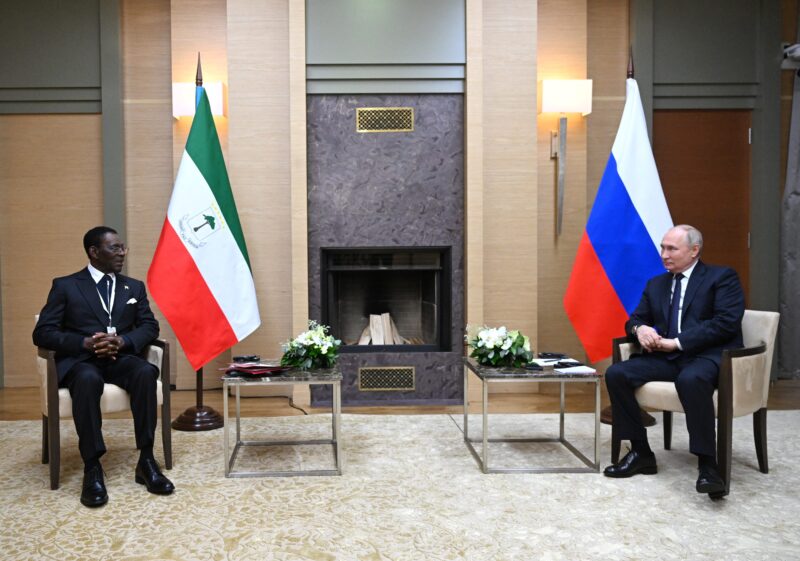
On a visit to Moscow in September, Obiang thanked Russian President Vladimir Putin for sending "instructors" to strengthen Equatorial Guinea's defences, state news agency TASS reported.
Reuters interviewed three diplomatic sources, another source from the opposition, one from civil society and two people close to the government in the former Spanish colony.
The sources, who did not want to be identified, confirmed a Russian presence in Equatorial Guinea. Three of them estimated that 100 to 200 Russians had arrived in the past two months.
Two of the sources said the military personnel may include troops from Russia's ally Belarus, while Reuters identified one as coming from an elite Russian paratrooper unit. Two of the sources said the men were likely to be part of Africa Corps, a Kremlin-controlled paramilitary force.
Equatorial Guinea's foreign ministry and Russia's defence and foreign ministries did not respond to requests for comment.
Will Brown, a senior policy fellow at the European Council on Foreign Relations' Africa programme, said Russia was continuing a policy of "opportunistic expansion" that has undermined Western influence and provided a service.
PAYMENT IN CASH OR CRYPTO
Two sources said the Russians were in the capital Malabo, located on an island in the Gulf of Guinea, and in Bata, in the country's mainland territory, a sliver of land between Cameroon and Gabon.
The deployment comes after advertisements for work in Equatorial Guinea appeared in June on Russian pro-military Telegram channels aimed at private security contractors.
Recruiters offered six-month contracts with a monthly salary of $3,000 to $5,000 to be paid in cash or cryptocurrency. The original adverts have since been deleted.
Diario Rombe, a news organisation based in Spain that is close to Equatorial Guinea's opposition, has published several photos showing white men in fatigues posing with local troops. Three had Russian flags on their uniforms.
Using facial recognition software, Reuters has identified one of the men as an elite paratrooper who has served in units in the south of Russia.
Reuters' sources said a key aim for the Russians was to protect Obiang's high-living son Teodoro Nguema Obiang Mangue, known as Teodorin, the multi-millionaire vice-president and presumed successor.
He has been the subject of investigations, criminal charges, sanctions and asset seizures in the United States, France and Britain over embezzlement and money-laundering.
U.S. energy firms including Exxon Mobil Corp and Marathon invested billions of dollars in Equatorial Guinea in the 2000s, when the Gulf of Guinea was seen as crucial to meet U.S. energy demand. But U.S. interest has faded as production has ramped up at home.
Equatorial Guinea currently produces around 80,000 barrels of crude per day, down from a peak of well over 300,000 two decades ago.
On Sept. 27, Russia's Interfax news agency reported that the two countries had discussed terms for Russian companies to enter Equatorial Guinea's oil and gas sector.
A U.S. State Department spokesperson said it encouraged all countries, including Equatorial Guinea, to avoid transactions with Russian defence or Kremlin-backed proxies, saying these could trigger "serious consequences under U.S. law".
Obiang has survived several coup attempts, most famously in 2004 when mercenaries backed by foreign businessmen tried to oust him. In the past, he has beefed up his presidential guard with Moroccans and Israelis.
Russia's expansion in Africa in recent years has been primarily driven by the private Wagner Group, which has sent thousands of men to Central African Republic and Mali.
In July, Wagner suffered a serious setback when dozens of its men were killed in a battle with Tuareg rebels and al Qaeda-linked militants in northern Mali.
Following the death of Wagner founder Yevgeny Prigozhin last year, Moscow has increasingly used the Africa Corps, which experts say is more directly controlled by Moscow, for African deployments. Africa Corps men are in Burkina Faso and Niger.
Latest Stories
-
David Selassie Anthony declares bid for NDC Deputy National Organiser
1 hour -
Amin Adam proposes 13 measures to strengthen Ghana’s debt transparency and market confidence
2 hours -
Mahama announces $2bn annual investment to accelerate industrialisation
2 hours -
Amin Adam urges monthly disclosure of Sinking Fund as Ghana prepares for DDEP repayments
2 hours -
Stronger banks will fuel business growth and jobs – ADB MD
2 hours -
Galamsey: ‘Rivers that fed our grandparents now run the colour of chocolate milk’ – Sam Jonah
2 hours -
We have been scammed by NDC, government is only doing PR – Abanga Fuseini
2 hours -
Republic Bank–JoyNews Habitat Fair opens in Ho today
2 hours -
BoG pledges stability to attract investment, urges stronger Africa–Asia partnerships
2 hours -
Amin Adam warns treasury bill dependence could expose Ghana to refinancing risks
2 hours -
Ghana better placed to withstand commodity price shocks – IMF
2 hours -
GAPTE intensifies efforts to increase bus availability for Aayalolo contra-flow
2 hours -
Amin Adam warns cedi depreciation could reverse Ghana’s debt relief gains
2 hours -
Fiscal discipline crucial for pension fund investments – Finance Minister
2 hours -
BoG Governor rallies IMF to back Africa’s digital sovereignty
2 hours