

Audio By Carbonatix
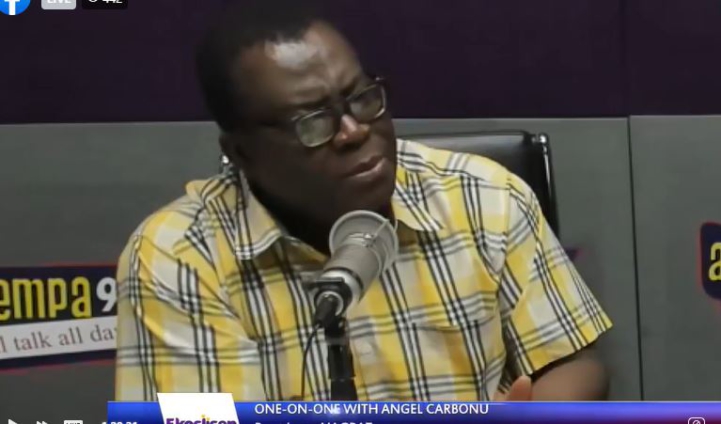
The President of the National Association of Graduate Teachers (NAGRAT), Angel Carbonu, has expressed deep concern over Ghana’s lack of robust democratic systems that can function independently of human emotions, particularly during political transitions.
Mr. Carbonu noted that while Ghana is often celebrated as a beacon of democracy, the country has failed to establish institutional systems that transcend individual sentiments and ensure smooth governance transitions.
In an interview on Joy FM Top Story on Tuesday, December 17, he said: “As a Ghanaian and a public sector worker, I am very disturbed and worried. Over the years, we’ve been touting ourselves as a beacon of democracy, yet we have failed to put in place democratic systems that can transcend individual human sentiments."
His comments come at a time of heightened debate over the delayed mini-budget, with public sector salaries and government operations for early 2025 hanging in the balance.
Mr. Carbonou emphasized the need for automatic systems to manage critical state functions, especially during the period between elections and the swearing-in of a new government.
“If systems were in place, whenever elections are over and a government becomes a lame duck, and the newly elected party prepares to assume office, we would know how to transition seamlessly. We currently rely too much on human emotions and last-minute decisions.”
He cited the importance of operational budgets to sustain the nation during the transition period. “For example, the operational budget—funds necessary to manage this country for the next three months, covering salaries, emoluments, and financial obligations of various agencies—should have been managed by a system that automatically kicks in after December 7 until January 7 when power is handed over.”
Mr. Carbonou stressed that the absence of such systems exposes the country to unnecessary risks.
He also referenced past instances where laws were hurriedly passed during the final days of a government, only to have negative repercussions later.
Calling for urgent reforms, Mr. Carbonu urged stakeholders to develop clear frameworks that define what an outgoing government can and cannot do in its final month in office.
“…We should put in place measures to know what the government can do and cannot do in the last month.”
Latest Stories
-
Parliament scrutinises govt but cannot scrutinise itself – Dramani challenges MPs to apply their own standards
9 minutes -
Partisan solidarity overrides accountability – Dr Dramani accuses Parliament of protecting its own
31 minutes -
This goes beyond Afenyo-Markin – CDD warns fresh allegations could damage Parliament
59 minutes -
Parliament is in crisis of confidence – CDD’s Osae-Kwapong warns fresh allegations could ceepen public distrust
1 hour -
Nigeria’s president orders rescue after mass kidnapping exposes security failings
2 hours -
Meta, US states have discussed settling teen social media harm case, Bloomberg News reports
2 hours -
All the best Savinho – welcome Savio… new club, new name for Spurs signing
2 hours -
Baleba completes £70m Man Utd move from Brighton
2 hours -
China prepares for more heavy rain from back-to-back storms
2 hours -
Alcaraz and Williams thrill in US Open mixed doubles
2 hours -
Ghislaine Maxwell loses bid to throw out conviction for aiding Jeffrey Epstein
3 hours -
Instagram head Mosseri, at children’s addiction trial, says few teenagers knew of safety feature
3 hours -
Tanzania’s vice-president announces resignation in unprecedented move
3 hours -
If Parliament loses public trust, democracy suffers – Osae-Kwapong warns of damage to oversight
4 hours -
We gave them our mandate, not our purse – Inusah Fuseini demands accountability from MPs
4 hours