

Audio By Carbonatix
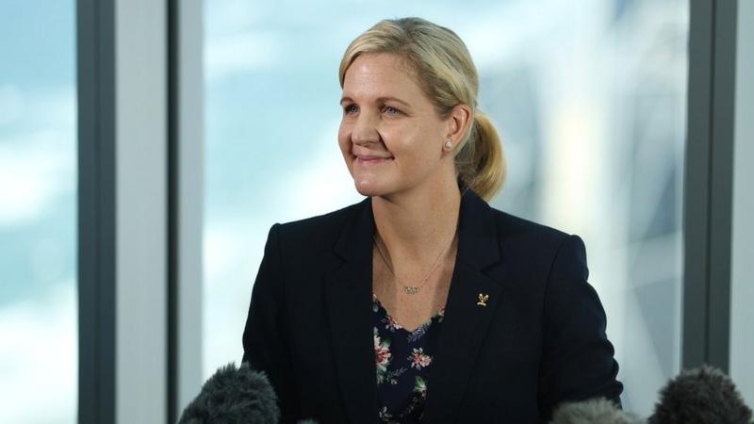
Kirsty Coventry, the former Olympic swimmer and current candidate for the International Olympic Committee (IOC) elections, recently sat down with a group of African journalists, including Joy Sports lead editor Fentuo Tahiru Fentuo, to discuss her vision for the IOC. The conversation touched on a wide range of issues, from gender inclusivity to supporting African athletes, all within the broader framework of strengthening the Olympic movement.
Kirsty Coventry has never been one to chase headlines. But if she is elected as the next president of the International Olympic Committee (IOC) next March, she will make history in more ways than one. She would become both the first woman and the first African to lead the world’s most powerful sporting body.
Now 41, Coventry is no stranger to breaking barriers. She won seven Olympic medals for Zimbabwe in swimming between 2004 and 2008, becoming Africa’s most decorated female Olympian. Since then, she has transitioned into a career in politics and sport administration, serving as Zimbabwe’s Minister of Sport and sitting on the IOC’s executive board.
Her bid for the presidency comes at a critical time. The Olympic movement faces growing scrutiny over everything from athlete welfare and political neutrality to gender identity and the role of emerging regions. Coventry, soft-spoken but firm, believes the IOC needs to return to its core values of fairness, inclusion and integrity, while adapting to a rapidly changing world.
“The Olympic Games have always been a beacon of hope,” she said in an interview in Lausanne. “But that only happens when we stay true to our principles, even when it’s difficult.”
One of those difficult issues is the inclusion of transgender athletes in women’s sport. While the IOC has largely left the matter to individual federations, Coventry is pushing for a more coordinated global framework. “I believe we need to protect the female category,” she said. “But that protection must come through clarity and collaboration, not exclusion.”
Coventry’s campaign is rooted in the belief that sport should be more accessible, especially in parts of the world that have long existed on the Olympic periphery. She sees Africa, her home continent, not as a recipient of Olympic goodwill but as a vital contributor whose time has come.
“We saw how well South Africa hosted the 2010 World Cup,” she said. “There’s no reason Africa couldn’t support an Olympic Games just as successfully.” With countries like Egypt, Nigeria and Kenya expressing interest in future bids, she believes the IOC must create policies that promote genuine global equity, not symbolic gestures.
Africa’s youth is central to her vision. By 2050, nearly half a billion Africans will be under the age of 35. Coventry argues that if the Olympic movement fails to connect with this generation, it risks becoming irrelevant in the very places where it could thrive most. “We have to meet young people where they are,” she said. “Not just with inspiration, but with access and opportunity.”
That belief also shapes her views on athlete support. Coventry opposes the idea of prize money at the Olympics. Instead, she advocates for stronger development systems. “The hardest part of my journey wasn’t winning a medal,” she said. “It was getting to the Games in the first place.” She wants the IOC to invest more in grassroots athletes, especially those from under-resourced regions, rather than focusing solely on podium finishes.
At the heart of her approach is the African concept of Ubuntu, meaning “I am because we are.” For Coventry, this philosophy offers a blueprint for how the IOC can navigate its thorniest challenges, from AI in officiating to the participation of athletes from conflict zones. “If we’re not working together,” she said, “we’re working against each other.”
That spirit also informs her call to strengthen National Olympic Committees (NOCs), particularly in the Global South. Drawing on her own experience competing in Zimbabwe and training in the US, she points to the vast disparities in infrastructure and funding. Technology, she believes, can help close the gap, but only if the IOC prioritises capacity building and local partnerships.
Her long-term ambition is to help develop an African sports model tailored to the continent’s needs. She envisions a system that borrows from the American collegiate structure but is rooted in local realities. “We’ve already seen what collaboration can do with East African distance running,” she said. “Now imagine that scaled up.”
Even on contentious issues like boxing’s uncertain Olympic future, Coventry remains athlete-focused. While acknowledging governance failures in the sport’s international federation, she insists the Games must continue to provide a platform for boxing athletes. “The spotlight should stay on them,” she said. “Not on administrative politics.”
Coventry faces six rivals in the race to succeed Thomas Bach. These include IOC Vice-President Juan Antonio Samaranch Jr., World Athletics President Sebastian Coe, Jordan’s Prince Feisal Al Hussein, and other seasoned sports leaders. The vote will take place at the IOC Session in Greece in March 2025.
In the original Olympic ethos imagined by Pierre de Coubertin, the Games were to be a global stage where the body and spirit met in noble combat. But even Coubertin, steeped in Eurocentric ideals, did not imagine a Zimbabwean girl swimming against apartheid-era stereotypes. Nor that she would one day be in contention to lead the very institution he founded. Coventry’s vision is both a continuation and an undoing of that legacy. It makes space for voices long excluded from the Olympic narrative.
But win or lose, Coventry’s campaign is already shaping the debate over the future of the Olympics. She offers a vision grounded not in slogans but in lived experience, as an athlete, policymaker and African woman on the world stage.
“If I can help make sport more accessible and fair,” she said, “then that’s a legacy worth building, whether from the top job or not.”
Latest Stories
-
Contractors move to site for construction of 120-bed trauma hospital in Bole – Kwakye Ofosu
7 minutes -
Poor institutional leadership hindering Ghana’s creative industry – Oscar Provencal
19 minutes -
CSA demands faster sharing of cyber threat intelligence among financial institutions
35 minutes -
CSA warns Ghanaians to verify money requests as AI makes online fraud harder to detect
40 minutes -
NEIP CEO urges Africa to build systems that turn ideas into businesses
42 minutes -
Global Organised Crime Index says cybercrime is undermining Ghana’s digital sector
42 minutes -
Global Organised Crime Index says fraud and tax evasion are widespread across Ghana’s economy
45 minutes -
Threats to journalists limit coverage of cocaine trade in Ghana – Global Organised Crime Index
48 minutes -
Kumawu MP commissions 4-unit nurses’ quarters at Bodomase
48 minutes -
Two arrested after suspected narcotics intercepted at Kasoa
49 minutes -
Our pipes stock are all gone — Duraplast Marketing Manager counts losses after Avenor fire
53 minutes -
Ntim Fordjour calls for cancellation of Ghana-Colombia maritime deal over drug trafficking concerns
55 minutes -
Daily Insight for CEOs: The CEO’s Q4 leadership priorities
58 minutes -
Cybersecurity is a business risk, not just an IT issue – CSA Director-General
58 minutes -
NSA releases 70,072 postings for 2026/2027 national service year
60 minutes