

Audio By Carbonatix
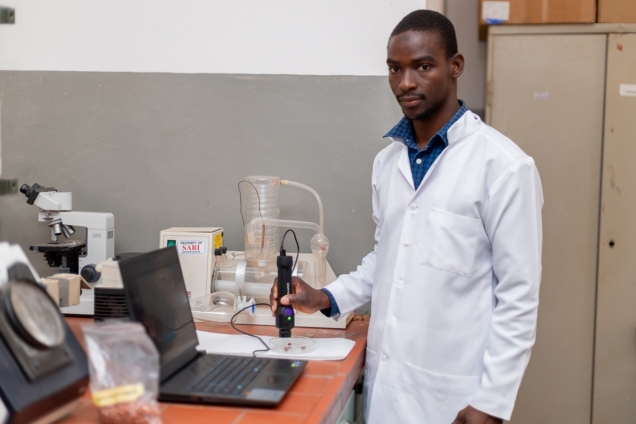
Ghana's Council for Scientific and Industrial Research – Savannah Agricultural Research Institute (CSIR-SARI) has reached the semifinals of the Seeding The Future Global Food System Challenge with its project focused on developing an NIR (Near-Infrared) tool for the rapid screening of aflatoxin-resistant groundnuts to help combat aflatoxin contamination.
The initiative aims to combat aflatoxin contamination by utilizing two naturally occurring antifungal metabolites found in peanut seed coats. The dual strategy offers a sustainable solution for farmers in Sub-Saharan Africa, particularly in Northern Ghana.
A research scientist at CSIR-SARI, Dr. Leslie Commey, says the approach can help smallholder farmers reduce crop losses caused by aflatoxin contamination, which often results in lower yields and economic losses.
It will also provide a more sustainable and affordable option compared to traditional post-harvest practices, improve food safety, help overcome trade restrictions, and strengthen the resilience of groundnut farming across Africa, paving the way for a more sustainable and profitable future for smallholder farmers.
“With the ability to select resistant germplasm early in the breeding process, farmers can increase productivity while improving the quality of their harvest, which can be sold at higher market values.
"Additionally, the reduction in aflatoxin contamination will allow farmers to access a broader range of markets, particularly international markets with strict aflatoxin standards, such as Europe. This opens up opportunities for smallholder farmers to gain access to higher-value markets, boosting their income and contributing to local economic growth,” Dr Commey stated.
Only 36 organizations including Boundless Haven Solutions in Djibouti, Deutsche Welthungerhilfe (WHH) in Niger, iPAGE Global, Inc. in Bangladesh, Safe Environment Hub – Kenya among others have also advanced to the semifinals of the challenge.
A total of 13 winners will share in USD $1 million prize fund, with up to eight Seed Grant winners receiving $25,000 each, up to three Growth Grant winners awarded $100,000 each, and up to two Seeding The Future Grand Prize winners receiving $250,000 each. All semifinalists will also be included in the Seeding The Future Global Food System Innovation Database and Network, currently under development.
The peer-reviewed, interactive platform will highlight innovations to global organizations like the United Nations Food and Agriculture Organization (FAO) and the World Food Programme, as well as philanthropic groups and the investment community, creating opportunities for funding and collaboration.
ABOUT CSIR-SARI NIR TOOL
The NIR (Near-Infrared) tool is a method that doesn’t damage the sample and uses light to study the chemical bonds or structures in it. The light creates a special pattern that shows the chemical makeup of the compounds in the sample.
To measure the amount of these compounds, the NIR tool uses a calibration model. This model is created by comparing the NIR data with known amounts of target compounds, usually measured with a reference method like HPLC-MS (High-Performance Liquid Chromatography-Mass Spectrometry), which is a wet chemistry technique. After the model is tested and confirmed, the NIR tool can accurately estimate the concentration of specific compounds in unknown samples by analyzing their spectral patterns.
The NIR tool has many benefits over traditional wet chemistry methods, such as faster analysis with little sample preparation, making it more efficient and affordable. It doesn’t require reagents or solvents, which lowers costs and reduces environmental impact. The NIR tool is easy to use, allowing for quicker, large-scale testing with less technical knowledge needed. Its ability to process many samples quickly and provide real-time data greatly boosts productivity, particularly in areas with limited resources.
Dr. Commey explained that, building on the availability of the NIR tool, the proposal for the Global Food System Challenge aims to use NIR technology to create a strong calibration model. The model will help select and predict groundnut germplasm resistant to Aspergillus flavus by measuring the concentrations of two key antifungal compounds, 2,5-dihydroxybenzaldehyde and ferulic acid, found in the seed coat.
The development of the calibration model for aflatoxin-resistant germplasm will allow for efficient and cost-effective screening of large numbers of groundnut lines, promoting the rapid identification of resistant varieties. “This approach offers a scalable solution to combat aflatoxin contamination, addressing public health concerns and improving the economic viability of groundnut production in Ghana and other African nations.”
Latest Stories
-
Comparing ourselves to NPP is setting the bar at ground level, NDC must aim higher – Opong-Fosu
3 minutes -
GAUA strike: KNUST administration offices opened but essential IT services hampered
6 minutes -
T.I. AMASS, Wa breaks decade-long jinx to qualify for NSMQ national contest
17 minutes -
Bond market: Turnover surges 148.95% week to GH¢5.67 billion
18 minutes -
No policy to impose Arabic on Ghanaian students — Education Ministry clarifies
18 minutes -
Prof Bokpin laments poor road network, calls for emergency action on Accra-Kumasi highway
21 minutes -
NPA Deputy CEO Dr Dramani Bukari Ecomog dies in London
24 minutes -
Anti-Witchcraft Accusations Bill advances as Gender Ministry engages Amnesty International Ghana
30 minutes -
Apostolic Nuncio commends Mahama’s support, pledges prayers for Ghana
39 minutes -
Selective justice claims false, lawyers only trying to delay cases — Deputy AG
43 minutes -
Two Obuasi SecTech teachers arrested over alleged assault on headmaster
43 minutes -
GBA got it completely wrong on legal vacation — Deputy A-G
44 minutes -
GTA’s data collection model is defective – Francis Doku
46 minutes -
Ghana’s merchandise trade increases to US$52.5bn in 2025 from US$6bn in 2004
46 minutes -
Stakeholders urge sustained investment in youth to harness demographic dividend
48 minutes