

Audio By Carbonatix
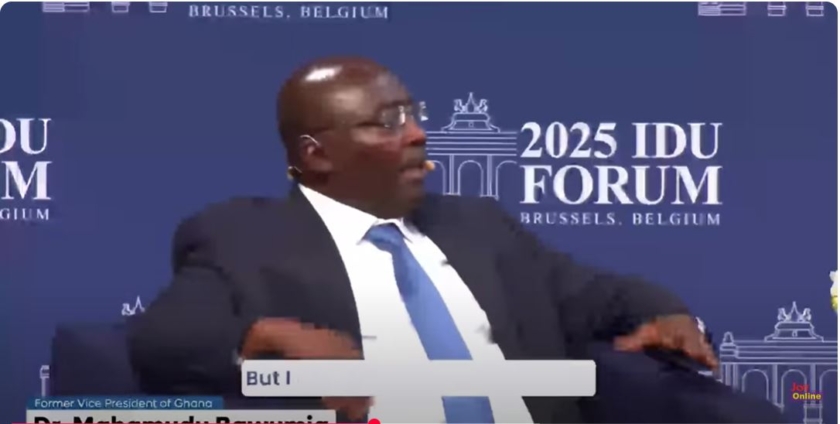
Former Vice President, Dr. Mahamudu Bawumia, has criticised contemporary global policymakers for failing to heed the fundamental lessons of history and economics, particularly in the handling of trade imbalances.
He made this remark while responding to a question on the weaponisation of trade and its impact on African economies, especially Ghana and what strategies can enhance the continent's economic resilience at the International Democracy Union (IDU) Forum in Brussels on Saturday, May 17.
"I think that one of the things that policy makers are doing recently is failing to understand the lessons of history as well as the lessons of economics, we they are surely trading balances," he stated.
He also cautioned against simplistic solutions such as tariffs, noting that trade deficits are deeply rooted in macroeconomic realities, not trade policy failures.
“If you look at the share of global trade, Africa contributes only 2.5% of global exports and 2.9% of imports,” Dr. Bawumia noted.
“In contrast, Asia accounts for 43% of global exports and 38% of imports, Europe 38% and 51% respectively, while the U.S. contributes 8% of exports and 14% of imports. These imbalances are real, but they cannot be fixed with tariffs.”
He explained that trade deficits result from a mismatch between national savings and investment, citing the national income identity as a basic economic principle.
“A country that spends more than it saves will inevitably run a trade deficit. This is a macroeconomic issue, not a trade policy issue.”
Referencing history, Dr. Bawumia pointed to the Smoot-Hawley Tariff Act of the 1930s, which imposed 20% tariffs and contributed to the Great Depression, as well as the U.S.–China trade war of 2018–2019, which disrupted global trade flows.
He also raised concerns over recent U.S. tariff hikes, noting the average rate has jumped from 2.4 per cent to 10 per cent — the highest since 1943.
While Africa is less exposed than other regions, Dr. Bawumia warned that specific countries like Lesotho, which rely heavily on textile exports to the U.S. through the African Growth and Opportunity Act (AGOA), could suffer severe consequences.
“When 50% of your exports are at risk, the impact will be significant,” he said.
Latest Stories
-
Alima Mahama Refund: Jinapor challenges Ablakwa’s authority, says only Auditor-General can surcharge
1 minute -
Wontumi Conviction: 2 star witnesses placed under police protection amid death threats
16 minutes -
Srem-Sai reveals surge in death threats after Wontumi conviction
25 minutes -
GCB, Ecobank, 4 others are top tier banks in Ghana – PwC Banking Survey
32 minutes -
Today’s front pages: Tuesday, August 18, 2026
1 hour -
Banks’ sustainable success will be defined less by interest margins – PwC
2 hours -
CJ Baffor-Bonnie was part of ‘grand conspiracy to remove Torkornoo – Afenyo-Markin alleges
2 hours -
The GIPA Act: Resetting Ghana’s investment framework
3 hours -
GIPA secures investor leads at Invest Fest 2026
3 hours -
Ghana’s missing billions: What 16 years of Auditor-General reports show
3 hours -
Police disown viral flyer on AirPods, earphones use while driving
3 hours -
Stop using media to challenge judicial decisions – Thaddeus Sory to lawyers
3 hours -
The next generation expects more than degrees from universities
4 hours -
Ebenezer Dwomoh to stage fourth stand-up comedy special in Kumasi
4 hours -
Central Regional Minister urges traditional leaders to hold public officials accountable
4 hours