


Audio By Carbonatix
Motorists across Ghana are breathing a sigh of relief as two of the country’s leading oil marketing companies—Goil and Star Oil—announce significant reductions in fuel prices, following the recent appreciation of the Ghanaian cedi against the US dollar.
The price cuts are expected to ease the financial burden on consumers and transport operators who have long called for downward reviews following the cedis strong gains.
Goil rolls back prices across all fuel types
Goil, Ghana’s largest and wholly indigenous oil marketing company, has revised prices downward across its entire fuel range. The new rates are as follows:
- Petrol: now selling at ₵12.52 per litre, down from ₵13.27
- Diesel: reduced to ₵12.98, from ₵13.87
- Premium: slashed to ₵14.34, previously ₵15.27
The move positions Goil as one of the first major players to respond proactively to the improved forex environment.
Star Oil joins price reduction wave
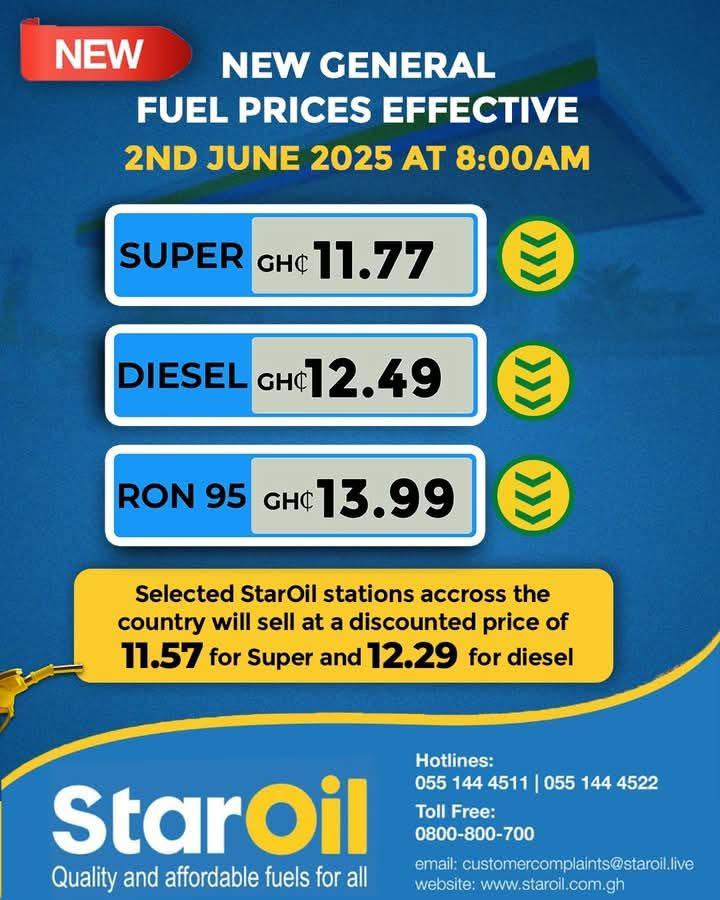
Star Oil has also made notable reductions, though its premium fuel remains unchanged. New prices at Star Oil stations are:
- Petrol: now ₵11.77, down from ₵12.57
- Diesel: now ₵12.49, reduced from ₵13.49
- Premium: holds steady at ₵14.89
This development places Star Oil’s petrol as among the most competitively priced on the market, likely influencing broader pricing trends in the coming days.
Cedi rebound drives change
The reductions come on the back of a strengthening Ghanaian cedi, which has recorded significant gains against the US dollar in recent weeks. As fuel imports are dollar-denominated, the improved exchange rate has provided room for oil marketing companies to lower prices at the pump.
Market watchers say this could signal the start of a broader downward trend in fuel pricing—provided the cedi’s stability is sustained and global crude prices remain relatively subdued.
Relief for consumers, pressure on others
Transport operators and consumers have welcomed the reductions, but are also calling on other oil marketing companies to follow suit to create a level playing field and further drive down transport fares.
Industry insiders suggest that competition and customer pressure may soon push more fuel retailers to adjust their prices accordingly.
Latest Stories
-
‘Gov’t doesn’t understand our plight; 8% fare hike is too small’ – Kumasi drivers
1 second -
Court grants two persons bail in alleged GH₵127m cyber theft case
2 minutes -
Salomey Baffoe bail denied: Cyber-related investigation poses risk of witness interference – High Court
11 minutes -
Court is being too ‘high-handed’ by keeping Salomey Awiti Baffoe in custody – Criminologist
12 minutes -
Lawyer for Salomey Baffoe appeals bail refusal, petitions CJ to intervene
16 minutes -
Washington State delegation explores healthcare partnership with Ghana Medical Trust Fund
20 minutes -
BoG backs cedi payments for Ghana-China trade
21 minutes -
EPA shuts down Earl International mining operation at Gbane over environmental breaches
24 minutes -
GoldBod resumes significant gold shipments, supporting reserves – BoG
26 minutes -
FX interventions are rules-based, not discretionary-BoG
31 minutes -
DVLA explains delinquency charges related to expired driver’s licences
38 minutes -
High Court denies bail application for Salomey Awiti Baffoe
40 minutes -
GES urges communities to help provide kitchens for school feeding programme
47 minutes -
Mahama invokes Nkrumah, says Ghana’s freedom must serve Africa
48 minutes -
From Cotonou to Bata: Ghana and Côte d’Ivoire’s rivalry enters a new chapter
49 minutes