

Audio By Carbonatix
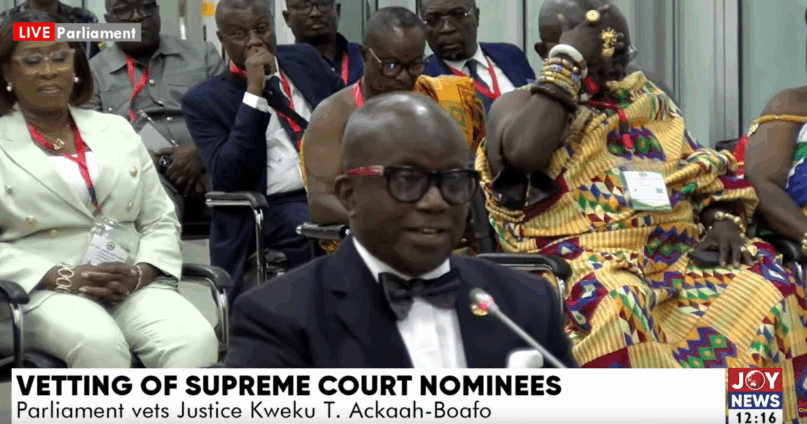
Supreme Court nominee, Justice Kweku T. Ackaah-Boafo, has strongly condemned mob justice, stressing that no individual or group has the right to take the law into their own hands through lynching, demonstrations, or vigilante acts.
"I believe that nobody can use mob justice or demonstrations to resolve a legal matter," he stated during his vetting by Parliament’s Appointments Committee on Friday, 20 June.
Responding to a question from the Minority Leader, Alexander Afenyo-Markin, on the phenomenon of mob justice and its implications on constitutional governance, Justice Ackaah-Boafo insisted that all legal matters must be addressed through the country’s judicial processes as enshrined in the Constitution.
“If somebody has done something wrong, the judicial process should be allowed to take its place. Using mob justice clearly is illegal, and people who engage in it must be dealt with by the law,” he argued.
On the perceived public mistrust in the justice system—often cited as a reason for mob actions—Justice Ackaah-Boafo urged Ghanaians to believe in national institutions and the individuals who serve in them.
“The issue of people not trusting the judiciary is a result of the general perception of all of us. But as Ghanaians, we need to believe and trust in our institutions. Those who work in the justice delivery system are Ghanaians, so then, you don't develop this mistrust because somebody has gone to be a judge. You either trust the person or you don't. Let us have faith in the judicial system and allow the courts to work rather than taking the law into our hands,” he said.
Mob justice remains a troubling issue in Ghana, with several tragic incidents casting long shadows over the nation’s conscience. Notably, in 2017, Major Maxwell Adam Mahama was lynched in Denkyira-Obuasi after being mistaken for an armed robber—a killing that shocked the nation. Similarly, in 2021, two brothers were lynched in Ejura, Ashanti Region, prompting national outrage and a ministerial probe.
Justice Ackaah-Boafo’s comments add to the ongoing national discourse on restoring public confidence in lawful justice delivery while condemning violent extrajudicial actions.
Latest Stories
-
Conflicts among care providers linked to maternal, neonatal deaths – Expert
9 minutes -
GIS marks 10th TIME conference, champions improved teaching practices
16 minutes -
BRICS Or Balance? What Ghana’s bid really means
42 minutes -
GPRTU wants full TRAFFITECH-GH implementation to start in 2027
1 hour -
Mahama announces plans to import electric wheelchairs for PWDs
1 hour -
KGL U17 Colts 2026: Western beat Prempeh Elite Academy to set up final final with Greater Accra Region
1 hour -
Late Solanke strike salvages 10-man Spurs draw at Man United
2 hours -
Gender Ministry to monitor welfare of Nana Akua Addo’s children amid domestic violence case
2 hours -
Benedict Okyere Yeboah: Ghana’s football problem goes beyond sacking a coach
2 hours -
GPL 2026/27: Darkwah Wiafe’s winner sees All Blacks beat Kotoko
2 hours -
ITF World Tour : Patel Wins Boys’ Singles Final at J100 Accra
2 hours -
Ghana must pursue BRICS partnership if it brings economic benefits – Kpebu
2 hours -
Success and Wright Claims J100 Accra Girls’ Doubles Championship
2 hours -
ITF J100: America’s Wright wins J100 Accra Girls’ Singles Title
2 hours -
Expedition hopes to find aviator Amelia Earhart’s plane on remote island
2 hours