

Audio By Carbonatix
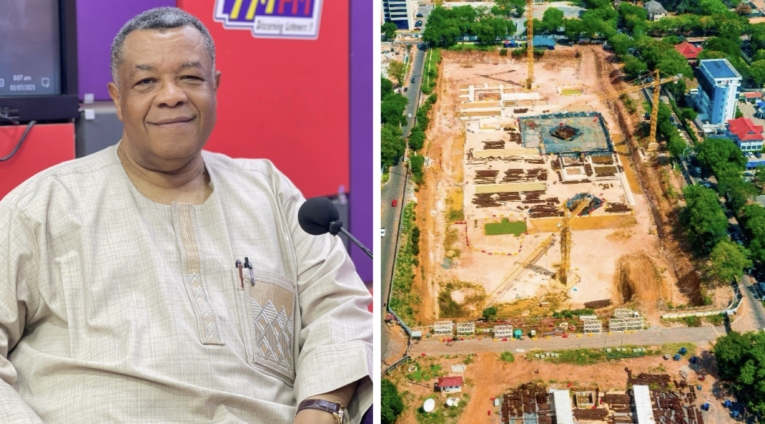
The government has announced plans to convert the stalled National Cathedral project into a National Cultural Convention Centre (NCCC), positioning it as the flagship hub for Ghana’s burgeoning creative economy and cultural diplomacy efforts.
According to a policy document under the new 24-hour economy initiative for culture, creative arts and tourism dubbed “SH0W24”, the NCCC will be established in partnership with the AfCFTA Secretariat and is expected to become Africa’s leading venue for international exhibitions, film festivals, trade shows and summits.
The initiative, government says, will address a critical infrastructure gap while avoiding conflict with religious or national values.
“At the national level, a bold flagship intervention is proposed: converting the National Cathedral site into the National Cultural Convention Centre (NCCC), in partnership with the AfCFTA Secretariat. This venue will serve as Africa's premier cultural diplomacy and creative economy forum, hosting international exhibitions, film festivals, trade shows, and summits-filling a critical infrastructure gap without conflicting with national values or faith institutions,” the document states.
The NCCC project forms part of a broader plan to revitalise the creative arts, culture and tourism sectors as pillars of economic transformation. It marks a significant shift in the use of the controversial cathedral site, which has faced public scrutiny over delays, cost overruns and its relevance.
Under SH0W24, the centre will serve as the crown jewel in Ghana’s creative economy infrastructure. It is projected to host large-scale events and exhibitions that will place Ghana firmly on the global cultural map.
Feasibility studies for SHOW24 are scheduled for Phase 1 of implementation (2025-2026), with full commissioning expected by Phase 3 (2028-2030).
Other actions included in the SHOW24 strategy are the establishment of a National Creators Academy to train youth in music, film, fashion, digital media, and cultural performance. The training will integrate modern tools like AI and virtual reality, as well as business and cultural literacy.
In addition, over 250 community centres are set to be built or refurbished nationwide under the 24H+ Community Centre Network. These will operate 24/7 and serve as venues for training, production, exhibitions, and performances, stimulating night-time economic activity and local creative industries.
To boost market access, the initiative will also introduce the Ghana Cultural Passport, a digital platform offering curated cultural experiences for tourists, especially those from the diaspora. Ghana’s embassies will be equipped to promote creative exports, while licensing and export support systems will connect local creatives to global distribution networks.
Financing support will be provided through the 24H+ Value Chain Financing Facility and a Technical Assistance Grant Facility, both aimed at sustaining creative entrepreneurs and enterprises.
The SH0W24 document highlights the enormous potential of the creative sector to drive employment, youth innovation and global cultural influence. However, it also acknowledges deep-rooted constraints, such as inadequate infrastructure and fragmented talent pipelines, which the new programme seeks to address systematically.
Phase 2 of the rollout (2026-2027) will see the operationalisation of the Ghana Cultural Passport, the launch of regional cultural programmes, and the establishment of creative districts across the country. By Phase 3, the focus will shift to export expansion and international partnerships.
With the proposed NCCC, the government hopes to reposition Ghana as a cultural powerhouse in Africa, transforming its creative assets into viable economic drivers while preserving and promoting its rich cultural identity.
The National Cathedral project, originally launched in 2018 as a symbol of national unity and religious faith, has been one of the most controversial public infrastructure projects in Ghana’s recent history. Intended to serve as a non-denominational Christian worship centre, the project was plagued by delays, lack of transparency, ballooning costs and public outcry over the use of state funds in a secular republic.
Despite initial assurances that it would be funded largely through private donations, millions of cedis in public funds were allocated without clear accountability, leading to calls from civil society groups, opposition parties, and even some clergy for a halt or complete review of the project.
Its conversion into the NCCC signals a major policy pivot, one that the government believes will transform the contested site into a space of inclusive national value.
Latest Stories
-
Health professionals urged to translate medical knowledge into practice to save mothers
1 minute -
Conflicts among care providers linked to maternal, neonatal deaths – Expert
2 hours -
GIS marks 10th TIME conference, champions improved teaching practices
2 hours -
BRICS Or Balance? What Ghana’s bid really means
2 hours -
GPRTU wants full TRAFFITECH-GH implementation to start in 2027
2 hours -
Mahama announces plans to import electric wheelchairs for PWDs
3 hours -
KGL U17 Colts 2026: Western beat Prempeh Elite Academy to set up final final with Greater Accra Region
3 hours -
Late Solanke strike salvages 10-man Spurs draw at Man United
3 hours -
Gender Ministry to monitor welfare of Nana Akua Addo’s children amid domestic violence case
3 hours -
Benedict Okyere Yeboah: Ghana’s football problem goes beyond sacking a coach
3 hours -
GPL 2026/27: Darkwah Wiafe’s winner sees All Blacks beat Kotoko
3 hours -
ITF World Tour : Patel Wins Boys’ Singles Final at J100 Accra
4 hours -
Ghana must pursue BRICS partnership if it brings economic benefits – Kpebu
4 hours -
Success and Wright Claims J100 Accra Girls’ Doubles Championship
4 hours -
ITF J100: America’s Wright wins J100 Accra Girls’ Singles Title
4 hours