

Audio By Carbonatix
For years, Ghana’s proposed National Cathedral has been at the centre of political debate, public scrutiny and national controversy. Public discussions about the project have largely focused on its cost, delays and the intense criticism it has attracted.
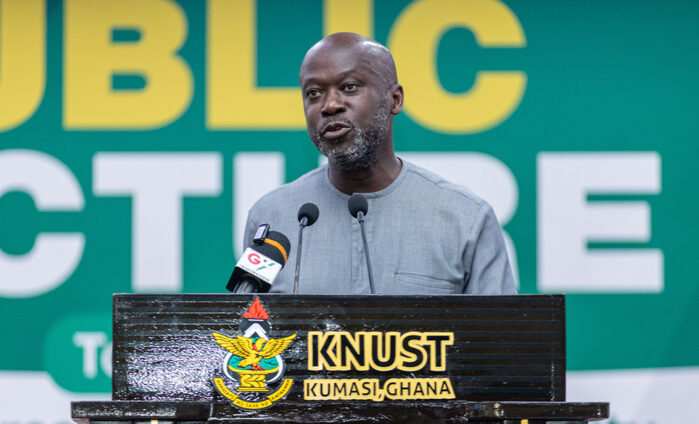
But at a public lecture delivered at the Kwame Nkrumah University of Science and Technology, Kumasi (KNUST), world-renowned architect Sir David Adjaye offered something rarely heard in Ghana’s heated discourse on the cathedral: an explanation of the vision behind the project.
Speaking to an audience of students, lecturers and built environment professionals at the College of Art and Built Environment (CABE), the Ghanaian-British architect reflected on the intentions that shaped the design and why he believed the project could have transformed Accra beyond its religious purpose.
Acknowledging the controversy that has surrounded the cathedral project over the years, Sir David Adjaye said the architectural team had not been given enough opportunity to explain the thinking behind the design.
“And I know that this project has caused a lot of heartache with lots of people. But let me just tell you how we thought about it because I don't think anybody has given us a chance to explain what this project is for us as architects,” he said.
According to him, the project was conceived not only as a place of worship but also as a long-term economic and cultural investment capable of positioning Ghana as a destination for religious tourism.
He explained that studies conducted by the team showed that religious tourism remains one of the world’s most enduring contributors to national economies.
“What has become very clear is that there are many forms of tourism in the world,” he noted.
“But one of the most enduring and most productive injections of GDP into a country is religious tourism.”
Drawing comparisons to historic centres of worship across the world, Sir David Adjaye said such spaces often attract diverse visitors while contributing significantly to local economies.
“There is a 2,000-year history now of going to places that are centres of worship that are about the place and the special nature of the place and the tourists who go are very diverse economically and are very respectful,” he said.
“If you are going to create engines of economic uplift, it is a great model, more than concerts or music.”
The architect said the team became convinced that Ghana had an opportunity to create a globally significant destination that would combine spirituality, culture, public infrastructure and economic activity.
“When we saw the data, we were like, wow. This is a must for our country,” he said.
“But we said, you can't just make a cathedral. You have to make something that contributes to Accra, that contributes to the community and uplifts and adds something more.”
Beyond the religious structure itself, Sir David Adjaye revealed that the project was intended to include a large biophilic park and garden, a green urban space designed to reconnect people with nature in an increasingly dense capital city.
He argued that Accra’s rapid urbanisation had made public nature spaces more important than ever.
“We argued with the administration that since independence there has not been one designed biophilic park garden in the capital city,” he said.
“Biophilic design of nature spaces, when we densify, Accra is plus five million people now, becomes a critical requirement for comfort and the humanity of people. We don't live in concrete. We live with nature.”
According to him, the cathedral was envisioned as a catalyst that would reactivate surrounding public space while creating opportunities for recreation and community life.
“We said this cathedral could activate a second opportunity. People would enjoy this as an asset,” he stated.
Sir David Adjaye also described the cathedral as a hybrid civic and religious complex intended to serve multiple functions beyond worship.
The proposal included a music school, conference facilities, a library, chapels for weddings and smaller services, a Bible museum exploring the Ghanaian and African roots of Christianity, as well as spaces for education and social support.
“It can't just be for the religious community. It has to be for the communities in Accra to want to use it,” he said.
“It also has to be a place where people want to get married so there has to be chapels in there that can create revenue.”
The architect explained that the design sought to merge contemporary engineering with traditional African spatial concepts and indigenous understandings of shade, hierarchy and communal gathering.
“All these things actually give us the blueprint for what an architecture of religious space would look like; the shade, the revealing of space, the hierarchy of structures,” he said.
“So we said let's use science and engineering and this to create a form that would be uniquely from our culture.”
He further disclosed that the project was designed to include a crypt dedicated to national heroes, a symbolic resting place meant to honour distinguished Ghanaians.
“At the lowest level of the building, a crypt for the heroes of our nation,” he said.
“We have incredible losses. We have great people and we put them under tents and we bury them in military cemeteries. We can make a crypt that can hold our heroes.”
Sir David Adjaye also spoke extensively about the physical structure of the cathedral, describing it as a monumental architectural form inspired by traditional Akan symbolism, sacred geometry and contemporary engineering systems.
The building was designed with soaring vertical forms, layered timber-inspired structures and elevated platforms intended to make it visible across much of Accra’s skyline.
“The funny thing about the building is that we think it is a small building. It actually would be the tallest building in Accra,” he said.
“It would become a symbol of a nation that is 70 percent Christian.”
According to him, the cathedral complex was designed to accommodate up to 25,000 people during major gatherings and international events.
“There is nothing like it,” he said.
“It would make a unique destination in Ghana, in Accra.”
Latest Stories
-
Young woman found dead at Kasoa Peace Town
26 minutes -
Livestream: The Law examines lawful arrest in Ghana
51 minutes -
Mahama urges African governments to treat healthcare as an investment, not budget cost
1 hour -
Bawumia congratulates John Boadu and new NPP executives, pledges support ahead of 2028
1 hour -
‘No talent should be left out’ – Bawumia pledges inclusive NPP campaign for 2028
2 hours -
Prof. Mike Oquaye recounts how he blocked Special Prosecutor’s attempt to arrest Bawku Central MP
2 hours -
Make health sovereignty a priority for Africa – Mahama
2 hours -
Dorimon Naa, Wa West DCE lead massive clean-up exercise; threaten sanctions against recalcitrant residents
2 hours -
Photos from Adom FM Y2K Jam
2 hours -
Praye Tiatia steals the show at Adom FM Y2K Jam [Watch]
2 hours -
Boakye Agyarko congratulates John Boadu, pledges support for NPP leadership
3 hours -
Antwi HiMight thrills fans with Antwi ne Antwi hits at Adom FM’s Y2K Jam [Video]
3 hours -
Amb. Edward Boateng congratulates Boadu, Kodua on election wins
3 hours -
John Boadu pledges to rebuild NPP from grassroots and restore ‘winning machinery’
3 hours -
Ashaiman Assembly deploys monitoring system to curb dumping in storm drain
4 hours