

Audio By Carbonatix
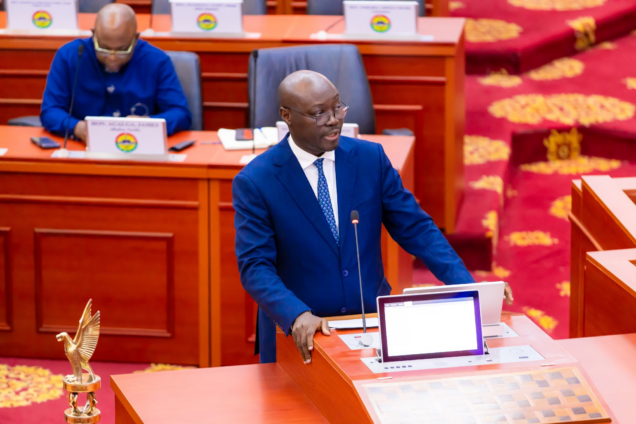
Finance Minister Dr. Cassiel Ato Forson has told Parliament that Ghana’s recent economic recovery reflects the outcome of disciplined reforms implemented under President John Dramani Mahama’s administration, following what he described as a deeply mismanaged economy inherited in a state of crisis.
Speaking on the floor of the House on Thursday, May 28, Dr. Forson said the government had to confront the consequences of fiscal indiscipline, structural weaknesses, and policy failures that, according to him, had left the economy severely weakened by the end of 2024.
He argued that the previous administration presided over a period in which the state became “bloated, purposefully inefficient, and riddled with waste and corruption,” a situation he said worsened the country’s economic vulnerabilities.
Dr. Forson further told Parliament that by December 2024, the then administration had “undermined” the International Monetary Fund (IMF) programme it had itself negotiated, citing missed targets and unfulfilled commitments.
He described this as evidence of the depth of the crisis inherited by the current government, stressing that Ghana’s economic challenges were not merely cyclical but structural in nature.
However, he cautioned that the purpose of revisiting the past was not to assign blame, but to highlight the importance of fiscal discipline and the consequences of economic mismanagement.
“These painful experiences must serve as a lesson,” he said, adding that Ghana must never return to such a path.
He emphasised that “some painful experiences cannot be taught; they must be lived to be understood,” before repeating the phrase “never again” emphatically on the floor of Parliament.
According to the Finance Minister, upon assuming office, President Mahama’s government moved swiftly to stabilise the economy and restore confidence in the IMF-supported programme.
He said the administration undertook a recalibration of the IMF framework to ensure what he described as fairer burden-sharing and deeper structural reforms.
A series of fiscal and institutional reforms were introduced, including stricter public financial management controls, audits of government arrears, and measures to eliminate inefficiencies in public expenditure.
Dr. Forson also announced the establishment of new governance and oversight institutions, including the Office of Value for Money and an Independent Fiscal Council, aimed at strengthening accountability and ensuring compliance with fiscal rules.
Other measures included the operationalisation of a Sinking Fund for debt management, the introduction of the Ghana Gold Board (GOLDBOD) to support foreign exchange stability, and amendments to the Public Financial Management Act to institutionalise long-term debt and deficit targets.
The government also reduced the size of the executive branch, cutting the number of ministers from 123 (later revised to 88) down to 60, and reducing ministries from 30 to 23.
In addition, what the Minister described as “nuisance taxes”—including the E-Levy, Betting Tax, Emissions Levy, and VAT on motor insurance—were removed to ease pressure on households and businesses.
Dr. Forson told Parliament that these policy interventions had produced “clear and measurable results” across key macroeconomic indicators.
He said real Gross Domestic Product (GDP) growth reached 6.0 per cent in 2025, marking the strongest post-pandemic expansion, while non-oil GDP growth rose to 7.6 per cent, the highest in 14 years.
Ghana’s economy, he added, had crossed the US$100 billion threshold for the first time, placing it among Africa’s largest economies and ranking it eighth on the continent. Per capita income also increased to US$3,385.
On fiscal performance, the Minister reported a primary surplus of 2.5 per cent of GDP in 2025, alongside a sharp reduction in the public debt-to-GDP ratio from 61.8 per cent in 2024 to 44.7 per cent by the end of 2025—achieving the IMF target ahead of schedule.
Debt servicing pressures also eased significantly, with the debt-to-domestic revenue ratio falling from 55.7 per cent in 2022 to 28.8 per cent in 2025, despite the resumption of full Eurobond payments.
He further stated that Ghana’s debt risk rating had improved from “high risk” to “moderate risk” under the Debt Sustainability Analysis.
Inflation, according to the Minister, declined from 23.8 per cent in December 2024 to 3.4 per cent in April 2026.
Interest rates also fell sharply, with the 91-day Treasury bill rate dropping by more than 2,300 basis points to 4.8 per cent. Government bond yields and the policy rate also recorded significant declines.
Externally, he said the current account balance recorded a surplus of 8.3 per cent of GDP in 2025, while the cedi appreciated by 40.7 per cent against the US dollar.
Dr. Forson concluded that the results demonstrated the effectiveness of fiscal discipline and prudent economic management.
“Fiscal prudence and discipline always deliver results,” he told Parliament, arguing that macroeconomic stability remains the foundation for sustainable growth, investor confidence, and job creation.
Latest Stories
-
Hotline Documentary: ‘Silent Football’ to air on JoyPrime and JoyNews today
11 minutes -
NDPC examines how evidence shapes Ghana’s development planning and policy decisions
12 minutes -
Education Ministry calls urgent talks to break GAUA strike deadlock
14 minutes -
NCCE engages women in North East Gonja on rule of law, anti-corruption
23 minutes -
NDPC reviews 2004 planning guidelines to reflect changes in decentralised system
29 minutes -
Trade Ministry commends Prisons Service for using art to drive inmate rehabilitation
35 minutes -
Books, brushes and second chances: Dr Abena Asomaning launches three titles to support prison outreach
42 minutes -
Treasury bill auction oversubscribed by 53.5% as yields fall across maturities
44 minutes -
NPP warns aspirants premature campaigning could jeopardise eligibility for primaries
50 minutes -
Ghana courts investors in Bangkok after exit from $3bn IMF bailout
55 minutes -
8 arrested over alleged internet fraud initiation assault in Bono Region
59 minutes -
SSNIT says Labadi Beach Redevelopment will create local economic opportunities
1 hour -
BoG proposes 30-day liquidity buffer requirement for banks
1 hour -
BoG plans reviews of banks’ cybersecurity compliance
1 hour -
GRA cautions taxpayers against attacking tax officials
1 hour