

Audio By Carbonatix
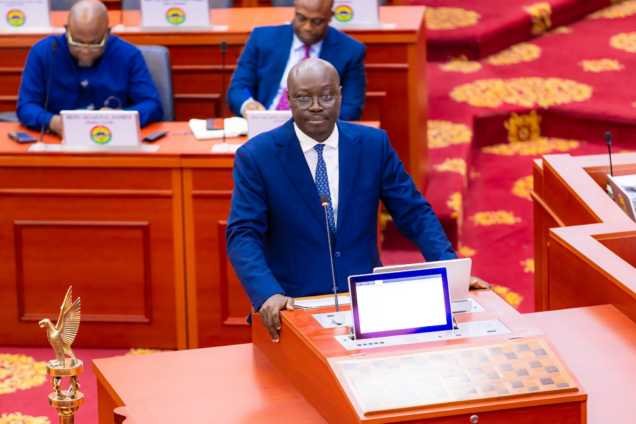
1. Rt. Hon. Speaker, I come before this House to provide an update on the substantial progress we have made in restoring macroeconomic stability and debt sustainability ahead of the original timeline.
2. This address will also announce a new chapter in Ghana’s engagement with the International Monetary Fund.
3. Mr. Speaker, this is a consequential moment in President Mahama’s Reset Agenda and, indeed, in the life of our Nation.
4. It signifies Ghana’s passage from crisis management to stability, from dependence on financial bailout to partnership in reform, and from uncertainty to renewed confidence in our economic future.
5. Mr. Speaker, to appreciate the significance of this moment, we must briefly recall the gravity of the crisis Ghana faced in 2022.
6. On 1st July 2022, the previous administration turned to the IMF for a financial bailout after their gross mismanagement of the economy had driven the country into fiscal, balance of payments and debt crises.
7. President Mahama, the then NDC flag bearer, acknowledged the decision as necessary, though a belated intervention to arrest the decline and to ease the severe hardship being borne by the Ghanaian people through no fault of theirs.
8. The scale of that crises was profound, if not traumatic:
• The cedi came under intense pressure;
• inflation rose to painful levels, investor confidence deteriorated sharply;
• external reserves were strained; and
• Ghana lost access to the international capital market.
9. As a result, credit rating agencies responded by downgrading Ghana’s sovereign rating, repeatedly, in 2022, to levels never seen in our country’s history:
• In February that year (2022), Moody’s downgraded Ghana to Caa1.
• In August, S&P downgraded Ghana to CCC+.
• Again, in August, Fitch downgraded Ghana to CCC.
• And in September, Fitch again, downgraded Ghana to CC.
• Finally, in October 2022, Ghana lost access to the international capital market with Ghana’s Eurobond spreads widening to an all-time high of 3400 basis point.
10. This further deepened the economic and financial crises, to the point that COCOBOD was unable to secure a syndicated loan for the first time in many years.
11. Also, some domestic commercial banks could no longer obtain external funding or establish letters of credit, as international banks declined to confirm those instruments.
12. Mr. Speaker, on 5th December 2022, following the announcement that Ghana could not meet its maturing domestic debt obligations, the NPP administration introduced the Domestic Debt Exchange Programme (DDEP), imposing significant haircuts on domestic bondholders.
13. On 13th December 2022, Ghana formally requested debt treatment under the G20 Common Framework in order to restructure its bilateral debt portfolio of more than US$5 billion.
14. On 19th December 2022, the NPP administration again defaulted on the servicing of Ghana’s external commercial debt obligations.
15. The far-reaching haircuts affected:
• The Bank of Ghana;
• commercial banks;
• non-bank financial institutions;
• pension funds;
• insurance companies;
• individual bondholders; and
• even pensioners were not spared.
16. Mr. Speaker, ordinary Ghanaians bore the heaviest burden of that crisis. The consequences were felt across households, businesses, and institutions through:
• rapid depreciation of the cedi;
• runaway inflation of more than 50 percent;
• massive erosion of disposable incomes and savings;
• painful haircuts on domestic bondholders, including pensioners;
• punitive interest rates that constrained private sector activity;
• the imposition of nuisance taxes including E-Levy, Betting Tax, COVID-19 Levy and Emissions Tax;
• job losses, business distress, and weakened investor confidence; and
• a sharp rise in poverty and economic insecurity.
17. Rt. Hon. Speaker, in the midst of all these hardships imposed on the Ghanaian people, the government of the day remained bloated, purposefully inefficient, and riddled with waste and corruption.
18. By December 2024, those responsible proceeded to undermine the very IMF programme they themselves had signed to correct the economic mess they imposed on Ghana, missing targets and commitments under the programme.
19. That was the depth of the crisis we inherited.
20. Mr. Speaker, it is important to recount this not to dwell on the past, but to remind ourselves of the heavy price of fiscal indiscipline and economic recklessness, and to affirm our collective resolve that Ghana must never return to that path.
21. Rt. Hon. Speaker, some painful experiences cannot be taught. They must be lived to be understood. But once experienced, never again should they be repeated.
22. Never again! Never again!! Never again!!!
23. Mr. Speaker, upon assuming office, President Mahama’s administration moved with clarity and purpose to reset the Ghanaian economy and bring the IMF-supported programme back on track.
24. We recalibrated the IMF Programme to ensure fairer burden-sharing, and deeper structural reform.
25. Among the principal measures we undertook were the following:
• We introduced the Public Financial Management (PFM) commitment authorization to control government expenditure;
• We audited government arrears and payables to eliminate recycled IPCs and overpayments;
• We stopped the misuse of the tax refund account to finance schemes such as SML;
• We amended the PFM Act to institutionalize a 1.5% of GDP primary surplus and 45% debt-to-GDP by 2034;
• We introduced the GOLDBOD to enhance FX stability and reserve accumulation;
• We operationalized the Sinking Fund with dedicated Cedi and US Dollar buffers to manage future debt maturities;
• We removed nuisance taxes such as E-Levy, Betting Tax, Emissions Levy, and VAT on motor insurance to support private sector activity;
• We established the Office of Value for Money to improve public expenditure efficiency;
• We established the Independent Fiscal Council to check compliance with the fiscal rules;
• We concluded IPP renegotiations, saving over US$250 million, and cleared over US$1 billion of legacy arrears in the energy sector;
• We reduced ministers of state from 123 (later 88) to 60; and
• We reduced government ministries from 30 to 23; and
26. Mr. Speaker, I am pleased to report that these measures have produced clear and measurable results.
• Real GDP growth reached 6.0% in 2025, marking the highest expansion in the post-pandemic period;
• Most importantly, non-oil GDP reached 7.6%, the highest in 14 years;
• For the first time, Ghana’s economy crossed the US$100 billion threshold in 2025, making it a fully-fledged emerging market economy;
• Ghana’s economy is now ranked the 8th largest in Africa;
• Ghana’s per capita income increased to US$3,385 for the first time;
• The primary balance recorded a surplus of 2.5% of GDP in 2025;
• Public debt-to-GDP ratio reduced substantially from 61.8% in 2024 to 44.7% at the end of 2025;
• Ghana achieved the debt-to-GDP target of 45% well ahead of the IMF programme and the PFM debt rule target of 2034;
• Debt service-to-domestic revenue ratio declined from 55.7% in 2022 to 28.8% in 2025, even with the resumption of full Eurobond obligations in 2025;
• Ghana achieved a moderate risk of debt distress from a high risk of debt distress under the DSA;
• Inflation declined from 23.8% in December 2024 to 3.4% in April 2026.
• 91-Day Treasury Bill has declined by over 2300 basis points from 28.4% in January 2025 to 4.8% in April 2026;
• The 2-year, 3-year, and 5-year bonds are now trading in the range of 11.0%–12.6%, compared to 20% in the previous year;
• The monetary policy rate has declined by 1,300 basis points from 27% in January 2025 to 14.0% in April 2026;
• The current account balance recorded a surplus of 8.3% of GDP in 2025; and
• The cedi appreciated by 40.7% against the US Dollar in 2025.
27. Mr. Speaker, these results affirm a simple but enduring truth: fiscal prudence and discipline always deliver results.
28. Macroeconomic stability is not an abstract policy objective; it is the foundation for jobs, incomes, investor confidence, and national prosperity.
29. It is also the lesson we must carry forward if we are to ensure that Ghana never again relives the hardships of 2022.
30. Prudence does not mean we are failing to spend. We can only spend what we have. Prudence is the difficult road to wealth creation.
31. Mr. Speaker, at the 77th Annual New Year School on 6th January 2026, President Mahama stated that:
"It is my hope that this will be the very last time we will ever go for a bailout from the IMF…It must be the 17th and the last time that Ghana goes for a bailout from the IMF."
32. The President further noted:
"We'll continue our collaboration with the IMF under Article 4 and other instruments... But it will definitely be the last time we go on our knees to beg for a bailout."
33. Consequently, no further IMF financial bailout will be required in the foreseeable future. I repeat, no further IMF financial bailout will be required in the foreseeable future.
34. We have evolved from a position of “supplicant” to one of “partner”.
35. Mr. Speaker, it is therefore my singular honour to announce to the House that Ghana has successfully concluded the final review of the current IMF financial bailout programme, pending approval by the IMF Executive Board.
36. Mr. Speaker, as Ghana moves beyond the Extended Credit Facility, our engagement with the International Monetary Fund will transition to a reform-focused, non-financing Policy Coordination Instrument.
37. The Policy Coordination Instrument is a non-financing IMF instrument designed for countries that do not require IMF financing but seek a credible framework for reform, regular policy reviews, and a stronger signal to investors and development partners.
38. For Ghana, this marks an important shift—from seeking financial bailout to engaging as a credible reform partner—while continuing to benefit from policy discipline, external validation, and strengthened investor confidence.
39. Mr. Speaker, the PCI will enable us to continue leveraging the IMF’s regular policy assessments and expertise as a signal to investors, thereby certifying the credibility of our stewardship and further strengthening our credit rating.
40. In other words, Ghana has moved from the intensive-care unit (ICU) to the wellness center.
41. Mr. Speaker, to build on this hard-won foundation of stability, President Mahama’s administration has designed a new economic programme, The New Economy, to be unveiled in the 2027 Budget.
42. The New Economy will move Ghana from stabilization to transformation, with a clear focus on sustainable jobs, higher productivity, greater resilience, and broad-based prosperity.
43. Mr. Speaker, President Mahama is deeply grateful to Ghanaians for their sacrifice, patience, and steadfast forbearance.
44. We do not take their support for granted.
45. Mr. Speaker, our solemn pledge is that we will not be complacent; we will continue the hard work of building the Ghana We Want.
46. May God bless our homeland Ghana. I thank you, Mr. Speaker.
Latest Stories
-
Ghana lose Morocco friendly as Atlas Lions turn to Mali
14 minutes -
2026/2027 GPL: Kelvin Nkrumah strike sends Medeama top of league table
20 minutes -
Emmanuel City crowned champions of maiden Global Game Scouting Tournament
29 minutes -
Thomas Partey loses father Jacob Teye Partey
42 minutes -
Martin Kpebu explains when EOCO can arrest Manhyia South MP after securing court warrant
60 minutes -
EOCO’s reasons for seeking Manhyia South MP arrest warrant not justified – Kpebu
1 hour -
MTN Ghana warns SMEs against sharing PINs amid digital fraud risks
1 hour -
Yendi nursing students warn restricted access to skills lab could affect their training
1 hour -
Minority awaits formal notice of arrest warrant for Manhyia South MP – Annoh-Dompreh
1 hour -
LTIF announces 2026 Pan-African edition in Accra from October 6-7
1 hour -
Mfantsipim needs broader funding partnerships to bridge infrastructure gap – Prof Baiden
1 hour -
MP status must not shield anyone from law enforcement – Kwakye Ofosu
1 hour -
EOCO had tactical team ready to arrest Baffour Awuah – Felix Kwakye Ofosu
2 hours -
Afoko can unite NPP’s factions, says Charles Owusu Juanah
2 hours -
Guardiola backing Man City after guilty verdicts
2 hours