

Audio By Carbonatix
Finance Minister Dr. Cassiel Ato Forson has announced that Ghana will no longer require an International Monetary Fund (IMF) financial bailout in the foreseeable future, signaling what government describes as a major turning point in the country’s economic recovery efforts.
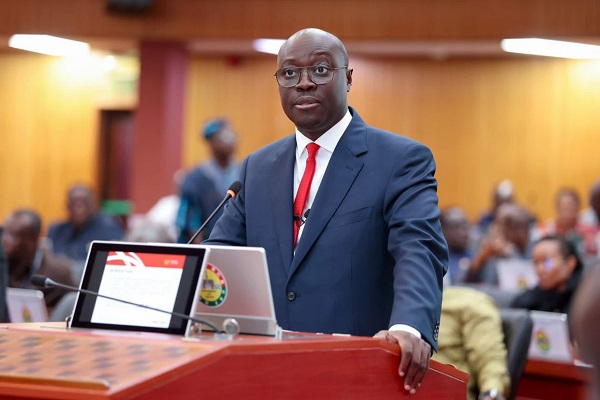
Presenting a statement to Parliament on the state of the economy on Thursday, May 28, Dr. Forson referenced comments made by President John Dramani Mahama during the 77th Annual New Year School on January 6, 2026, where the President expressed optimism that Ghana’s current IMF programme would be the last bailout arrangement in the country’s history.
“It is my hope that this will be the very last time we will ever go for a bailout from the IMF. It must be the 17th and the last time that Ghana goes for a bailout from the IMF,” President Mahama stated at the event.
The President further emphasised that although Ghana "will continue our collaboration with the IMF under Article IV and other instruments, it will definitely be the last time we go on our knees to beg for a bailout.”
Building on the President’s remarks, Dr. Forson told Parliament that government’s current economic reforms had positioned Ghana to move beyond dependence on IMF financial support.
“Consequently, no further IMF financial bailout will be required in the foreseeable future. I repeat, no further IMF financial bailout will be required in the foreseeable future,” the Finance Minister declared.
According to him, Ghana has now transitioned from being a country dependent on emergency financial assistance to becoming a credible reform partner of the IMF. “We have evolved from a position of ‘supplicant’ to one of ‘partner’,” he said.
Dr. Forson also announced that Ghana has successfully concluded the final review of the current IMF financial bailout programme, pending approval by the IMF Executive Board.
He explained that Ghana’s next phase of engagement with the IMF would be through a Policy Coordination Instrument (PCI), a non-financing framework designed for countries that no longer require financial assistance but seek policy guidance, regular economic reviews, and credibility with investors and development partners.
“The Policy Coordination Instrument is a non-financing IMF instrument designed for countries that do not require IMF financing but seek a credible framework for reform, regular policy reviews, and a stronger signal to investors and development partners,” he explained.
The Finance Minister noted that the new arrangement would help Ghana maintain policy discipline and strengthen investor confidence while continuing to benefit from IMF expertise and periodic assessments.
“For Ghana, this marks an important shift—from seeking financial bailout to engaging as a credible reform partner—while continuing to benefit from policy discipline, external validation, and strengthened investor confidence,” he stated.
He added that the PCI framework would serve as an important signal to international investors and credit rating agencies regarding the credibility of Ghana’s economic management.
“The PCI will enable us to continue leveraging the IMF’s regular policy assessments and expertise as a signal to investors, thereby certifying the credibility of our stewardship and further strengthening our credit rating,” he said.
Using a medical analogy to describe Ghana’s economic recovery, Dr. Forson declared that the country had made significant progress from the depths of its recent economic crisis.
“In other words, Ghana has moved from the intensive-care unit (ICU) to the wellness center,” he stated.
Latest Stories
-
Ghana lose Morocco friendly as Atlas Lions turn to Mali
14 minutes -
2026/2027 GPL: Kelvin Nkrumah strike sends Medeama top of league table
20 minutes -
Emmanuel City crowned champions of maiden Global Game Scouting Tournament
29 minutes -
Thomas Partey loses father Jacob Teye Partey
42 minutes -
Martin Kpebu explains when EOCO can arrest Manhyia South MP after securing court warrant
59 minutes -
EOCO’s reasons for seeking Manhyia South MP arrest warrant not justified – Kpebu
1 hour -
MTN Ghana warns SMEs against sharing PINs amid digital fraud risks
1 hour -
Yendi nursing students warn restricted access to skills lab could affect their training
1 hour -
Minority awaits formal notice of arrest warrant for Manhyia South MP – Annoh-Dompreh
1 hour -
LTIF announces 2026 Pan-African edition in Accra from October 6-7
1 hour -
Mfantsipim needs broader funding partnerships to bridge infrastructure gap – Prof Baiden
1 hour -
MP status must not shield anyone from law enforcement – Kwakye Ofosu
1 hour -
EOCO had tactical team ready to arrest Baffour Awuah – Felix Kwakye Ofosu
2 hours -
Afoko can unite NPP’s factions, says Charles Owusu Juanah
2 hours -
Guardiola backing Man City after guilty verdicts
2 hours