

Audio By Carbonatix
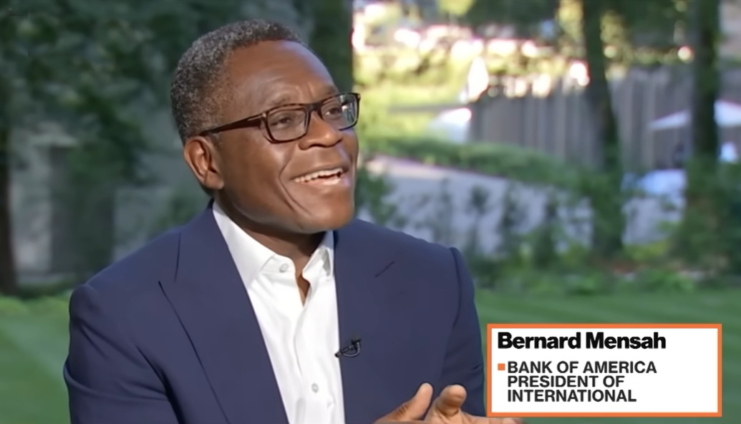
President of International at Bank of America, Bernard Mensah, has offered valuable insights into the evolving impact of artificial intelligence (AI) on the financial industry, macroeconomic uncertainties, and the potential effects of rising global tariffs.
Speaking with Bloomberg Television’s Tom Mackenzie over the Bank of America Breakthrough Technology Dialogue in Goodwood, Bernard Mensah noted that AI remains top of mind across industries, though the conversation has significantly matured since early discussions around ChatGPT 2.0 in 2022.
He observed that dialogue has now shifted from prompt engineering to more complex areas such as agentic systems, synthetic biology, and AI’s integration into material sciences and healthcare.
Bernard Mensah emphasised that Bank of America has long been engaged in AI development and adoption, citing the bank’s AI-powered virtual assistant, Erica, which has recorded billions of client interactions.
“We’ve already seen efficiency gains, particularly in our contact centres,” he said, noting that AI has allowed a smaller workforce to manage high volumes of customer interactions effectively.
However, he cautioned against assumptions that AI will lead to widespread job displacement, saying “Traditional AI has already transformed trading desks. We’ve gone from needing 20 to 30 FX traders to just a few handling significantly more volume,” he explained.
Yet, he underscored that generative AI introduces a level of creativity that demands a fundamental rethink of work processes.
The future of junior banking roles, according to Mensah, is less about headcount reduction and more about role evolution. While pitch book creation may decline, junior bankers may instead focus on deeper data analysis and industry trend forecasting to provide clients with more strategic insights.
On the global economic front, Bernard Mensah addressed the impact of rising tariffs, such as recent threats targeting Brazilian goods and copper.
He said markets appear to be rational in their pricing, factoring in more detailed information now available. “There is still value in specific sectors, while in others, that value is diminishing,” he remarked.
Mensah also noted that some companies have absorbed tariff-related costs, while others engaged in early pre-stocking to minimise exposure.
He suggested the full economic effect of the tariffs may become clearer in upcoming Q2 earnings reports.
Despite geopolitical concerns, including potential client hesitancy to engage with US banks amid rising protectionism, Mensah reported no significant loss of business. “There’s been no indication that we’re missing out on bond deals because of our American identity. Our global reach and value proposition remain strong,” he affirmed.
Regarding US Federal Reserve independence, Bernard Mensah expressed confidence in market pricing mechanisms, and while acknowledging concerns for 2026, he said current bond yields reflect reasonable assumptions about growth and central bank responses.
He stressed the importance of data-driven analysis in navigating the rapidly evolving intersections of AI, global economics, and finance, saying, “We're in an age where adaptability and forward-thinking are not optional—they’re essential,” he said.
Latest Stories
-
SIGA’s claim on highest audited proportion inaccurate – Bright Simons
34 seconds -
Money bouquets, spraying and dancing on cash unlawful – BoG warns
26 minutes -
Sam George pushes for nationwide 4G upgrade of rural telephony sites
27 minutes -
Local Government Ministry to support MMDAs to deliver gov’t agenda
37 minutes -
At least five killed in Sudan’s South Kordofan in attack by rebel group
49 minutes -
“Music is so stressful” – Headless YouTuber on why he won’t return
50 minutes -
Cleveland police chief proud of force but being ‘let down’ by funding
1 hour -
Black Sherif drops new 6-track EP ‘Sun Sherif’
2 hours -
GTA partners Africa’s Brain Bank for Medical City groundbreaking
2 hours -
How to check 2026 WASSCE results on mobile phone
2 hours -
President Mahama is a professional comedian – DKB
2 hours -
Final day of Joy FM Back-to-School Fair: Come shop, save and prepare for the new school year
3 hours -
GSE showed strong performance in August 2026 despite recording more stock losses
5 hours -
If CJ needs ethics law to know SOE comments were wrong, he may not be worthy of office – Arthur Kennedy
6 hours -
Stop touring state agencies and focus on the Judiciary’s problems – Arthur Kennedy to CJ
6 hours